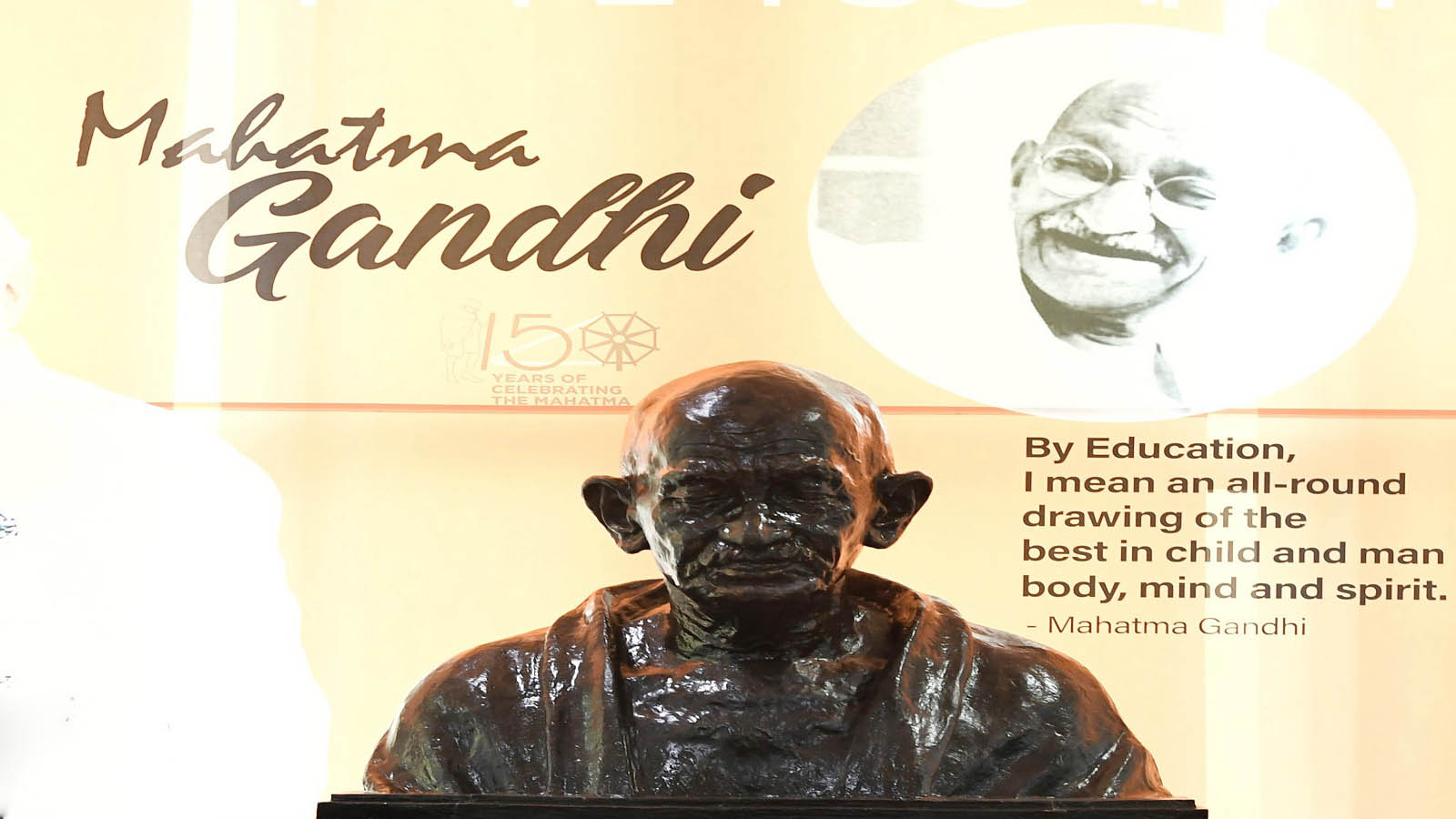
As the nation marks the death anniversary of Mahatma Gandhi, India and the world pause to remember the life and legacy of a man whose ideas continue to shape moral, political, and social thought across generations. On January 30, 1948, Mahatma Gandhi was assassinated while on his way to attend his daily prayer meeting. Though he departed physically that day, his philosophy of truth, non-violence, and simplicity remains deeply ingrained in global consciousness.
Often recalled as a thin, bespectacled figure clad in a simple piece of cloth, walking with a stick or seated quietly at the charkha, Gandhi’s outward simplicity symbolised the essence of his life and teachings. His appeal lies not merely in his role as the leader of India’s freedom struggle, but in the rare harmony between his words and actions. There was no gap between what he preached and what he practiced.
One of the most enduring principles of Gandhi’s life was non-violence. For him, it was not confined to abstract philosophy or political strategy; it was a way of life to be practised at the personal, social, and national levels. His belief extended beyond human relationships to encompass respect for all living beings, including animals and nature.
Gandhi’s philosophy of Satyagraha – truth-force or non-violent resistance – became a powerful tool in India’s struggle for independence from British rule. While it proved effective as a political strategy, Gandhi believed its true strength lay in its application in everyday life to end exploitation, injustice, and hatred within families and communities.
A pioneer of modern pacifism, Gandhi championed forgiveness over revenge, famously stating that “forgiveness is the attribute of the strong.” He held that responding to hatred with hatred would only perpetuate violence, warning that an “eye for an eye” would make the whole world blind. His ability to appeal to the conscience of even his adversaries earned him respect across borders, including among sections of British society during colonial rule.
Gandhi viewed his life as an ongoing experiment with truth and non-violence, constantly learning, adapting, and refining his approach. His belief in lifelong learning is reflected in his words: “Live as if you were to die tomorrow; learn as if you were to live forever.” This openness to growth allowed his ideas to remain relevant and dynamic.
A prolific writer, Gandhi produced nearly 55,000 pages of writing – compiled into 100 volumes of collected works – entirely by hand, in an era without modern technology. His writings continue to serve as a moral compass for individuals, institutions, and governments.
In contemporary India, Gandhi’s ideals continue to inspire public policy and social movements. Initiatives such as the Swachh Bharat Abhiyan draw directly from his emphasis on cleanliness and civic responsibility. Efforts to revive khadi among the younger generation echo his call for self-reliance and dignity of labour. His philosophy of simple living also aligns with today’s global emphasis on sustainable lifestyles and reduced carbon footprints, a relevance acknowledged when India signed the Climate Change Agreement on his birth anniversary.
Gandhi’s influence extends far beyond India’s borders. Movements such as the Chipko and Appiko campaigns for forest conservation drew inspiration from his non-violent methods, led by figures like Padma Vibhushan Sunderlal Bahuguna. Internationally, leaders such as Nelson Mandela used Gandhian principles to dismantle apartheid in South Africa, while Martin Luther King Jr. applied non-violence in the civil rights movement in the United States.
Recalling Gandhi’s words spoken in contemplation of death – “So long as my faith burns bright… I shall be alive in the grave and what is more speaking from it” – his presence continues to be felt through the resonance of his ideas across the world.
On his death anniversary, Gandhi is remembered not merely as a historical figure, but as a living influence. Paying tribute to the Father of the Nation, many believe, lies not in remembrance alone, but in practising his ideals of truth, non-violence, simplicity, and compassion in everyday life.