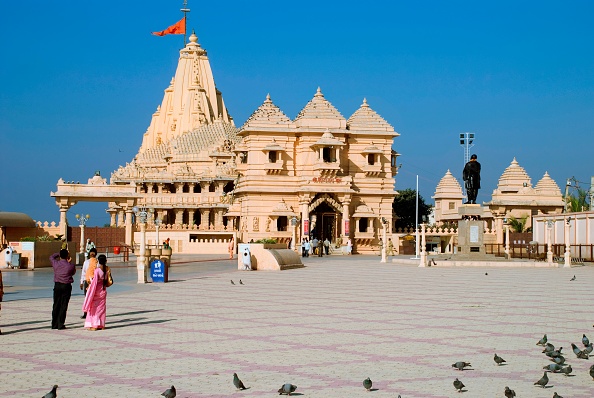
India is marking a major milestone with the Somnath Swabhiman Parv, being observed from 8 to 11 January 2026, to commemorate one thousand years since the first recorded attack on the Somnath Temple in 1026 by Mahmud of Ghazni. The event is not framed as a remembrance of destruction, but as a celebration of resilience, faith and civilisational pride embedded in India’s oldest spiritual traditions.
Somnath, located at Prabhas Patan near Veraval in Gujarat, occupies a unique place in the country’s spiritual landscape. It appears at the very beginning of the Dwadasha Jyotirlinga Stotram, underscoring its status as the first of the twelve Jyotirlingas of Lord Shiva. For centuries, Somnath has drawn millions of devotees and stood as a cultural landmark reflecting India’s civilisational continuity.
The Parv coincides with another important anniversary: seventy-five years since the reopening of the rebuilt Somnath Temple in May 1951, after Independence. That reconstruction was initiated by Sardar Vallabhbhai Patel, who visited the ruins on 12 November 1947 and declared that rebuilding the temple was essential to rebuilding the nation’s cultural confidence. The present structure, built in the Kailash Mahameru Prasad architectural style, was consecrated on 11 May 1951 in the presence of then President Dr. Rajendra Prasad. In 2001, the fiftieth anniversary of the reopening was marked by a commemorative event attended by Prime Minister Atal Bihari Vajpayee, Home Minister Lal Krishna Advani and then Gujarat Chief Minister Narendra Modi.
The Somnath Swabhiman Parv seeks to weave together these two timelines—the millennium since the first attack and the seventy-five years since restoration. Over four days, Somnath has been transformed into a space for spiritual discourse, cultural expression and national remembrance. One of the central activities is a 72-hour Akhand Omkar chanting, symbolising spiritual continuity and collective devotion. Devotional music, discourses and cultural programmes are being organised across the temple town.
Historically, Somnath has undergone multiple cycles of destruction and rebuilding, beginning with the Ghazni invasion in 1026. Despite repeated demolition by invaders over centuries, the temple survived in cultural memory, literature and collective faith. This cycle of devastation and revival—described as unparalleled in world history—has made Somnath a powerful symbol of Indian resilience. The message of the Parv is therefore not to recount historical violence, but to highlight how faith endured despite adversity.
Somnath today is both a vibrant pilgrimage destination and a site of heritage preservation. The temple attracts 92 to 97 lakh devotees annually, while major occasions such as Maha Shivratri and Bilva Pooja draw lakhs of pilgrims. Cultural initiatives like the Light and Sound Show, upgraded with 3D laser technology, have helped reintroduce temple history to younger visitors. Programmes such as the Vande Somnath Kala Mahotsav reconnect devotees with classical dance traditions dating back centuries. Under the leadership of Prime Minister Narendra Modi as Chairperson of the Shri Somnath Trust, the temple has seen new investments in infrastructure, governance and conservation.
The Parv has also thrown light on women’s empowerment and sustainability at Somnath. Declared a “Swachh Iconic Place” in 2018, the temple recycles flowers into vermicompost for Bilva trees, and processes plastic waste into paver blocks under Mission LiFE. A rainwater harvesting system treats nearly 30 lakh litres of sewage water per month, while a Miyawaki forest of 7,200 trees absorbs significant carbon emissions annually. Women form a core part of the temple’s workforce. Out of 906 employees, 262 are women, and in total 363 women are engaged in temple-linked livelihoods, collectively earning around ₹9 crore annually. They contribute to activities ranging from Bilva Van management to prasad distribution and dining services, strengthening the temple’s social ecosystem.
In the days leading up to the Parv, Somnath witnessed a spiritual build-up, including a Padayatra by saints from Girnar and other sacred centres. Their arrival at the temple amid chants of “Har Har Mahadev,” traditional music and floral showers added to the devotional atmosphere.
The Parv has gained national significance with the visit of Prime Minister Narendra Modi. On 10 January, he is participating in the Omkar Mantra chanting and witnessing a drone show as part of the celebrations. On 11 January, he will lead the Shaurya Yatra, a symbolic procession honouring the courage and sacrifices associated with Somnath’s history, followed by prayers at the temple and an address to devotees.
The essence of the Somnath Swabhiman Parv lies in honouring resilience over destruction, faith over fear, and unity over adversity. Standing on the shores of Saurashtra, the temple continues to inspire millions, reflecting India’s civilisational journey through centuries of challenge and renewal. The Parv’s message emphasises that while forces of destruction fade into history, spiritual conviction, cultural identity and civilisational self-respect endure.