







A new scientific study has found that airborne pathogens embedded in desert dust plumes from western India are travelling hundreds of kilometres to the Eastern Himalayas, potentially contributing to respiratory, skin and gastrointestinal illnesses in high-altitude regions.
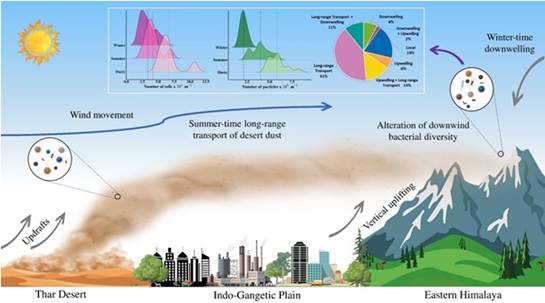
Researchers from the Bose Institute, an autonomous body under the Department of Science and Technology (DST), monitored dust storms originating from arid regions of western India over a period of more than two years. The study observed that these storms travel across the densely populated Indo-Gangetic Plain before settling over Himalayan hilltops, carrying bacteria—including disease-causing pathogens.
While Himalayan hill-top environments are often perceived as health-friendly, researchers noted that vulnerability among populations is already elevated due to cold climatic conditions and low oxygen levels. However, limited evidence has existed linking airborne microbes to respiratory disease outcomes in high-altitude Himalayan communities, prompting the new investigation.
The study found that long-range dust transport is not the only concern. Local pathogens from Himalayan foothills are also injected into the atmosphere through vertical uplift, where they mix with the incoming desert-borne microbes. Together, these airborne bacterial communities were found to contribute to respiratory, skin and gastrointestinal infections.
Described as a “first-of-its-kind” effort, the findings were published in the journal Science of the Total Environment. According to the study, the combined effect of horizontal dust transport and vertical uplift of polluted air is reshaping the microbial composition over the Himalayan atmosphere, with direct implications for public health.


