







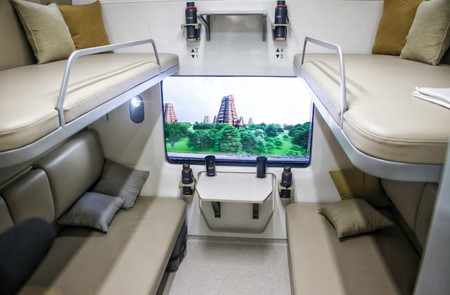
The government has completed the trial, testing and certification of the Vande Bharat Sleeper train, with the first route chosen between Guwahati and Kolkata, Railway Minister Ashwini Vaishnaw announced on Thursday.
Prime Minister Narendra Modi will flag off the first sleeper train sometime soon, the minister said at a press conference.
“For a long time, there has been a demand for new-generation trains. The Vande Bharat chair car started a new era in Indian Railways and has been widely welcomed. We are receiving demands from all corners of the country for Vande Bharat trains,” Vaishnaw said.
“The Vande Bharat Sleeper train has been designed for long-distance travel of over 1,000 kilometres. It will provide a fast, comfortable and modern travel experience for long-distance passengers. The train is equipped with advanced safety features, an improved suspension system and world-class sleeper coaches to make overnight journeys more convenient,” he added.
“Typically, airfare on the Guwahati–Howrah route ranges between Rs 6,000 and Rs 8,000 and sometimes goes up to Rs 10,000. In the Vande Bharat Sleeper, the 3AC fare from Guwahati to Howrah has been set at around Rs 2,300, which is affordable for common passengers. The 2AC fare will be about Rs 3,000, while the First AC fare has been proposed at approximately Rs 3,600, keeping the middle class in mind,” he said.
According to Vaishnaw, around 12 Vande Bharat Sleeper trains will be ready and inducted into the rail network by the end of this year, with expansion set to accelerate next year.
Indian Railways has successfully completed the final high-speed trial of the indigenously designed and manufactured Vande Bharat Sleeper Train under the supervision of the Commissioner of Railway Safety (CRS). The trial was conducted on the Kota–Nagda section, during which the train achieved a maximum speed of 180 kmph, marking a significant milestone in India’s journey towards advanced and self-reliant rail technology.
During the trial, comprehensive technical evaluations were carried out, including assessments of ride stability, oscillation, vibration behaviour, braking performance, emergency braking systems, safety systems and other critical parameters. The train’s performance at high speed was found to be fully satisfactory, and the CRS declared the trial successful.
Vaishnaw earlier shared a video of the high-speed trial on social media, highlighting the successful CRS trial at 180 kmph on the Kota–Nagda section. The video also showcased a water-glass stability demonstration, in which glasses filled with water remained steady without spillage even at high speed, underscoring the train’s advanced ride quality, superior suspension and technological robustness.
The 16-coach Vande Bharat Sleeper rake used in the trial has been designed for long-distance passenger travel and is equipped with state-of-the-art amenities. These include comfortable sleeper berths, advanced suspension systems, automatic doors, modern toilets, fire detection and safety monitoring systems, CCTV-based surveillance, digital passenger information systems and energy-efficient technologies.
These features aim to provide passengers with a safe, comfortable and world-class travel experience.
Key safety and technology features of the Vande Bharat Sleeper trains include the KAVACH train protection system, crashworthy semi-permanent couplers with anti-climbers, fire-barrier doors, aerosol-based fire detection and suppression systems, regenerative braking, UV-C–based air-conditioning disinfection, centrally controlled automatic doors, sealed wide gangways, CCTV surveillance across all coaches, emergency talk-back units, dedicated lavatories for Divyangjan passengers, a centralised coach monitoring system, and ergonomically designed ladders for upper berths.
(IANS


