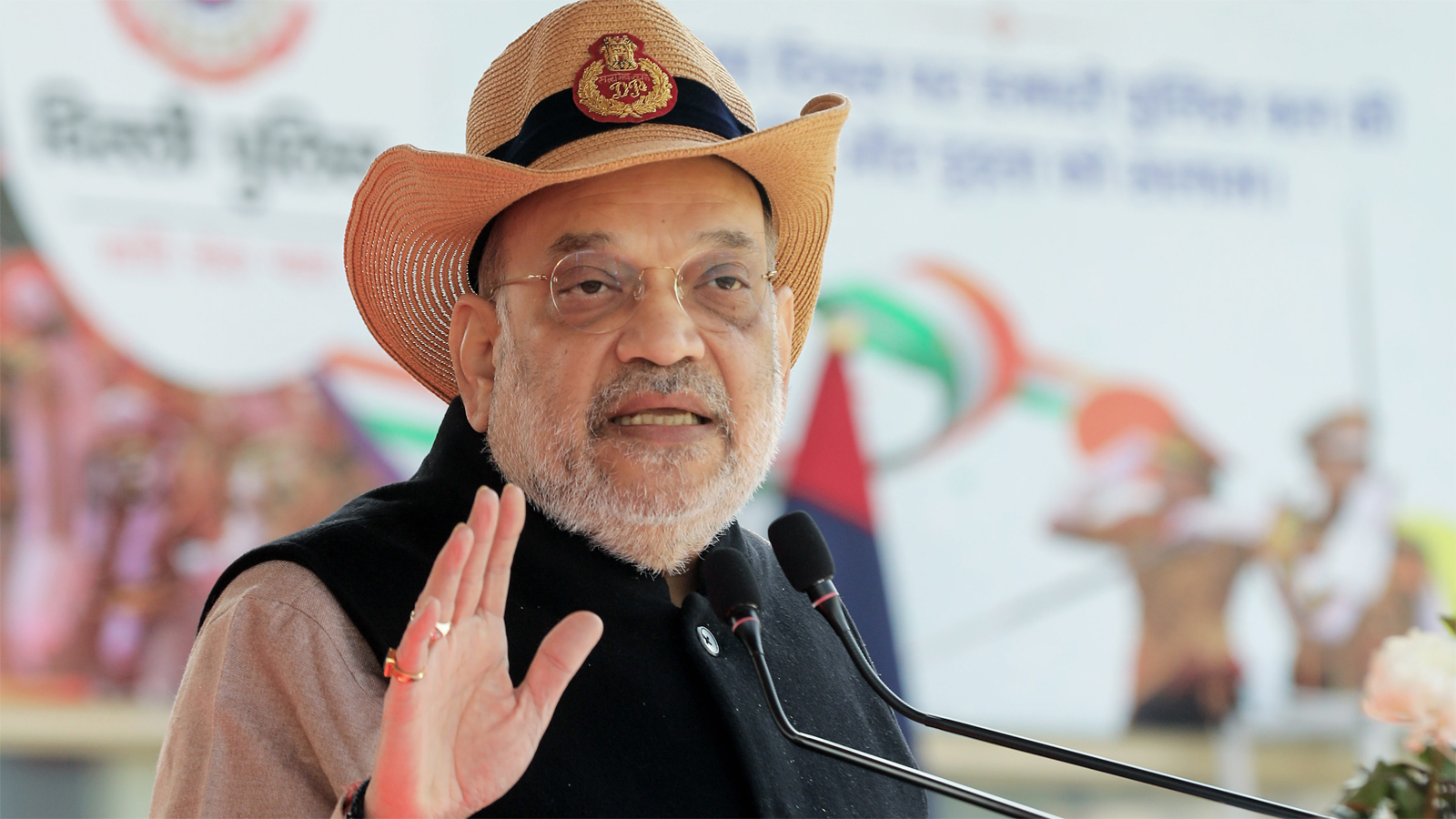
Union Home Minister Amit Shah on Monday said the period from 2014 to 2026 under the leadership of Prime Minister Narendra Modi would be recorded as a “golden era” in India’s internal security history, asserting that Naxalism is on the verge of eradication and major legal reforms will significantly boost conviction rates.
Addressing the 79th Raising Day ceremony of Delhi Police as the chief guest in the national capital, Shah lauded the force for its commitment to “peace, service and justice” since its inception. Delhi Police Commissioner Satish Golchha and other senior officials were present at the event.
Shah said Delhi, as the national capital and the centre of India’s democracy, must meet the highest global security standards. Given the presence of key constitutional authorities, diplomatic missions and frequent national and international events, he noted that the responsibility on Delhi Police is significantly greater.
The Home Minister electronically laid the foundation stone for the Integrated Headquarters of the Special Cell, being built at a cost of ₹368 crore. He said the facility would become the country’s most modern centre for tackling terrorism, narcotics, organised crime and cyber threats.
The headquarters will include a state-of-the-art indoor firing range, war room, cyber lab and training facilities. Shah said the Special Cell has played a crucial role in investigating drug syndicates, fake Indian currency rackets, complex cybercrimes and major terror cases across the country.
He also laid foundation stones for 10 new Delhi Police projects and inaugurated the first phase of the Safe City Project, developed at a cost of ₹857 crore. Under the initiative, a modern Integrated Command, Control, Communication and Computer Centre (C4I) has been dedicated to the public.
According to Shah, 2,100 cameras have already gone live under the plan to connect 10,000 cameras across Delhi, while over 15,000 existing cameras have been integrated into the system. He said the project would significantly enhance surveillance and response capabilities in the capital.
Highlighting legal reforms, Shah said the repeal of colonial-era criminal laws and the introduction of the three new Nyaya Sanhitas marked a historic shift toward a justice-centric legal system.
He asserted that within two years of full implementation, any FIR registered in the country would reach a final decision—up to the Supreme Court—within three years.
The new laws include a dedicated chapter on crimes against women and children, legal backing for e-FIR and Zero FIR, mandatory forensic visits in cases punishable by more than seven years, and legal recognition of electronic and digital records. Terrorism has been defined for the first time in Indian criminal law, and provisions for trial in absentia and attachment of properties of absconding offenders abroad have been introduced.
Shah said integration under the Integrated Criminal Justice System (ICJS) has brought police, judiciary, forensic science, prosecution and prisons onto a common digital platform. He added that community service has been introduced as a form of punishment for minor offences.
He expressed confidence that the reforms would reduce delays and significantly improve conviction rates, citing improvements already seen in states such as Assam, Haryana and Gujarat.
The Home Minister said that before 2014, India faced persistent internal security challenges in Jammu and Kashmir, Left-Wing Extremism-affected areas, and the Northeast.
“Naxalism, which once spread across 11 states, is now on the verge of being eliminated,” Shah said, expressing confidence that the country would be free from Naxal violence by March 31, 2026.
He added that in the Northeast, more than 10,000 youths have laid down arms and joined the mainstream, with over a dozen peace agreements contributing to stability in the region.
Looking ahead, Shah said the Ministry of Home Affairs plans to expand a nationwide CCTV network and further modernise border security infrastructure to prevent infiltration and strengthen national security.
He reiterated the government’s resolve to build a robust security framework “so strong that not even a single infiltrator can cross the border,” underscoring a continued focus on modernisation and reform.