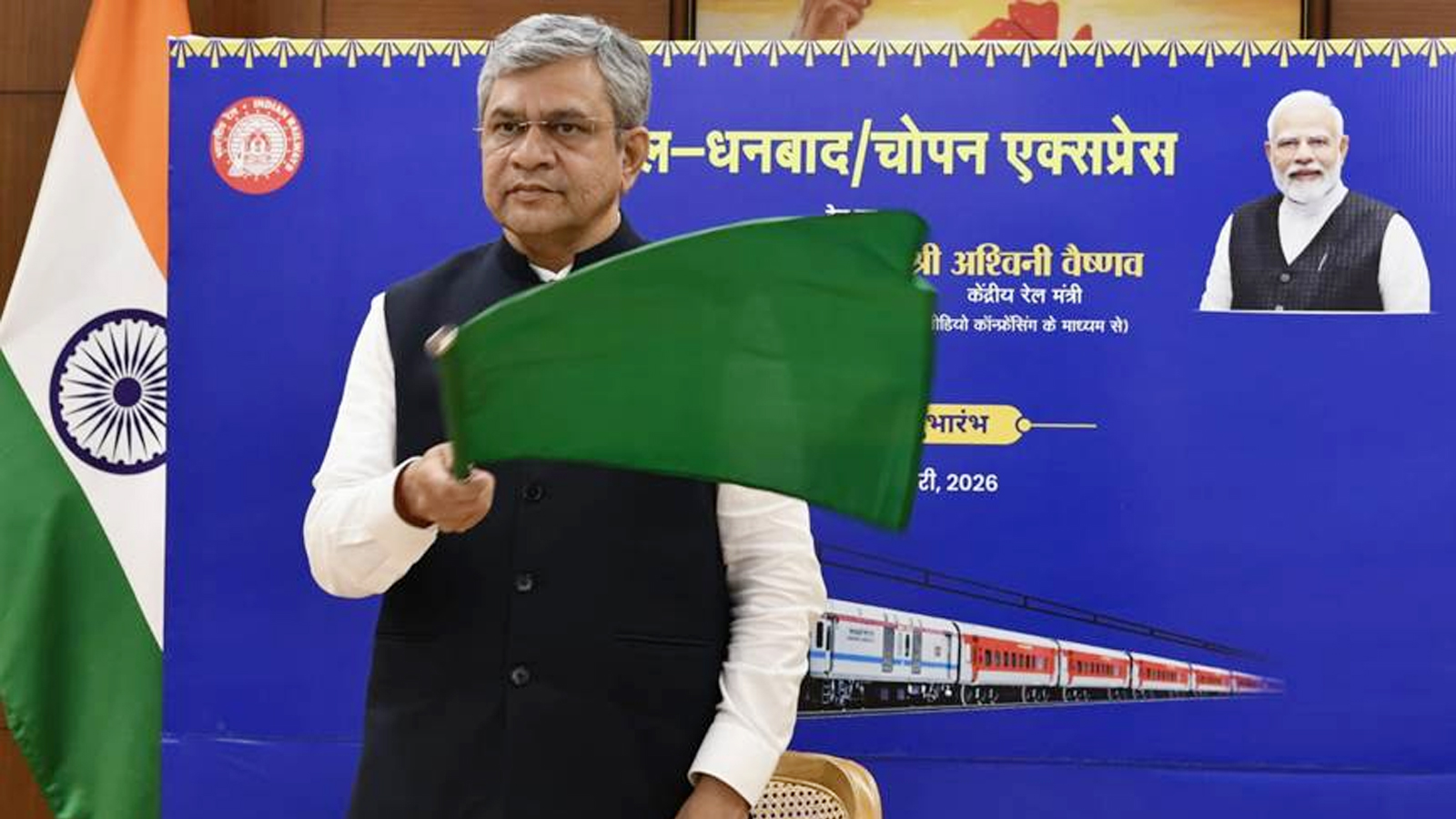
Union Minister for Railways Ashwini Vaishnaw on Tuesday virtually flagged off two new express trains connecting Bhopal with Dhanbad and Chopan, marking a significant boost to rail connectivity between Madhya Pradesh, Uttar Pradesh and Jharkhand.
The Bhopal–Dhanbad–Bhopal Tri-Weekly Express (Train No. 11631/32) and the Bhopal-Chopan-Bhopal Weekly Express (Train No. 11633/34) were flagged off from Rail Bhawan, New Delhi. The launch ceremony was held at Bhopal Railway Station in the presence of Madhya Pradesh Chief Minister Mohan Yadav, Deputy Chief Ministers Jagdish Devda and Rajendra Shukla, Members of Parliament and other public representatives.
The new services have been introduced to address the growing demand for direct connectivity from Madhya Pradesh to Uttar Pradesh and Jharkhand, and to improve passenger convenience.
Speaking on the occasion, Vaishnaw said railway development in Madhya Pradesh has reached an unprecedented scale during the Prime Minister’s third term, with projects worth approximately ₹48,000 crore directly connecting to the state sanctioned during this period.
He highlighted several major railway infrastructure projects, including the Indore-Manmad new railway line sanctioned at an estimated ₹18,000 crore, the Itarsi-Nagpur fourth line project (₹5,400 crore), the Itarsi-Bhopal-Bina fourth line corridor (₹4,300 crore), and the Vadodara-Ratlam third and fourth line project (₹8,800 crore). Other key projects include the Gondia-Jabalpur doubling project and multiple line expansions and gauge conversion works aimed at enhancing capacity, punctuality and freight movement.
The Union Minister also announced a new Dedicated Freight Corridor from Dankuni in West Bengal to Surat in Gujarat, passing through Odisha, Chhattisgarh, Madhya Pradesh and Maharashtra. The 2,052-km East–West corridor will connect with the existing Western Dedicated Freight Corridor, enabling seamless movement of goods to western ports and easing pressure on the current rail network.
Vaishnaw said the corridor would serve as a strong foundation for large-scale industrial development in Madhya Pradesh by improving access to major ports in Gujarat and Maharashtra, including the upcoming Vadhvan Port. Enhanced freight connectivity, he added, would benefit both containerised and bulk cargo operations, strengthening the state’s logistics ecosystem.
Chief Minister Mohan Yadav welcomed the launch of the new trains, describing the daily rail connectivity to Singrauli as a significant development for the region. He said the services would benefit passengers travelling between Singrauli and Dhanbad, where many residents are engaged in trade and employment, and would establish direct rail connectivity with Jharkhand and Bihar.
The Bhopal-Dhanbad Express will halt at 30 stations and operate with 24 coaches, including AC, Sleeper and General class. It will depart Bhopal at 8:55 pm and reach Dhanbad the following evening, with the return journey starting from Dhanbad in the morning.
The Bhopal-Chopan Express will halt at 15 stations and also operate with 24 coaches. It will depart Bhopal at 8:55 pm and reach Chopan the next morning, with a same-day evening return from Chopan.
The new services will provide direct connectivity to key stations including Vidisha, Bina, Sagar, Damoh, Katni, Beohari, Singrauli, Chopan, Chandrapura and Dhanbad. They are expected to strengthen links between coalfields, industrial regions and the capital city of Bhopal, benefiting trade, energy and mining sectors across the three states.
The Union Budget 2026–27 has allocated a record capital expenditure of ₹2,93,030 crore for Indian Railways and ₹1.20 lakh crore for safety. Madhya Pradesh has received ₹15,188 crore for railway development this year — 24 times higher than the allocation during 2009–2014.
Currently, railway projects worth ₹1,18,379 crore are underway in the state. The Ministry of Railways said 100 per cent electrification of railway lines in Madhya Pradesh has been completed, 80 stations are being redeveloped under the Amrit Bharat Station Scheme, and safety measures such as the Kavach system are planned across 4,591 route kilometres.
With the addition of new services and infrastructure upgrades, the government said it remains committed to strengthening railway connectivity, enhancing passenger amenities and accelerating balanced regional development in the state and beyond.