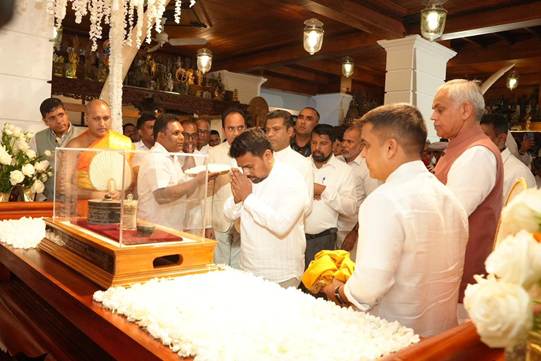
Prime Minister Narendra Modi on Thursday said India and Sri Lanka are connected by “deep civilisational and spiritual bonds” as he thanked Sri Lankan President Anura Kumara Dissanayake for inaugurating the exposition of the holy Devnimori Relics of Lord Buddha at the Gangaramaya Temple in Colombo.
In a post on X, PM Modi expressed his gratitude to President Dissanayake for inaugurating the exposition at the sacred temple. He recalled that during his visit to Sri Lanka in April 2025, it was decided that the relics would be brought to the island nation, allowing devotees to pay their respects.
“Our nations are connected by deep civilisational and spiritual bonds. May Lord Buddha’s timeless message of compassion, peace and harmony continue to guide humanity,” PM Modi said.
Origin of the relics
The Devnimori Relics are named after the Devnimori archaeological site near the Hindu pilgrimage centre of Shamlaji in Gujarat’s Aravalli district.
According to a statement by the Indian High Commission in Colombo, the site was first explored in 1957 by eminent archaeologist Prof. S. N. Chowdhry. Excavations revealed significant Buddhist structures and relics, underscoring the spread of Buddhism in western India during the early centuries of the Common Era.
The High Commission provided detailed information on the relic casket discovered within the Devnimori Stupa at a height of 24 feet from the base. The casket, made of green schist, bears an inscription in Brahmi script and Sanskrit reading “dashabala sharira nilay”—meaning the abode of the Buddha’s bodily relic. It contains a copper box holding organic material with holy ashes, along with silk cloth and beads.
The casket comprises three parts: a body measuring 6.8 inches at the base and 2.9 inches in height, a lid with a diameter of 6.7 inches, and a rounded knob measuring 0.66 inches in height. The copper box inside features a flat top and base with a slip-on lid fitted onto a rim ledge. It contained silk cloth, organic material with holy ashes, black clay used as a covering, and a small amphora-like gold-coated silver-copper bottle with a cylindrical body, narrow neck, and screw-type lid.
According to the High Commission, the holy relics are now housed in a desiccator sealed within an air-tight glass enclosure to prevent deterioration. The relics, along with the gold-coated bottle and silk cloth, rest on a cotton base to ensure long-term preservation.
Journey to Sri Lanka
The relics, enshrined at The Maharaja Sayajirao University of Baroda in Vadodara, arrived in Sri Lanka on Wednesday with full State Honours, coinciding with the country’s 78th Independence Day. They were transported aboard a special Indian Air Force aircraft and received in accordance with established bilateral protocols.
A high-level Indian delegation led by Gujarat Governor Acharya Devvrat and Gujarat Deputy Chief Minister Harsh Sanghavi accompanied the relics, along with senior Buddhist monks and officials.
The exposition follows an announcement made by PM Modi during his State Visit to Sri Lanka in April 2025. During the visit, the Prime Minister had also announced grant assistance for the development of the Sacred City Complex in Anuradhapura, in addition to the USD 15 million grant earlier extended to promote Buddhist ties between the two countries.
The exposition was formally inaugurated on Wednesday by President Dissanayake at the revered Gangaramaya Temple, in the presence of senior dignitaries from both countries and the Chief Incumbent of the temple, Ven. Dr. Kirinde Assaji Thero.
Responding to the Prime Minister’s message, President Dissanayake thanked PM Modi and the Government of India for honouring their commitment and enabling public veneration of the sacred relics in Sri Lanka.
The exposition will remain open for public veneration from February 5 to February 11. Two accompanying exhibitions – Unearthing the Sacred Piprahwa and Sacred Relic and Cultural Engagement of Contemporary India – were also inaugurated as part of the event.
This marks the first public exposition of the Devnimori Relics outside India. Earlier, India had organised expositions of the Kapilavastu Relics in 2012 and the Sarnath Relics in 2018 in Sri Lanka.