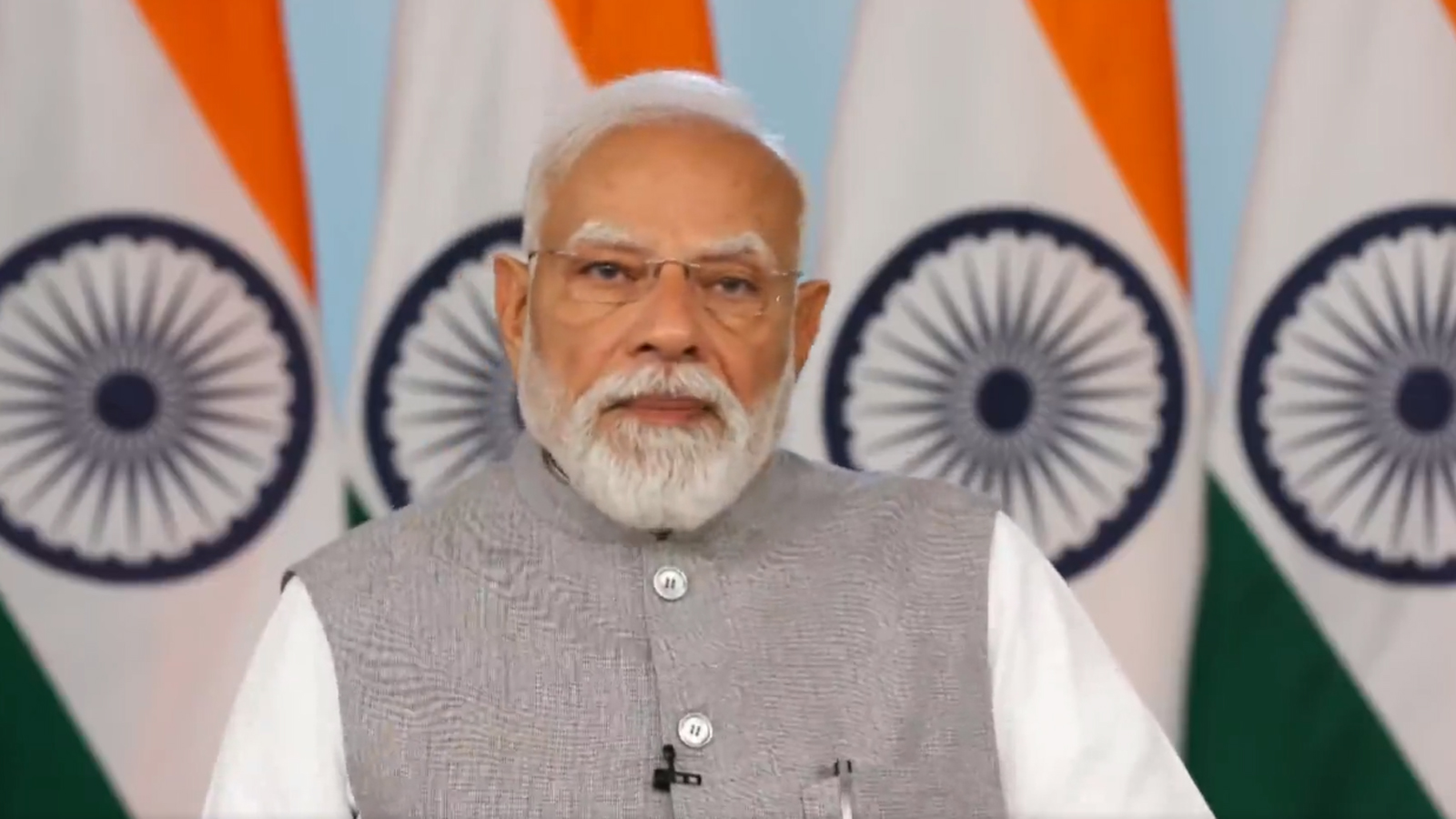
Prime Minister Narendra Modi on Friday said the Union Budget 2026-27 lays a comprehensive roadmap for building a “Viksit Bharat” by 2047, driven by technology, reforms and finance, and urged stakeholders to ensure that reforms translate into tangible results on the ground.
Addressing the first in a series of post-Budget webinars themed “Technology Reforms and Finance for Viksit Bharat,” the Prime Minister stressed that the Budget should not be viewed as a short-term financial document but as a policy blueprint for long-term nation-building.
“Every budget is a step towards a larger goal — the construction of a Developed India by 2047. Every reform, allocation and policy change must be seen as part of this long journey,” he said.
Highlighting the government’s reform trajectory over the past decade, PM Modi said processes have been simplified, ease of doing business has improved, technology-led governance has expanded and institutions have been strengthened. “Even today, the country continues to ride the Reform Express,” he remarked.
The Prime Minister underscored that the real test of reforms lies in delivery excellence. He called for leveraging emerging technologies such as Artificial Intelligence, blockchain and data analytics to enhance transparency, accountability and speed in governance. He also emphasised the need for robust grievance redressal systems to monitor the impact of reforms.
Stressing the government’s continued focus on infrastructure, PM Modi said public capital expenditure has increased significantly over the past 11 years — from around ₹2 lakh crore to over ₹12 lakh crore in the current Budget. He described this as a clear signal for greater private sector participation in infrastructure and innovation.
“We have made a conscious decision that India’s development will be driven by the creation of solid assets such as highways, railways, ports, digital networks and power systems. These assets will enhance productivity for decades to come,” he said.
Calling upon industry and financial institutions to come forward with renewed energy, the Prime Minister urged stronger collaboration in emerging sectors and innovation in financing models. He also stressed the importance of improving project appraisal mechanisms through rigorous cost-benefit analysis and life-cycle costing to minimise delays and inefficiencies.
On the financial front, PM Modi said the government is working to further simplify the foreign investment framework to make it more predictable and investor-friendly. He highlighted ongoing efforts to deepen bond markets, enhance liquidity and introduce new instruments to better manage risk and attract sustained foreign capital.
“We need to follow global best practices to strengthen market confidence,” he said.
Proposing the creation of a “Reform Partnership Charter,” the Prime Minister suggested a shared commitment between the government, industry, financial institutions and academia to ensure effective implementation of Budget announcements.
He clarified that the purpose of the post-Budget webinars is not to revisit the contents of the Budget but to ensure its rapid and seamless execution. “When government, industry and knowledge partners move forward together, reforms are transformed into results and announcements become achievements on the ground,” he said.
Expressing confidence in the deliberations, PM Modi urged stakeholders to focus on simplifying processes and accelerating implementation, asserting that collective effort would pave the way for a vibrant and developed India.