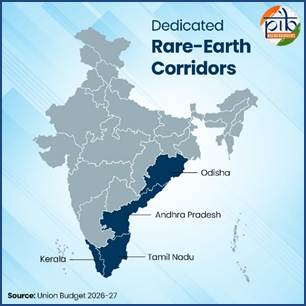
India is stepping up its strategy to secure critical minerals and advanced materials, with the Union Budget 2026–27 announcing the creation of Dedicated Rare Earth Corridors across Odisha, Kerala, Andhra Pradesh and Tamil Nadu. Combined with a ₹7,280 crore Rare Earth Permanent Magnet (REPM) Manufacturing Scheme approved in November 2025, the initiatives mark a decisive move towards self-reliance in materials vital for electric vehicles, renewable energy, electronics, aerospace and defence.
The measures are aligned with the national priorities of Atmanirbhar Bharat, Net Zero 2070 and Viksit Bharat @2047, while positioning India as a credible player in global advanced-materials value chains.
Why Rare Earths Matter
Rare Earth Permanent Magnets are among the strongest and most efficient magnets available, prized for their compact size and high performance. They are indispensable for electric vehicle motors, wind turbine generators, industrial electronics, defence systems and precision sensors. As India scales up manufacturing in clean energy, mobility and strategic sectors, a reliable domestic supply of REPMs has become a strategic necessity.
Currently, India relies heavily on imports—largely from China—for permanent magnets, with imports accounting for 60–80 per cent of value and 85–90 per cent of quantity between 2022 and 2025. With demand expected to double by 2030, driven by electric mobility and renewable energy expansion, building domestic capacity has become urgent.
Strong Resource Base
India has a substantial rare-earth mineral endowment. The country holds about 13.15 million tonnes of monazite, containing an estimated 7.23 million tonnes of rare-earth oxides. Deposits are spread across coastal and inland regions of Odisha, Kerala, Andhra Pradesh, Tamil Nadu, West Bengal, Gujarat, Maharashtra and Jharkhand. In addition, hard-rock areas in Gujarat and Rajasthan contain 1.29 million tonnes of in-situ rare-earth oxide resources.
Exploration efforts by the Geological Survey of India have further strengthened this base, identifying 482.6 million tonnes of rare-earth ore resources through 34 exploration projects. Together, these reserves provide a solid foundation for building an integrated domestic manufacturing ecosystem.
REPM Manufacturing Scheme
To translate resource potential into industrial capability, the government approved a ₹7,280 crore REPM Manufacturing Scheme in November 2025. The scheme aims to create 6,000 tonnes per annum of integrated manufacturing capacity for sintered rare earth permanent magnets, covering the entire value chain from rare-earth oxides to finished magnets.
Under the scheme, up to five beneficiaries will be selected through global competitive bidding. It provides ₹6,450 crore in sales-linked incentives over five years, along with a ₹750 crore capital subsidy to support advanced manufacturing facilities. After a two-year gestation period, incentives will be linked to actual production. The objective is to ensure reliable domestic supply for sectors such as electric mobility, renewable energy, electronics, aerospace and defence.
Rare Earth Corridors Announced in Budget
Complementing the manufacturing scheme, the Union Budget 2026–27 announced Dedicated Rare Earth Corridors in four mineral-rich states. These corridors will focus on mining, processing, research and manufacturing, creating integrated hubs that link raw material extraction with high-value production and innovation.
The corridor initiative builds on the existing footprint of IREL (India) Limited, which operates under the Department of Atomic Energy. IREL already runs a rare-earth extraction plant in Odisha and a refining unit at Aluva in Kerala, alongside its large-scale processing of strategic minerals. Integrating these facilities with new corridor-based investments is expected to accelerate domestic capacity, foster research and development, and generate regional economic growth.
Aligned with National Goals
The rare earth push reflects a broader alignment with India’s strategic objectives. Reducing import dependence strengthens self-reliance and supply chain security. Expanding REPM production supports the clean energy transition by enabling domestic manufacturing of EV motors and wind turbines, crucial for achieving Net Zero emissions by 2070. For defence and aerospace, assured access to rare earth magnets enhances national security by reducing vulnerability to global supply disruptions.
These initiatives also complement institutional reforms, including amendments to the Mines and Minerals (Development and Regulation) Act and the National Critical Minerals Mission approved in January 2025, which aim to open exploration to private participation and secure sustainable supply chains.
Global Partnerships for Resilience
India’s strategy extends beyond domestic reforms. The country has signed bilateral agreements with mineral-rich nations such as Australia, Argentina, Zambia, Mozambique, Peru, Zimbabwe, Malawi and Côte d’Ivoire to secure access to critical minerals. India is also an active participant in multilateral platforms like the Minerals Security Partnership and the Indo-Pacific Economic Framework, which focus on diversifying and stabilising global supply chains.
Khanij Bidesh India Limited (KABIL), a joint venture under the Ministry of Mines, is playing a key role in acquiring overseas mineral assets. Its agreement with Argentina’s CAMYEN for lithium brine exploration is a significant step in securing external sources of critical minerals.
A Strategic Shift
Together, the REPM Manufacturing Scheme and the Budget-backed Rare Earth Corridors represent a strategic shift in India’s approach to critical materials. By combining domestic resource development, manufacturing incentives, corridor-based infrastructure and global partnerships, India is laying the groundwork for a resilient and competitive rare earth ecosystem. As demand for advanced materials accelerates worldwide, these measures position India to emerge as a reliable player in global supply chains while strengthening its own clean energy, manufacturing and defence capabilities.