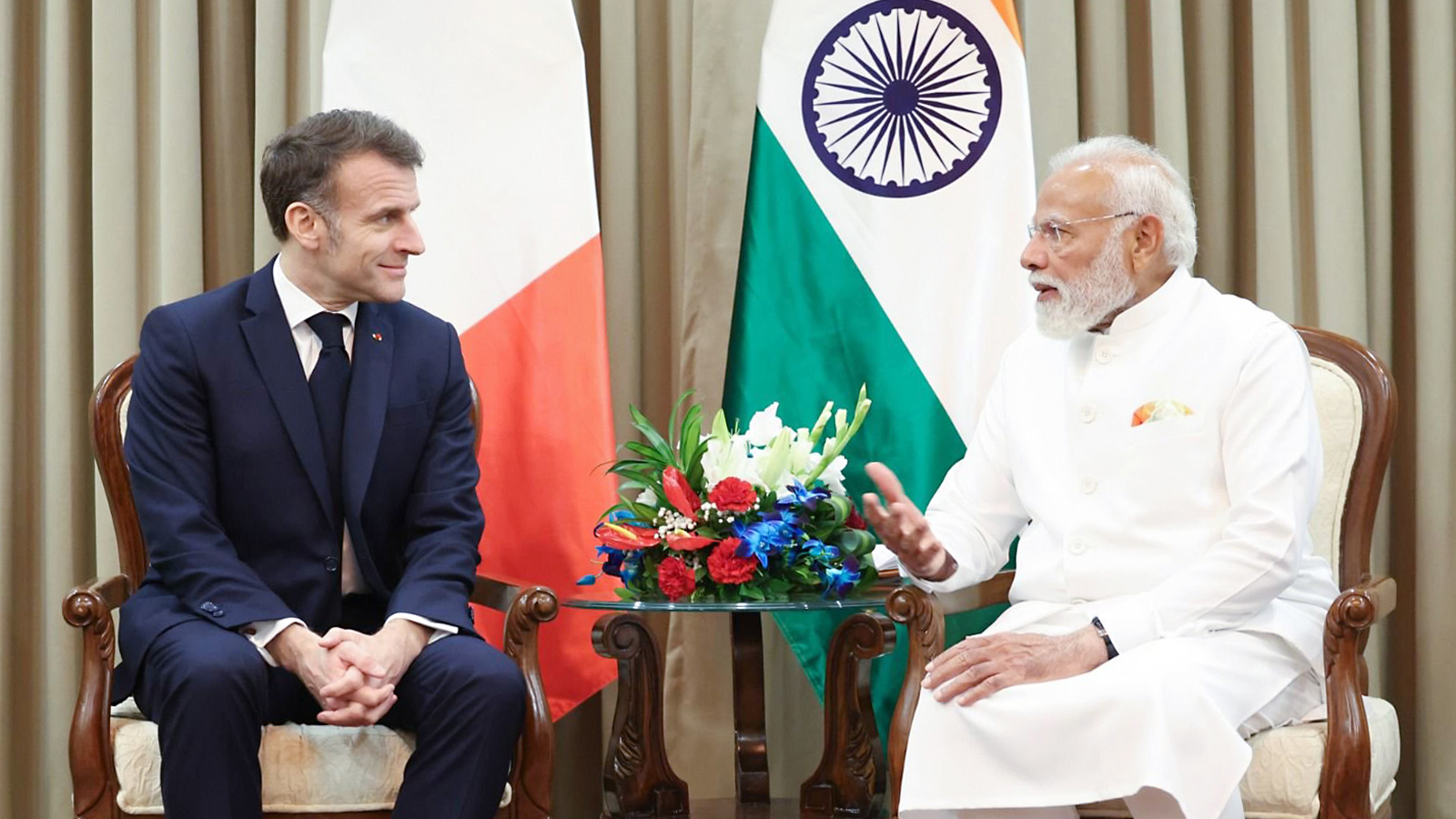
India and France on Tuesday elevated their bilateral relationship to a “Special Global Strategic Partnership”, marking a significant expansion of cooperation across defence, critical minerals, advanced technologies, climate action, health, education and economic security.
The decision was announced following talks between Prime Minister Narendra Modi and French President Emmanuel Macron in Mumbai. Macron, who is on an official visit to India from February 17 to 19, also jointly inaugurated the 2026 India-France Year of Innovation. He is scheduled to participate in the India AI Impact Summit 2026 on Thursday.
This is President Macron’s fourth visit to India and follows PM Modi’s visit to France in February 2025.
A New Strategic Framework
The elevation builds on the India-France Strategic Partnership launched in 1998 and the Horizon 2047 Roadmap adopted in 2023, coinciding with the 25th anniversary of the partnership. The two leaders agreed to establish an annual Foreign Ministers Comprehensive Dialogue to review progress under the upgraded framework and coordinate on economic security, global issues and people-to-people ties.
The new designation signals deeper coordination at bilateral, regional and global levels, with both countries reaffirming their commitment to a rules-based international order, reformed multilateralism and closer engagement in the Indo-Pacific.
France reiterated its firm support for India’s permanent membership in a reformed United Nations Security Council, and both sides pledged to intensify coordination in multilateral forums.
Defence Ties Deepen
Defence cooperation emerged as a cornerstone of the upgraded partnership. The two sides renewed their 10-year defence cooperation agreement and signed multiple MoUs during the 6th India-France Defence Dialogue.
Among key outcomes were a joint venture between Bharat Electronics Limited (BEL) and Safran to produce HAMMER missiles in India; reciprocal deployment of officers between the Indian Army and French Land Forces in 2026; constitution of a Joint Advanced Technology Development Group to co-develop emerging and critical technologies; and renewal of the defence cooperation agreement and strengthening of joint research, co-design, co-development and co-production under the Defence Industrial Roadmap.
The leaders welcomed the inauguration of the H125 helicopter Final Assembly Line at Vemagal, Karnataka, a collaboration between Tata Advanced Systems and Airbus, marking a milestone in India’s “Make in India” initiative.
They also noted progress on the procurement of 26 Rafale-Marine fighter jets and ongoing cooperation on jet engines and helicopters, including Safran’s partnership with HAL for the Indian Multi Role Helicopter (IMRH).
Cooperation on Critical Minerals
Recognising the strategic importance of supply chains for clean energy and advanced manufacturing, India and France announced a Joint Declaration of Intent on cooperation in critical minerals and rare earths. The agreement aims to strengthen collaboration in exploration, extraction, processing and recycling technologies to build diversified and resilient supply chains.
Innovation, AI and Technology
The two leaders launched the 2026 India-France Year of Innovation, which will feature collaborations in science and technology, cyberspace, artificial intelligence, healthcare, sustainable development and research.
They also launched the India-France Innovation Network to connect startups, incubators, businesses and academic institutions from both countries. A Letter of Intent was signed between T-Hub and Nord France Invest to promote startup ecosystem cooperation.
Building on earlier AI cooperation, both sides reaffirmed their commitment to secure and trustworthy artificial intelligence that serves public interest and bridges the global AI divide.
A major highlight was the launch of the Indo-French Centre for AI in Health at AIIMS, New Delhi, in collaboration with Sorbonne University and the Paris Brain Institute.
Economic and Tax Reforms
In a significant move to facilitate business, the two countries agreed to amend the protocol on the Double Tax Avoidance Agreement (DTAA), aimed at providing greater certainty for investors and encouraging bilateral trade.
Both leaders welcomed the sustained growth in trade and investments and committed to strengthening collaboration in MSMEs, digitalisation, AI-driven enterprises and resilient supply chains.
France, the first European country to adopt India’s Unified Payments Interface (UPI), agreed to expand acceptance of digital payment systems to ease transactions for Indian tourists.
Climate, Nuclear and Energy Cooperation
The leaders reaffirmed their commitment to the Paris Agreement and sustainable development. They agreed to deepen cooperation in renewable energy and civil nuclear energy, including discussions on the Jaitapur Nuclear Power Plant project and collaboration on Small Modular Reactors (SMRs).
They also welcomed joint initiatives under the International Solar Alliance and the Coalition for Disaster Resilient Infrastructure, both headquartered in New Delhi.
Indo-Pacific and Global Issues
India and France reiterated their commitment to a free, open and rules-based Indo-Pacific. They pledged closer coordination under frameworks such as the India-Middle East-Europe Economic Corridor (IMEC) and trilateral partnerships with Australia and the UAE.
On global conflicts, the leaders expressed concern over the war in Ukraine and called for a just and lasting peace through dialogue and diplomacy. They also reiterated support for a two-state solution in West Asia and condemned terrorism in all forms, with France expressing solidarity following recent terror attacks in India.
Expanding People-to-People Ties
The two leaders underscored the importance of cultural, educational and mobility partnerships. France aims to host 30,000 Indian students by 2030, up from 10,000 currently. They welcomed new academic collaborations, skill development initiatives and a National Centre of Excellence in Aeronautics in Kanpur.
Cultural cooperation will be strengthened through upcoming exhibitions, museum partnerships and the celebration of 30 years of strategic partnership in 2028.
President Macron invited PM Modi to attend the G7 Summit to be hosted by France in 2026 and to participate in preparatory discussions on global economic imbalances and international partnerships.
The establishment of the India-France Special Global Strategic Partnership marks a new chapter in bilateral relations, with both nations positioning themselves as key partners in shaping global governance, technological transformation and sustainable development in the decades ahead.