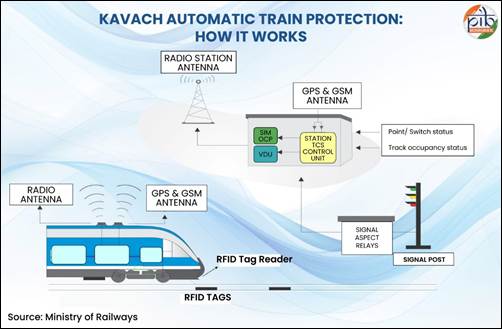
Every railway journey in India carries an unspoken assurance – that passengers will reach their destinations safely. As train speeds rise and traffic density increases across one of the world’s busiest rail networks, Indian Railways is undertaking a quiet but far-reaching transformation to strengthen that assurance. At the heart of this shift is Kavach, an indigenously developed Automatic Train Protection (ATP) system, supported by a growing suite of AI-driven safety and monitoring technologies.
The impact of this technology-led push is already visible. Consequential train accidents have declined sharply – from 135 in 2014-15 to 31 in 2024-25, and further to 11 in 2025-26 (up to November). The Ministry of Railways attributes this improvement to a sustained focus on accident prevention, modern signalling systems, and continuous investment in safety infrastructure.
Kavach: India’s Homegrown Safety Shield
Developed by the Research Designs and Standards Organisation (RDSO), Kavach is a real-time train protection system designed to prevent accidents caused by human error, signal violations, overspeeding, and collisions. Certified to Safety Integrity Level 4 (SIL-4) – among the highest global railway safety standards – the system provides loco pilots with in-cab displays showing movement authority, target speed, distance to go, and signal aspects, enabling safer operations even beyond 120 kmph.
Kavach automatically applies brakes if a train approaches a danger signal, exceeds permitted speed, or enters a conflicting route, effectively preventing Signal Passing at Danger (SPAD) and collisions. In block sections, the system can issue automatic Stop-on-Sight commands when trains approach each other on the same track.
As of now, Kavach has been implemented on more than 2,200 route kilometres, with Kavach Version 4.0 covering 1,306.3 route kilometres across five railway zones, including critical corridors such as Delhi-Mumbai and Delhi-Howrah.
Scaling Up for a High-Density Network
Nearly 96 per cent of railway traffic moves on High-Density and Highly Used Network routes, making safety upgrades on these corridors a top priority. Indian Railways has adopted a phased strategy – first covering high-speed, high-density sections equipped with Automatic Block Signalling and Centralised Traffic Control, followed by other busy passenger routes.
In a significant milestone achieved in January 2026, Indian Railways commissioned Kavach 4.0 on 472.3 route kilometres in a single month, the highest such expansion so far. Additional works covering 2,667 route kilometres are already sanctioned, with execution underway.
Looking ahead, Kavach 5.0, announced in April 2025, is being designed specifically for suburban sections to reduce inter-train headway and increase frequency without compromising safety. The upcoming Vande Bharat 4.0 trains are envisaged to incorporate this next-generation system as part of their advanced safety framework.
Backed by Rising Safety Investments
This technological transformation is underpinned by growing financial commitment. Expenditure on railway safety has risen steadily from ₹39,200 crore in 2013-14 to ₹1.17 lakh crore in 2025-26, reflecting a long-term strategy to modernise safety infrastructure across the national rail network.
AI and Digital Technologies Add a New Layer of Protection
Beyond Kavach, Indian Railways is deploying artificial intelligence and digital systems to enhance situational awareness, predictive maintenance, and real-time monitoring.
AI-enabled Intrusion Detection Systems using Distributed Acoustic Sensing technology are helping detect elephants and other wild animals on tracks in vulnerable corridors. These systems are operational over 141 route kilometres on the Northeast Frontier Railway, with tenders issued for nearly 1,000 additional kilometres. Complementary measures such as honey-bee buzzers and thermal cameras are also being piloted to prevent wildlife collisions.
At stations, AI-based Video Surveillance Systems with facial recognition and video analytics have been installed at over 1,700 locations, improving security and proactive incident management. Predictive maintenance tools using machine vision, wheel impact detectors, and automated inspection systems are helping detect defects in rolling stock and infrastructure before failures occur.
Strengthening Communication and Visibility
Reliable communication remains central to safe train operations. Digital VHF radio systems have replaced analogue walkie-talkies, while tunnel communication systems ensure uninterrupted contact in long tunnel sections such as the Udhampur-Srinagar-Baramulla Rail Link. The expansion of the optical fibre cable network – now covering over 67,000 route kilometres -supports modern signalling and data transmission.
Fog safety devices, electronic interlocking systems, vigilance control devices in locomotives, and advanced track health monitoring using ultrasonic testing and track recording cars further reinforce operational safety.
A Safer, Smarter Rail Network
From its first field trials in 2016 to nationwide deployment today, Kavach’s evolution reflects India’s emphasis on indigenous innovation, continuous improvement, and safety-first governance. Combined with AI-led monitoring and predictive tools, Indian Railways is building a modern, integrated safety architecture – one that protects passengers and staff, safeguards infrastructure, improves suburban capacity, and reduces risks to wildlife.
As expansion continues, the rail network is steadily moving toward becoming one of the safest and most technologically advanced railway systems in the world, ensuring that every journey remains as reliable as it is essential.