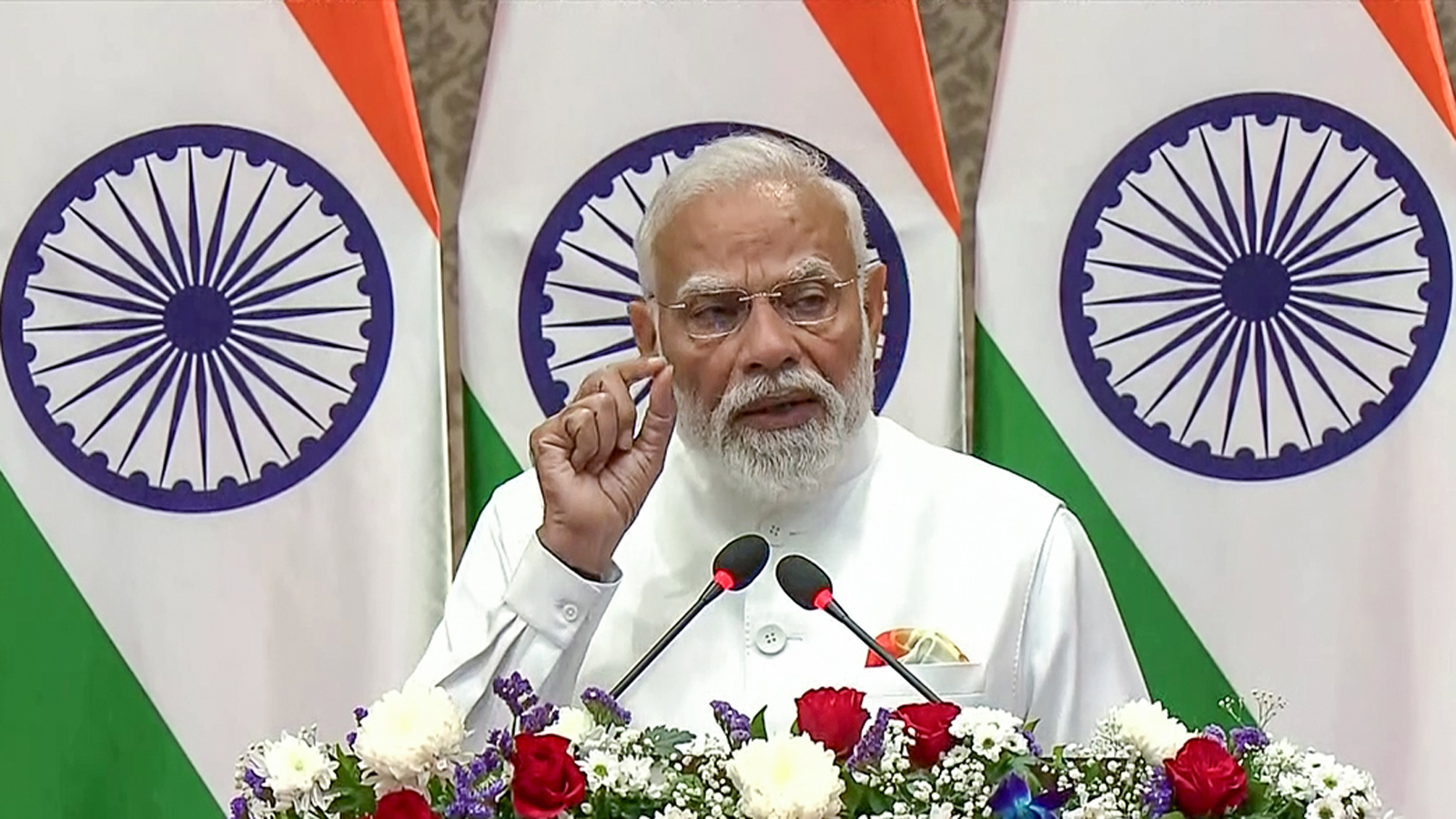
Prime Minister Narendra Modi has outlined an ambitious vision for India’s role in the global artificial intelligence revolution, declaring that the country should be “among the top three AI superpowers globally” by the time it celebrates 100 years of independence in 2047.
He made the remarks during an exclusive interview with ANI as the 5-day India AI Impact Summit 2026 is underway in New Delhi – the first global AI summit of its scale to be hosted in the Global South.
In a post on X, PM Modi said, “As India hosts the AI Impact Summit in Delhi, I’ve shared my thoughts on the transformative potential of AI, the role India can play in the AI revolution and more in this interview with ANI.”
The Prime Minister stressed that artificial intelligence must remain human-centric, inclusive and development-oriented, guided by the civilisational ethos of “Sarvajan Hitay, Sarvajan Sukhaye” – welfare and happiness for all.
‘AI Stands at a Civilisational Inflection Point’
Describing artificial intelligence as a turning point in human history, the Prime Minister said, “Today, AI stands at a civilisational inflection point. It can expand human capability in unprecedented ways, but it can also test existing social foundations if left unguided.”
He emphasised that the summit’s focus on “Impact” reflects India’s desire to ensure equitable outcomes rather than mere technological advancement.
“The guiding spirit, ‘Sarvajan Hitay, Sarvajan Sukhaye’, reflects India’s civilisational philosophy. The end goal of technology should be ‘Welfare for All, Happiness of All’. Technology exists to serve humanity, not replace it,” he said.
The summit, structured around the themes of People, Planet and Progress, aims to ensure that AI’s benefits are widely distributed and not limited to early adopters or advanced economies.
“As the first global AI summit hosted in the Global South, India is creating a platform that amplifies under-represented voices and development priorities,” PM Modi noted.
AI and the Road to Viksit Bharat 2047
Linking AI to India’s long-term development goals, PM Modi said artificial intelligence represents a transformative opportunity in the country’s journey toward Viksit Bharat 2047.
“Leveraging AI mindfully, with a strategic lens, helps address deep developmental challenges while creating entirely new economic opportunities,” he said.
He cited several examples of AI already delivering results: AI-based solutions for early detection of tuberculosis, diabetic retinopathy and epilepsy at primary health centres; AI-powered personalised learning platforms in Indian languages supporting rural and government school students; a unique initiative by Amul reaching 36 lakh women dairy farmers with real-time guidance in Gujarati on cattle health and productivity; the Bharat Vistaar initiative integrating AI into crop advisory, soil analytics and weather intelligence; and digitisation and interpretation of ancient manuscripts using AI.
“At a time when the world is worried about AI deepening divides, India is using it to dissolve divides,” the Prime Minister said. “We are making it an efficient tool for delivering healthcare, education and economic opportunity to every village, every district, and every citizen.”
Addressing Bias and Ensuring Inclusion
Referring to concerns he had earlier raised at the AI Action Summit in Paris, PM Modi said AI bias remains a serious issue.
“As AI adoption accelerates, the risks also scale. AI systems can inadvertently perpetuate biases related to gender, language and socio-economic background,” he warned.
He pointed out that India’s linguistic and cultural diversity makes inclusive datasets and fairness research especially critical.
“An AI system trained primarily on English data or urban contexts may perform poorly for rural users or speakers of regional languages,” he said, adding that India is now focusing on creating diverse datasets and promoting AI development in regional languages.
DPI and AI: A Model for the Global South
Highlighting India’s experience with digital public infrastructure such as Aadhaar and UPI, the Prime Minister said the convergence of DPI and AI represents “the next frontier of inclusive development.”
“Our success with Aadhaar, UPI and other digital public goods was not accidental,” he said. “We built digital infrastructure as a public good, not a proprietary platform.”
He explained that AI layered on top of this infrastructure can improve welfare targeting, fraud detection, urban planning and governance transparency.
“With its experience of building a human-centric Digital Public Infrastructure, India is best placed to ensure that AI’s benefits reach the last mile,” he said.
‘India Must Move from Participating to Shaping AI Revolution’
Calling India a global engineering powerhouse, PM Modi expressed confidence that the country can evolve from being a technology consumer to a creator.
“India has the talent and entrepreneurial energy to become an AI powerhouse, not just as a consumer, but a creator,” he said.
He cited the IndiaAI Mission, expansion of data centres, high-performance AI compute access, semiconductor manufacturing push, AI Centres of Excellence, and digital skilling initiatives as key enablers.
“We are not just nurturing talent, but we are building the infrastructure, policy ecosystem and skills base required for India to move from participating in the AI revolution to shaping it,” he asserted.
AI and the Future of India’s IT Sector
The Prime Minister described AI as both an opportunity and a challenge for India’s IT sector.
“AI isn’t replacing the IT sector. It is transforming it,” he said, noting projections that India’s IT sector could reach $400 billion by 2030.
He emphasised that India wants its IT companies to lead not just in services but in building AI products and platforms for global markets.
Safety, Regulation and Global Norms
On concerns about AI misuse, PM Modi called for a global compact based on principles of human oversight, safety-by-design and transparency.
“These should include effective human oversight, safety-by-design, transparency and strict prohibitions on the use of AI for deepfakes, crime and terrorist activities,” he said.
He highlighted the launch of the IndiaAI Safety Institute in January 2025 and measures such as watermarking AI-generated content and strengthening data protection through the Digital Personal Data Protection Act.
“As AI becomes more advanced, our sense of responsibility must grow stronger,” he said.
Jobs and the Youth
Addressing fears among youth about job losses, the Prime Minister struck a reassuring note.
“Preparation is the best antidote to fear,” he said, emphasising large-scale skilling and re-skilling initiatives.
“History has shown that work does not disappear due to technology. Its nature changes and new types of jobs are created,” he said. “With the right skills and preparation, our youth will lead the future of work.”
He also cited India’s third-place ranking in the Stanford Global AI Vibrancy Index 2025 as evidence of growing AI strength.
Vision for Aatmanirbhar Bharat in AI
Outlining his long-term vision, PM Modi said AI in Aatmanirbhar Bharat would rest on sovereignty, inclusivity and innovation.
“My vision is that India should be among the top three AI superpowers globally, not just in the consumption of AI but in creation,” he declared.
“Our AI models will be deployed worldwide, serving billions in their native languages. Our AI startups will be valued in hundreds of billions, creating millions of high-quality jobs.”
He added, “Aatmanirbhar Bharat in AI means India writing its own code for the digital century.”
(With ANI inputs)