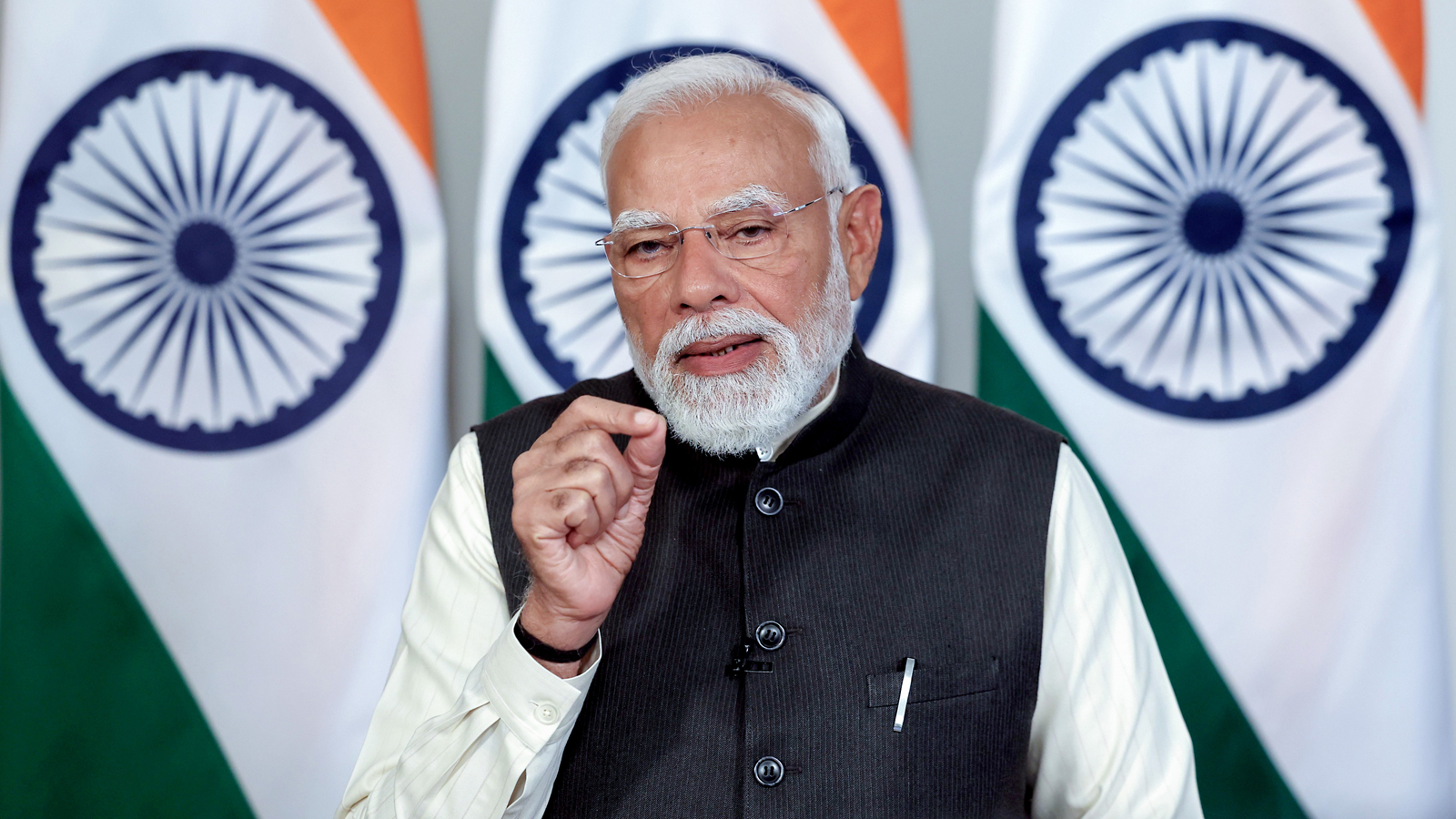
Prime Minister Narendra Modi outlined an ambitious roadmap for India’s economic transformation, emphasising structural reforms, manufacturing expansion, women-led development and global trade integration in an exclusive interview with Press Trust of India (PTI).
Speaking on a wide range of issues – from the Union Budget 2026-27 and trade agreements to defence modernisation and the government’s “Reform Express” – PM Modi said India is entering a decisive phase of growth as it works towards becoming a developed nation by 2047.
Trade Deals to Anchor Structural Transformation
Highlighting India’s expanding global engagement, the Prime Minister said recent trade agreements with major economies, including the European Union, the United Kingdom, Australia and the UAE, reflect the country’s growing competitiveness and policy stability.
He noted that India now has Free Trade Agreements (FTAs) with 38 partner nations, calling it an unprecedented milestone in India’s trade history. PM Modi said these agreements go beyond tariff reductions and are designed to integrate Indian manufacturing and services more deeply into global value chains.
He emphasised that MSMEs are central to the new trade strategy, with agreements aimed at reducing non-tariff barriers and boosting exports in sectors such as textiles, leather, engineering goods, chemicals, handicrafts, and gems and jewellery.
Record Capital Expenditure in Budget 2026-27
On the Union Budget, PM Modi described the record capital expenditure of ₹12.2 lakh crore for 2026-27 as a strategic choice focused on long-term productivity rather than short-term populism. He highlighted major allocations for railways, highways, freight corridors and ports, calling infrastructure development a key pillar of India’s growth strategy.
The Prime Minister said the Budget reflects continuity in governance, adding that each year’s financial plan builds on previous reforms with clear timelines and implementation goals.
Calling it the first Budget of the “second quarter of the 21st century,” PM Modi said it lays the foundation for achieving the vision of “Viksit Bharat” by 2047.
Manufacturing Push and Job Creation
Reiterating the importance of manufacturing, PM Modi said India cannot remain merely a consumer economy and must emerge as a producer of globally competitive goods.
He pointed to the success of initiatives such as ‘Make in India’ and the Production Linked Incentive (PLI) schemes, noting that India is now the world’s second-largest mobile phone manufacturer. He also cited progress in defence manufacturing, pharmaceuticals, electronics and toy exports.
The Prime Minister said manufacturing generates employment across skill levels and creates broader ecosystems of ancillary industries, logistics and services.
Technology, AI and Data Infrastructure
PM Modi said the Budget’s focus on IT, data centres and artificial intelligence is aimed at positioning India as a global technology leader. He stressed the importance of building foundational digital infrastructure, including secure data frameworks and computing capacity, to support AI development.
He highlighted the Digital Personal Data Protection law as a critical step in ensuring security and citizen rights while enabling innovation. Tax incentives for data centres, he said, would accelerate investments and generate employment opportunities for youth.
Defence Modernisation and Self-Reliance
The Prime Minister noted that a record ₹7.85 lakh crore has been allocated to defence in the current Budget, with a significant portion earmarked for modernisation and domestic procurement.
He said defence exports have crossed ₹23,000 crore, marking a sharp rise over the past decade, and reiterated the government’s commitment to self-reliance in defence production.
On Operation Sindoor, PM Modi said the nation is proud of the armed forces and that defence modernisation is part of a long-term strategy rather than a reaction to specific events.
Reform Momentum and Governance Simplification
Describing himself as “constructively restless,” PM Modi said reforms under his government have moved from incremental adjustments to systemic transformation. He cited GST restructuring, FDI liberalisation in insurance, labour reforms, digital payments through UPI, and the creation of new ministries for emerging sectors as examples.
He added that the next phase of reforms would focus on enhancing competitiveness, deepening innovation and simplifying governance further to promote ease of living and ease of doing business.
Women at the Centre of Growth Vision
Emphasising women-led development, PM Modi said the Budget includes measures to strengthen female entrepreneurship, STEM education and participation in sunrise sectors such as animation, VFX and gaming.
He highlighted initiatives such as Girls’ STEM hostels, caregiver training programmes and support for self-help groups and rural enterprises, stating that empowering women is central to achieving Viksit Bharat.
“The welfare of women guides every decision our Government takes,” he said, adding that women will play the most important role in building a developed India.
As India navigates global economic shifts and post-pandemic realignments, PM Modi asserted that the country is not acting out of compulsion but from preparedness. “This is not a ‘now or never’ moment,” he said. “It is a ‘we are ready’ moment.”