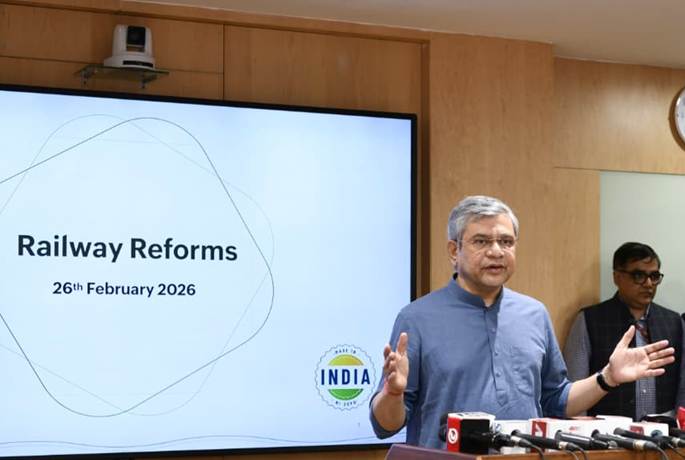
Union Minister for Railways, Information and Broadcasting, and Electronics and Information Technology Ashwini Vaishnaw on Thursday announced the launch of the RailTech Policy and the complete digitisation of the Railway Claims Tribunal (RCT), marking the third and fourth reforms under Indian Railways’ “52 Reforms in 52 Weeks” initiative.
Announcing the reforms, the Minister said the RailTech Policy aims to systematically induct technology and innovation into the Railways by engaging startups, innovators, industry and research institutions through a simplified and transparent framework.
As part of the policy, a dedicated RailTech Portal will be launched to enable innovators to submit proposals through a fully digital, end-to-end process. The new system allows innovation challenges to be initiated by both innovators and departmental users, with a single-stage proposal submission process. The policy also increases scale-up grants more than threefold and doubles the maximum grant for prototype development and trials.
Key focus areas under the RailTech Policy include artificial intelligence-based elephant intrusion detection systems, fire detection systems in coaches, drone-based broken rail detection, rail stress monitoring, sensor-based load calculation devices on parcel vans, solar panels on coaches, AI-based coach cleaning monitoring, fog-related obstruction detection, and AI-enabled pension and dispute resolution systems.
The Minister said the policy has been designed to move away from rigid vendor-based procurement models towards an innovation-driven framework focused on trials and large-scale adoption of successful technologies. He added that the RailTech model draws inspiration from initiatives such as iDEX in defence and startup frameworks in the electronics and telecom sectors.
Explaining the funding mechanism, Vaishnaw said the Railways will support up to 50 per cent of development costs for promising technologies. Once proven, successful solutions will be scaled up through long-term procurement orders. He said the objective is not limited to experimentation but to ensure implementation at scale.
Highlighting operational use cases, the Minister referred to AI-enabled CCTV systems for passenger security, advanced track monitoring using AI, radar and infrared technologies, predictive monitoring of overhead equipment, and drone-based inspection of rail assets. He also said technology could help streamline administrative processes such as pension disbursement for retired railway employees.
As part of Reform Number Four, the Minister announced the complete digitisation and AI-enabled transformation of the Railway Claims Tribunal through the e-RCT system. The initiative will enable end-to-end online filing, processing and adjudication of claims, making the system faster, more transparent and accessible across the country.
At present, the Railway Claims Tribunal operates through 23 benches across India. The Minister said passengers often face difficulties in identifying the appropriate jurisdiction for filing claims, especially when incidents occur during travel across states. The new e-RCT system will allow claims to be filed electronically from anywhere, irrespective of location.
Under the reform, all RCT benches are expected to be fully digitised within the next 12 months. The platform will support paperless court functioning, online exchange of pleadings and notices, daily online pronouncement of orders and judgements, and hybrid hearings in line with Supreme Court guidelines.
The e-RCT system will comprise modules for e-filing, a case information system and a document management system, enabling real-time case tracking, digital storage of records and automated workflows. The reform is expected to reduce delays, cut costs and improve access to justice for claimants.
Vaishnaw said that if successful, the digital tribunal model could be extended to other judicial bodies. He added that both reforms align with the government’s focus on technology-driven governance, transparency and citizen-centric service delivery.
Earlier this month, the Minister had announced two other reforms under the “52 Reforms in 52 Weeks” initiative, including continuous end-to-end cleaning of general coaches and expansion of Gati Shakti Cargo Terminals.