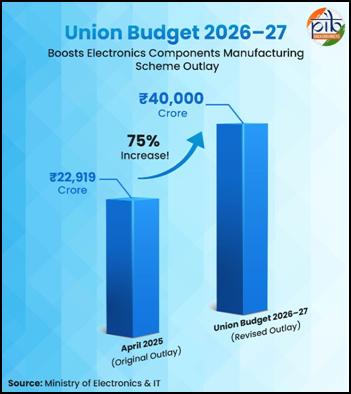
The Union Budget 2026-27 has given a major fillip to India’s fast-growing electronics manufacturing sector by raising the outlay of the Electronics Components Manufacturing Scheme (ECMS) to ₹40,000 crore. The enhanced allocation underscores the government’s commitment to deepening domestic manufacturing capabilities, strengthening the component ecosystem, and positioning India as a global hub for advanced electronics.
Over the last decade, India’s electronics sector has witnessed a dramatic transformation. Electronics production has increased nearly six-fold—from ₹1.9 lakh crore in 2014–15 to ₹11.3 lakh crore in 2024–25—while exports have surged eight-fold to ₹3.27 lakh crore. The sector has also emerged as a major employment generator, creating around 25 lakh jobs nationwide. With the Budget’s renewed focus, this growth momentum is expected to accelerate further.
Electronics Emerges as a Leading Export Sector
According to the Economic Survey 2025–26, electronics has become India’s third-largest and fastest-growing export category in 2024–25, rising sharply from seventh place in 2021–22. In the first half of FY 2025–26 alone, electronics exports stood at USD 22.2 billion, putting the sector on track to become the country’s second-largest export item.
Mobile manufacturing has been at the heart of this expansion. Mobile phone production has grown 28 times over the past decade, reaching ₹5.45 lakh crore in 2024–25. India is now the world’s second-largest mobile phone manufacturer, with over 300 manufacturing units compared to just two in 2014. Exports of mobile phones have grown even faster, increasing 127 times to ₹2 lakh crore over the same period. In the first five months of FY 2025–26, smartphone exports touched ₹1 lakh crore, reflecting a 55 per cent year-on-year growth.
This rapid progress has enabled India to achieve near self-reliance in mobile manufacturing, transitioning from heavy import dependence to domestic production of almost all devices.
ECMS: Strengthening the Component Ecosystem
Notified in April 2025 with an initial outlay of ₹22,919 crore, the Electronics Components Manufacturing Scheme is designed to build a strong and self-sustaining ecosystem for electronics components, sub-assemblies, and raw materials. With a tenure of six years, the scheme complements the India Semiconductor Mission and seeks to integrate India more deeply into global value chains.
As of December 2025, ECMS has significantly exceeded initial expectations. Expected investment commitments have reached ₹1.15 lakh crore—nearly double the original target—while projected production over six years stands at over ₹10.3 lakh crore. The scheme is also expected to generate more than 1.4 lakh direct jobs, far surpassing earlier estimates.
Strong Industry Response Across States
Industry response to ECMS has been robust. A total of 46 applications have been approved across 11 states, representing cumulative investments of ₹54,567 crore and projected production worth ₹3.67 lakh crore. These projects are expected to create direct employment for around 51,000 people.
Approved units will manufacture a wide range of components, including multi-layer printed circuit boards, camera modules, connectors, oscillators, optical transceivers and enclosures for mobile and IT hardware. The approvals, granted in three tranches between October 2025 and January 2026, highlight the scheme’s ability to attract large-scale investment and generate employment across regions.
Expected Gains in FY 2026–27
The scheme is expected to deliver tangible results in FY 2026–27 as projects scale up. By the end of the financial year, ECMS investments are projected to reach ₹11,156 crore, with production valued at ₹29,024 crore and employment generation of over 19,000 jobs.
Policy Ecosystem Supporting Electronics Growth
The expansion of ECMS is complemented by a range of government initiatives aimed at strengthening electronics manufacturing. The Production-Linked Incentive (PLI) Scheme, with an outlay of ₹1.97 lakh crore, has attracted over USD 4 billion in foreign direct investment since FY 2020–21, with nearly 70 per cent coming from PLI beneficiaries.
The Modified Electronics Manufacturing Clusters (EMC 2.0) scheme has also played a key role by creating world-class infrastructure. As of December 2025, 13 projects across 10 states have been approved, covering nearly 4,400 acres and projected to generate 1.8 lakh jobs.
In addition, the Union Budget 2026–27 has announced customs duty exemptions on select inputs for microwave ovens and waived the Social Welfare Surcharge on parts used for electronic toys, further reducing manufacturing costs.
Schemes such as SPECS, offering 25 per cent capital expenditure incentives, and the National Policy on Electronics 2019 continue to support India’s shift from assembly-based manufacturing to high-value component and design-led manufacturing.
A Cornerstone of India’s Technology Ambition
With the enhanced outlay of ₹40,000 crore, ECMS has emerged as a cornerstone of India’s electronics manufacturing strategy. By mobilising investment, boosting production, and generating employment, the scheme is strengthening the domestic component ecosystem and integrating India more deeply with global value chains. As the country advances towards its goal of building a $500 billion electronics manufacturing ecosystem by 2030–31, ECMS is set to play a pivotal role in shaping India’s future as a global technology and manufacturing leader.