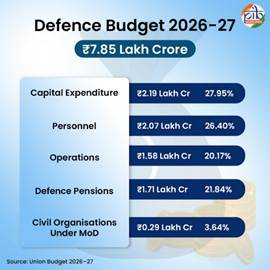
The Union Budget 2026-27 has placed national security at the centre of India’s development priorities, with the Ministry of Defence receiving its highest-ever allocation of ₹7.85 lakh crore. Announced by the central government on February 1, the defence outlay reflects a 15.19 per cent increase over the Budget Estimates of FY 2025–26 and accounts for 14.67 per cent of total Central Government expenditure – the highest share among all ministries.
Over the last decade, India’s defence budget has witnessed a sharp rise, increasing from ₹2.53 lakh crore in 2013-14 to ₹7.85 lakh crore in 2026-27, marking a nearly threefold jump. The latest allocation underscores the government’s focus on modernisation of the armed forces, strengthening indigenous defence manufacturing under the Aatmanirbhar Bharat initiative, and enhancing welfare measures for veterans.
Balanced Allocation Across Defence Needs
Of the total defence budget, 27.95 per cent has been earmarked for capital expenditure, aimed at capability development and modernisation. Revenue expenditure on sustenance and operational preparedness accounts for 20.17 per cent, while 26.40 per cent has been allocated for pay and allowances. Defence pensions constitute 21.84 per cent of the allocation, with the remaining 3.64 per cent set aside for civil organisations under the Ministry of Defence.
Major Push for Modernisation
A key highlight of the budget is the strong thrust on modernising the Army, Navy and Air Force. For FY 2026-27, over ₹2.19 lakh crore has been allocated under the capital head for the defence forces – an increase of 21.84 per cent over the previous year’s Budget Estimates. Of this, ₹1.85 lakh crore has been earmarked specifically for capital acquisition, representing a rise of around 24 per cent.
The upcoming capital acquisition projects are expected to equip the armed forces with next-generation fighter aircraft, advanced weapons systems, ships, submarines, unmanned aerial vehicles and drones. Infrastructure development has also received a boost, with the capital allocation for the Border Roads Organisation (BRO) increased to ₹7,394 crore. The enhanced funding is expected to accelerate strategic projects such as tunnels, bridges and airfields in border areas. Additionally, ₹975 crore has been allocated for the creation of an optical fibre cable-based network for defence services.
Boost to Indigenous Defence Manufacturing
Reinforcing the Aatmanirbhar Bharat vision, the budget provides a significant push to domestic defence manufacturing. A total of ₹1.39 lakh crore has been allocated for procurement from domestic defence industries, with nearly 75 per cent of the capital acquisition budget reserved for Indian manufacturers in FY 2026–27.
To further support domestic production, the government has proposed exemption of basic customs duty on raw materials imported for manufacturing aircraft parts used in maintenance, repair and overhaul activities by defence sector units. These measures are expected to reduce import dependence, attract investment, promote innovation and generate employment in the defence manufacturing ecosystem.
Higher Outlay for Research and Innovation
The allocation to the Defence Research and Development Organisation (DRDO) has been increased to ₹29,100.25 crore in FY 2026-27, up from ₹26,816.82 crore in FY 2025-26. A major portion of this – ₹17,250.25 crore – has been earmarked for capital expenditure, signalling continued emphasis on research, development and innovation.
In recent years, several initiatives have been undertaken to open up defence R&D to industry, start-ups and academia. About 25 per cent of the defence R&D budget has been made accessible to non-government entities, while 15 DRDO – Industry – Academia Centres of Excellence have been established across 82 research verticals. DRDO has also built a network of around 2,000 industries and transferred technologies at zero transfer-of-technology fee to Indian partners. Between 2022–23 and 2024–25, expenditure on defence R&D stood at over ₹68,210 crore, with 148 new R&D projects sanctioned during this period.
Enhanced Support for Veterans
The Union Budget 2026-27 also strengthens the government’s commitment to veterans’ welfare. An allocation of ₹12,100 crore has been made for the Ex-Servicemen Contributory Health Scheme (ECHS), marking a 45.49 per cent increase over FY 2025-26 Budget Estimates. Over the past five years, ECHS funding has risen by more than 300 per cent, supporting medical treatment-related expenditure for ex-servicemen and their dependents.
The total allocation for defence pensions stands at over ₹1.71 lakh crore, reflecting a 6.56 per cent increase over the previous year. This funding supports monthly pension disbursements to more than 34 lakh pensioners through the SPARSH system and other authorised pension disbursing authorities.
A Budget Aligned with Long-Term Vision
Coming in the backdrop of the recent success of Operation Sindoor, the Union Budget 2026-27 signals a sustained focus on strengthening India’s defence preparedness. With its emphasis on modernisation, indigenous manufacturing, research and innovation, and enhanced welfare for veterans, the budget aims to build a more secure, self-reliant and resilient India, in line with the long-term vision of Viksit Bharat@2047.