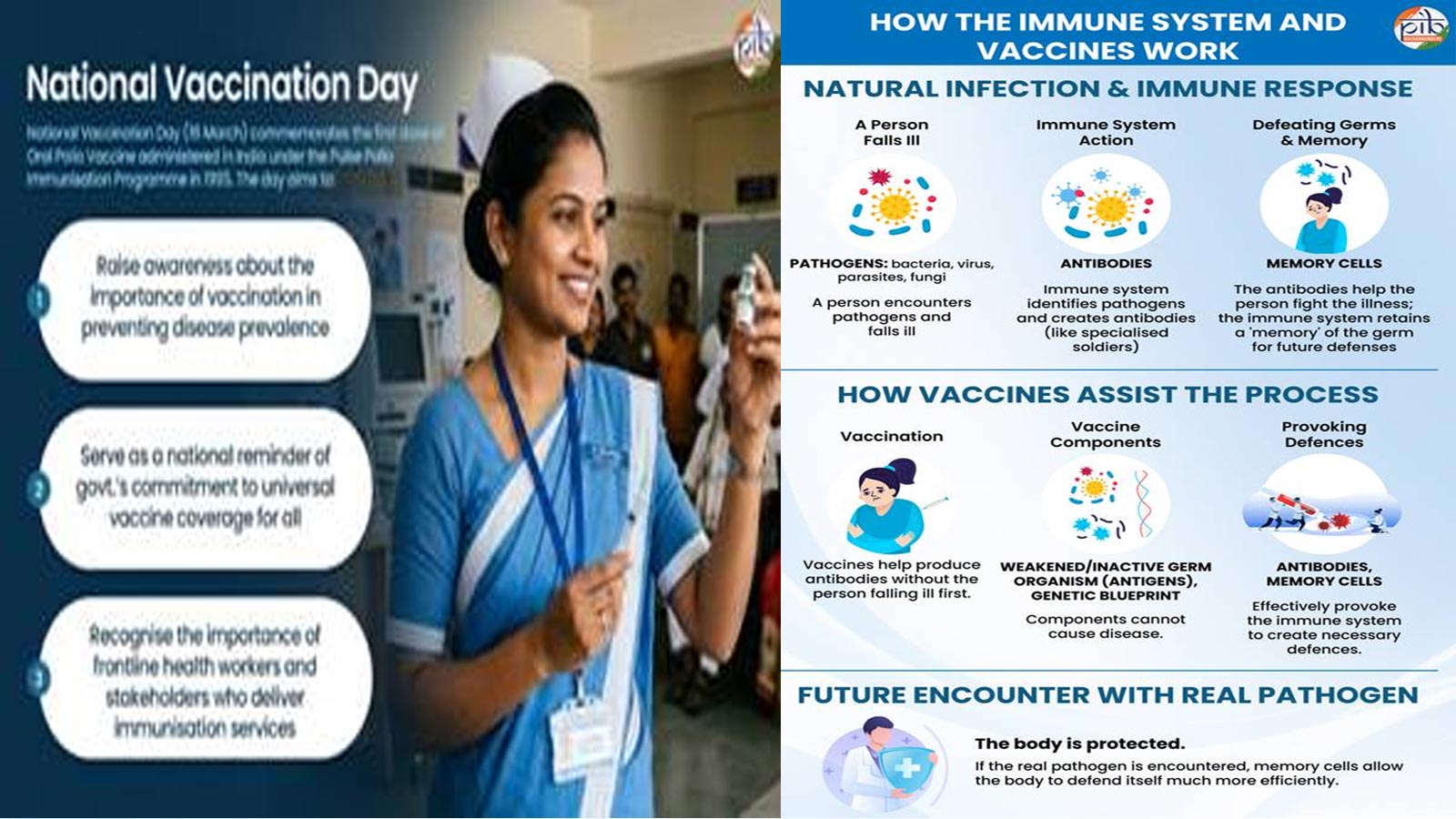
India’s vaccination journey stands as one of the most significant public health success stories, with the country not only eradicating deadly diseases but also steadily expanding its immunisation coverage to protect millions each year.
Marking National Vaccination Day, observed annually on March 16, the focus this year remains on the transformative impact of vaccines in saving lives and strengthening the nation’s healthcare system.
A legacy of disease eradication
India has successfully eliminated major diseases such as smallpox, polio and maternal & neonatal tetanus through sustained vaccination efforts. The last case of polio in the country was reported in 2011, a milestone achieved under the Pulse Polio Programme launched in 1995.
Vaccination has also contributed significantly to reducing child mortality and controlling diseases like measles-rubella and tuberculosis, reinforcing its role as a cornerstone of public health.
One of the world’s largest immunisation programmes
At the heart of India’s success lies the Universal Immunisation Programme (UIP), launched in 1985 and implemented by the Ministry of Health and Family Welfare.
The programme provides free vaccines to approximately 2.9 crore pregnant women and 2.54 crore newborns every year, making it one of the largest immunisation initiatives globally.
Over the past decade, India has made remarkable progress in coverage:
* Full immunisation coverage has surged from 62% in 2015 to 98.4% in January 2026
* The proportion of zero-dose children has declined from 0.11% in 2023 to 0.06% in 2024
These gains reflect a robust healthcare network supported by frontline workers, cold-chain infrastructure, and digital monitoring systems.
Expanding vaccine basket
India has continuously expanded its immunisation basket to address emerging health challenges. In recent years, vaccines such as Inactivated Polio Vaccine (IPV), Rotavirus Vaccine, Measles-Rubella vaccine, and Pneumococcal Conjugate Vaccine have been introduced.
In 2026, two major initiatives marked a new phase:
* Launch of an indigenously developed Tetanus-Diphtheria (Td) vaccine, produced at the Central Research Institute in Kasauli
* A nationwide Human Papillomavirus (HPV) vaccination campaign, targeting 14-year-old girls to prevent cervical cancer
These initiatives highlight India’s growing self-reliance as a global vaccine producer, supplying nearly 60% of the world’s vaccines.
Reaching the last mile
To ensure no one is left behind, the government launched Mission Indradhanush in 2015, focusing on children and pregnant women who are unvaccinated or partially vaccinated.
So far, the mission has covered over 5.46 crore children and 1.32 crore pregnant women across hundreds of districts, significantly improving outreach in remote and underserved areas.
Vaccines are delivered through an extensive network of Primary Health Centres, Community Health Centres, government hospitals, and outreach camps, supported by frontline workers such as ASHAs and Anganwadi staff.
Technology driving efficiency
India’s immunisation programme has been strengthened by digital platforms such as:
* CoWIN, which enabled large-scale COVID-19 vaccination
* U-WIN platform, designed for routine immunisation tracking and beneficiary management
* The Electronic Vaccine Intelligence Network (eVIN), which ensures real-time monitoring of vaccine stocks and temperature
These tools have improved transparency, efficiency, and last-mile delivery.
Strong infrastructure backbone
India’s vaccine delivery system is supported by one of the world’s largest cold-chain networks, comprising nearly 30,000 storage points and over 1 lakh refrigeration units. This ensures vaccines remain effective from production to administration.
More than 1.3 crore immunisation sessions are conducted annually, ensuring access even in remote areas.
A broader impact on society
Experts note that vaccination has far-reaching benefits beyond disease prevention. It reduces healthcare costs, improves child survival rates, and contributes to better educational and economic outcomes.
Better-immunised children grow into healthier adults, strengthening the workforce and supporting long-term national development.
Looking ahead
From eradicating smallpox to administering over 200 crore COVID-19 vaccine doses, India’s immunisation journey reflects sustained commitment and innovation.
As the country continues its efforts to eliminate diseases like measles and rubella, vaccination remains central to building a healthier population and achieving broader development goals.
The message is clear: vaccines are not just a medical intervention – they are an investment in the nation’s future.