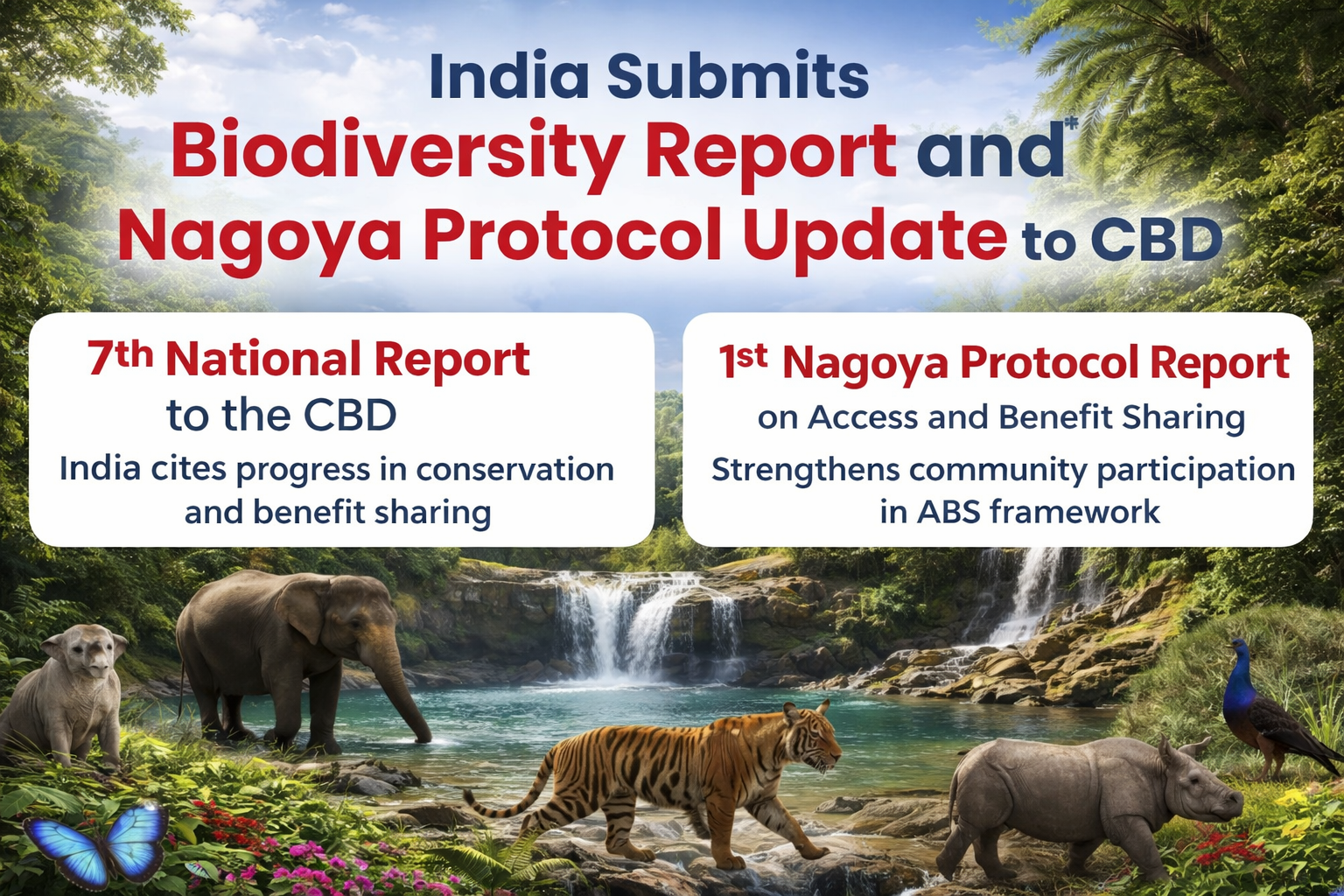
India has submitted two major national reports to the Convention on Biological Diversity (CBD), outlining progress in biodiversity conservation and the implementation of the Nagoya Protocol on access to genetic resources and benefit sharing, the Ministry of Environment, Forest and Climate Change (MoEFCC) said on Monday.
The Ministry submitted India’s Seventh National Report (NR-7) to the CBD on February 26, ahead of the February 28 deadline. The report assesses the country’s biodiversity efforts using 142 national indicators mapped against 23 National Biodiversity Targets under the updated National Biodiversity Strategy and Action Plan (2024–2030).
According to the Ministry, all 23 national biodiversity targets are currently “on track to achieve,” reflecting alignment with the Kunming–Montreal Global Biodiversity Framework, which aims to halt and reverse biodiversity loss by 2030.
The report draws on inputs from 33 Central Ministries and departments, State governments, statutory bodies, research institutions and other stakeholders, reflecting what the government described as a “whole-of-government and whole-of-society” approach to biodiversity conservation.
India’s forest and tree cover continues to show expansion. The recorded forest area stands at 7,75,377 sq. km (23.59% of the country’s geographical area), while total forest and tree cover has reached 8,27,356.95 sq. km (25.17%), according to the report. The number of Ramsar wetlands has also increased from 26 in 2014 to 98 in 2026.
The country’s conservation network includes 58 tiger reserves, 33 elephant reserves, 18 biosphere reserves, 106 national parks and 574 wildlife sanctuaries. India currently supports 3,682 tigers, more than 70% of the global tiger population, along with 4,014 one-horned rhinoceroses, 22,446 wild elephants, 891 Asiatic lions and an estimated 718 snow leopards, based on the first Snow Leopard Population Assessment.
The report also notes the completion of the country’s first river dolphin population estimation under Project Dolphin, which recorded 6,327 riverine dolphins.
India has identified 22 agrobiodiversity hotspots and prioritised the conservation of 769 crop wild relatives across 171 native crops and 230 native animal breeds, the Ministry said.
Separately, the government submitted India’s First National Report on the implementation of the Nagoya Protocol on access and benefit sharing (ABS) to the CBD Secretariat on February 27. The report covers the period from November 2017 to December 2025.
The Nagoya Protocol establishes rules to ensure that benefits arising from the use of genetic resources are shared fairly with countries and communities that provide them.
India’s ABS framework operates under the Biological Diversity Act, 2002, supported by the Biological Diversity Rules, 2024 and ABS Regulations, 2025. The system functions through a three-tier structure comprising the National Biodiversity Authority (NBA), State Biodiversity Boards and Biodiversity Management Committees (BMCs) at the local level.
More than 2,76,653 Biodiversity Management Committees have been established across the country to involve local communities in biodiversity governance.
Between 2017 and 2025, India issued 12,830 ABS approvals, including 5,913 approvals by the National Biodiversity Authority for activities such as research, commercial utilisation and intellectual property applications involving biological resources. State biodiversity boards granted 6,917 approvals for commercial utilisation by Indian entities.
India has also published 3,556 internationally recognised certificates of compliance, accounting for more than 60% of the global total under the ABS Clearing-House mechanism, according to the Ministry.
The ABS system has generated ₹216.31 crore in monetary benefits, of which ₹139.69 crore has been disbursed to local communities, farmers and traditional knowledge holders. An additional ₹51.96 crore was mobilised through approvals granted by State biodiversity boards.
The Ministry said non-monetary benefits such as training, technology transfer and collaborative research were also included in 395 approvals, while over 2.56 lakh individuals were trained through 3,724 workshops and programmes.
The reports also highlight the use of technologies such as remote sensing, geographic information systems, satellite telemetry, drones, camera traps and DNA-based tools for biodiversity monitoring.
According to the Ministry, the reports demonstrate India’s progress in conservation, sustainable use of biodiversity and community participation while reaffirming its commitment to global biodiversity goals under the CBD framework.