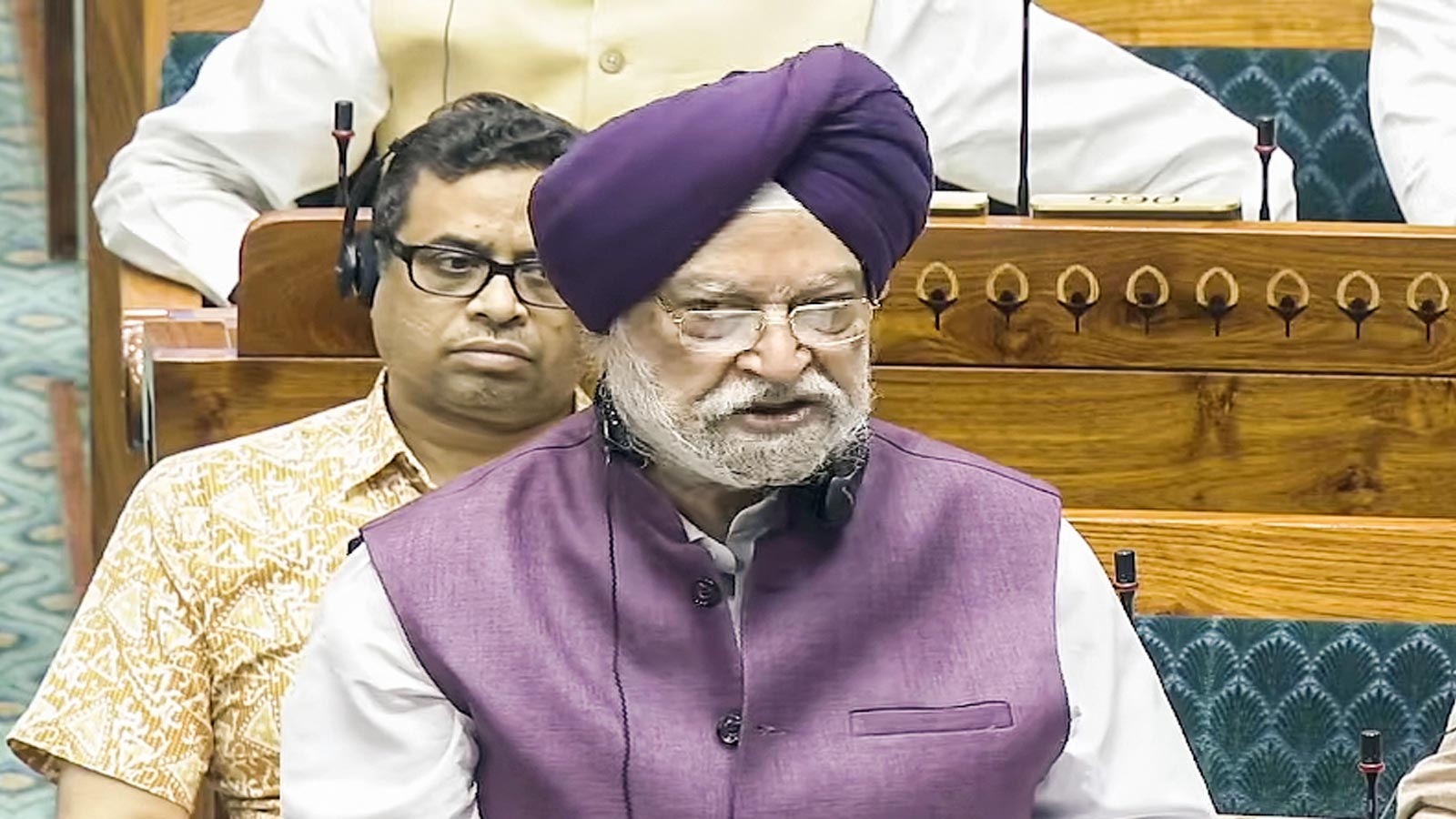
Union Minister for Petroleum and Natural Gas Hardeep Singh Puri on Thursday informed the Lok Sabha that India has taken multiple measures to ensure uninterrupted energy supplies amid global disruptions caused by the ongoing conflict in West Asia.
Making a detailed statement in Parliament, the minister said the government has acted swiftly to safeguard India’s energy security following disruptions in global energy supply chains, particularly after shipping through the Strait of Hormuz was affected.
“The world has not faced a moment like this in modern energy history. Today is the 13th day since the passage through the Strait of Hormuz, through which 20% of the world’s crude, 20% of the world’s natural gas and 20% of the world’s LPG flows, was disrupted,” Puri said.
He noted that for the first time in recorded history the Strait has been effectively closed to commercial shipping following military operations involving Iran, Israel and the United States.
“Despite India having no role in causing the conflict, like many countries, India has to navigate through its consequences,” the minister said.
Crude supply secure, no fuel shortage
Puri assured Parliament that India’s crude oil supply remains secure and sufficient despite the global crisis.
“India’s crude supply position is secure, and volumes secured exceed what Hormuz would have delivered,” he said.
He added that before the crisis around 45 per cent of India’s crude imports passed through the Strait of Hormuz, but the country has diversified supply sources significantly.
“Non-Hormuz sourcing has risen to approximately 70 per cent of crude imports, up from 55 per cent before the conflict began. India sources crude from 40 countries, against 27 in 2006-07,” he said.
The minister also confirmed that there is no shortage of petroleum products in the country.
“There is no shortage of petrol, diesel, kerosene, ATF or fuel oil. Retail outlets across the country are stocked and supply chains for these products are functioning normally,” Puri said.
Natural gas supply prioritised
Addressing concerns regarding natural gas availability, the minister said the government has prioritised supply for essential sectors.
“Domestic piped gas to homes and CNG for vehicles receive 100 per cent supply with no cuts. Industrial and manufacturing consumers will receive up to 80 per cent of their previous six-month average, while fertiliser plants will receive up to 70 per cent,” he stated.
He added that alternative imports are helping offset shortfalls caused by disruptions from Gulf suppliers.
“Large LNG cargoes are arriving on an almost daily basis through alternative supply routes, and India has sufficient gas production and supply arrangements to sustain this position even in the event of a prolonged conflict,” he said.
LPG supply boosted, panic buying warned against
The minister said the government has increased domestic LPG production and diversified imports to ensure uninterrupted supply to households.
“LPG production has been increased by 28 per cent through refinery directives, and further procurement is actively underway,” Puri said.
He emphasised that the government’s priority is to protect household cooking gas supply.
“The Narendra Modi government’s foremost priority is that the kitchens of India’s 33+ crore families, especially the poor and the underprivileged, do not face any shortage,” he said.
Puri also addressed reports of panic buying.
“The rush-booking pressure in some localities reflects a demand distortion, not a production or supply failure,” he said.
To prevent hoarding and diversion, the government has introduced measures including Delivery Authentication Codes for LPG deliveries and minimum booking gaps of 25 days in urban areas and 45 days in rural regions.
Commercial LPG regulated to prevent black marketing
The minister said the government has also introduced temporary regulation for commercial LPG cylinders.
“In a supply-constrained environment where public anxiety is elevated, this deregulated structure creates a direct and uncontrolled pathway for hoarding, diversion and resale at inflated prices,” he said.
To address this, a committee of executives from public sector oil companies has been formed to assess genuine demand and ensure fair allocation.
Prices shielded from global volatility
Puri said the government has taken steps to protect consumers from rising global energy prices.
“Despite the Saudi Contract Price rising 41 per cent between July 2023 and March 2026, the PMUY beneficiary price has fallen 32 per cent in the same period and stands at ₹613 per cylinder in Delhi,” he said.
He added that the government absorbed a significant portion of the cost increase.
“Of the ₹134 per cylinder adjustment required by prevailing global market conditions, the government absorbed ₹74,” he noted.
Call for unity during crisis
Concluding his statement, Puri urged citizens and political leaders to avoid spreading misinformation during the crisis.
“This is not the moment for rumour-mongering or fake narratives. India is navigating the most severe global energy disruption in recorded history,” he said.
“Crude supply is flowing. Gas is prioritised for homes and farms. LPG production has been stepped up by 28 per cent. Consumer prices are held far below what markets and regional comparators would dictate,” he added.
“India must stand united behind its energy warriors, behind the institutions managing this crisis, and behind the national interest.”