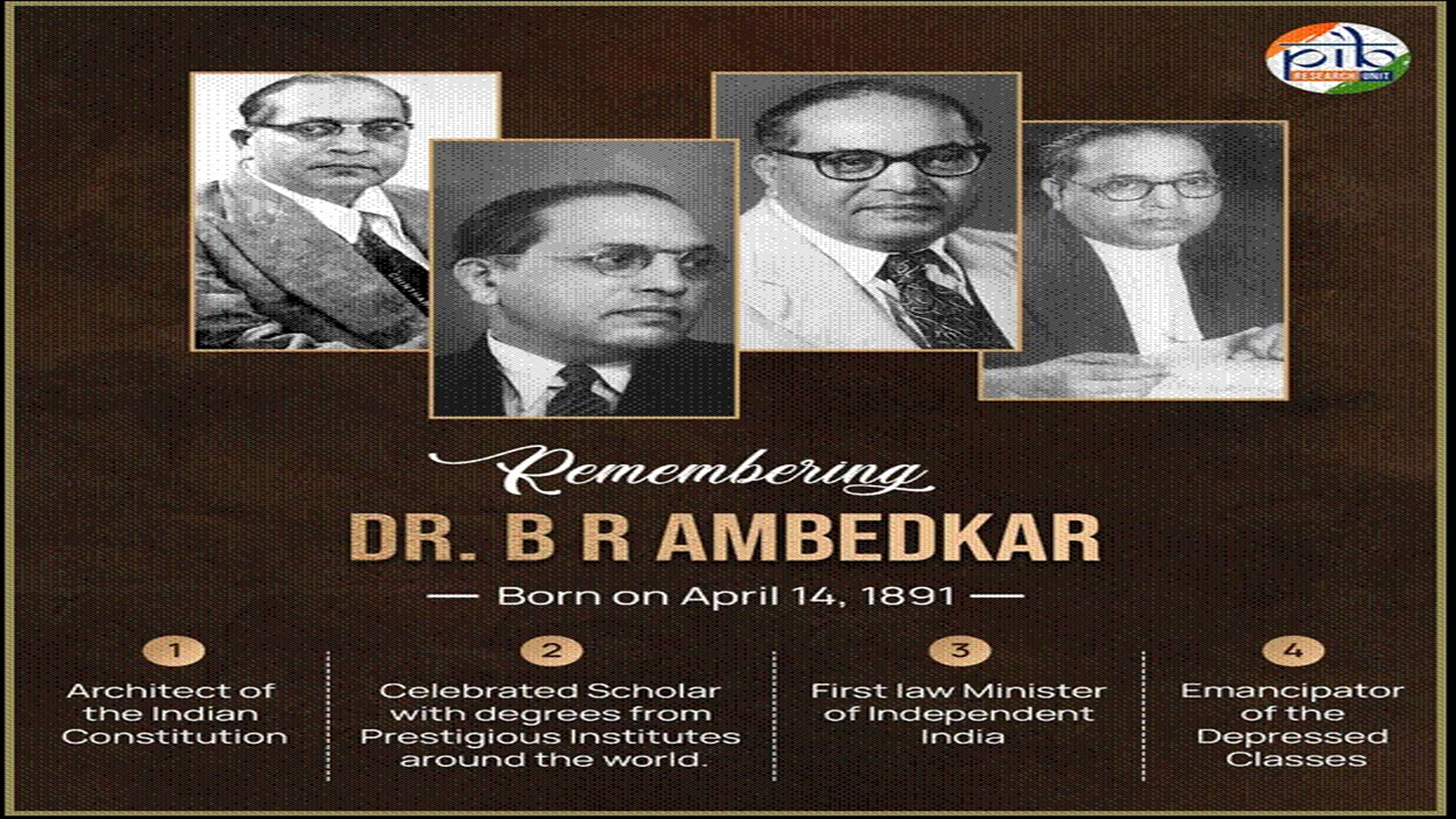
The nation remembers Dr. Bhimrao Ramji Ambedkar on his birth anniversary on April 14 every year, honouring a towering figure whose life and work transformed India’s social, political and constitutional landscape.
Born on April 14, 1891, in Madhya Pradesh’s Mhow, Ambedkar rose from humble beginnings as the fourteenth child of his parents to become one of the foremost intellectuals and nation-builders of India. His early life was marked by severe social discrimination due to the rigid caste system, yet his determination and brilliance helped him overcome these barriers.
A Scholar of Global Repute
Ambedkar’s academic journey remains extraordinary. After excelling at the University of Bombay, he pursued higher studies at Columbia University and later at the London School of Economics. He earned multiple doctorates, establishing himself as a distinguished economist, jurist and thinker.
His seminal works, including “The Evolution of Provincial Finance in British India” and “The Problem of the Rupee”, continue to influence economic thought. His early paper, “Castes in India: Their Mechanism, Genesis and Development,” remains a foundational critique of India’s caste system.
Champion of the Oppressed
Returning to India in 1923, Ambedkar dedicated his life to fighting social injustice. He founded the Bahishkrit Hitkarini Sabha to promote education and uplift marginalized communities.
His leadership in movements such as the Mahad Satyagraha (1927) and the Kalaram Temple Entry Movement (1930) marked historic milestones in the struggle for human rights and dignity. These efforts directly challenged practices like untouchability and social exclusion.
A defining political moment came with the Poona Pact between Ambedkar and Mahatma Gandhi, which replaced separate electorates with reservations for Scheduled Castes in legislatures and government jobs – reshaping India’s democratic framework.
Role in Freedom and Nation-Building
Ambedkar actively participated in the Round Table Conferences, where he forcefully advocated for the rights of the depressed classes.
After independence in 1947, he was appointed India’s first Law Minister in the cabinet of Jawaharlal Nehru. As Chairman of the Drafting Committee of the Constitution, Ambedkar played a pivotal role in shaping the Constitution of India.
Adopted in 1949, the Constitution enshrined principles of justice, liberty, equality and fraternity, with special provisions to safeguard the rights of Scheduled Castes, Scheduled Tribes and backward classes.
Vision for Social and Economic Democracy
Ambedkar believed that political democracy must be accompanied by social and economic equality. He advocated labour rights, land reforms, and women’s empowerment, and strongly opposed exploitative systems such as Jagirdari.
His economic ideas contributed to the establishment of key institutions, including the Reserve Bank of India, reflecting his deep understanding of financial systems.
Ambedkar’s final work, “The Buddha and His Dhamma,” encapsulated his philosophical vision.
On December 6, 1956, Ambedkar passed away, a day observed as Mahaparinirvan Diwas across India.
Enduring Legacy
Posthumously awarded the Bharat Ratna in 1990, Ambedkar’s legacy continues to inspire generations. His birth anniversary is celebrated nationwide as Ambedkar Jayanti, reaffirming his ideals of equality, justice and human dignity.
From a child facing discrimination to the principal architect of India’s Constitution, Dr. Ambedkar’s journey stands as a testament to the power of education, resilience and unwavering commitment to social reform.