







India has taken a major step in expanding its global economic partnerships with the signing of a comprehensive Free Trade Agreement (FTA) with New Zealand, a deal that promises to reshape bilateral trade, investment, and mobility frameworks while opening new opportunities across sectors. The agreement, signed at Bharat Mandapam in New Delhi by Commerce and Industry Minister Piyush Goyal and New Zealand’s Trade and Investment Minister Todd McClay on April 27, reflects the broader strategic vision of Prime Minister Narendra Modi to deepen ties with developed economies and position India as a key player in global trade.
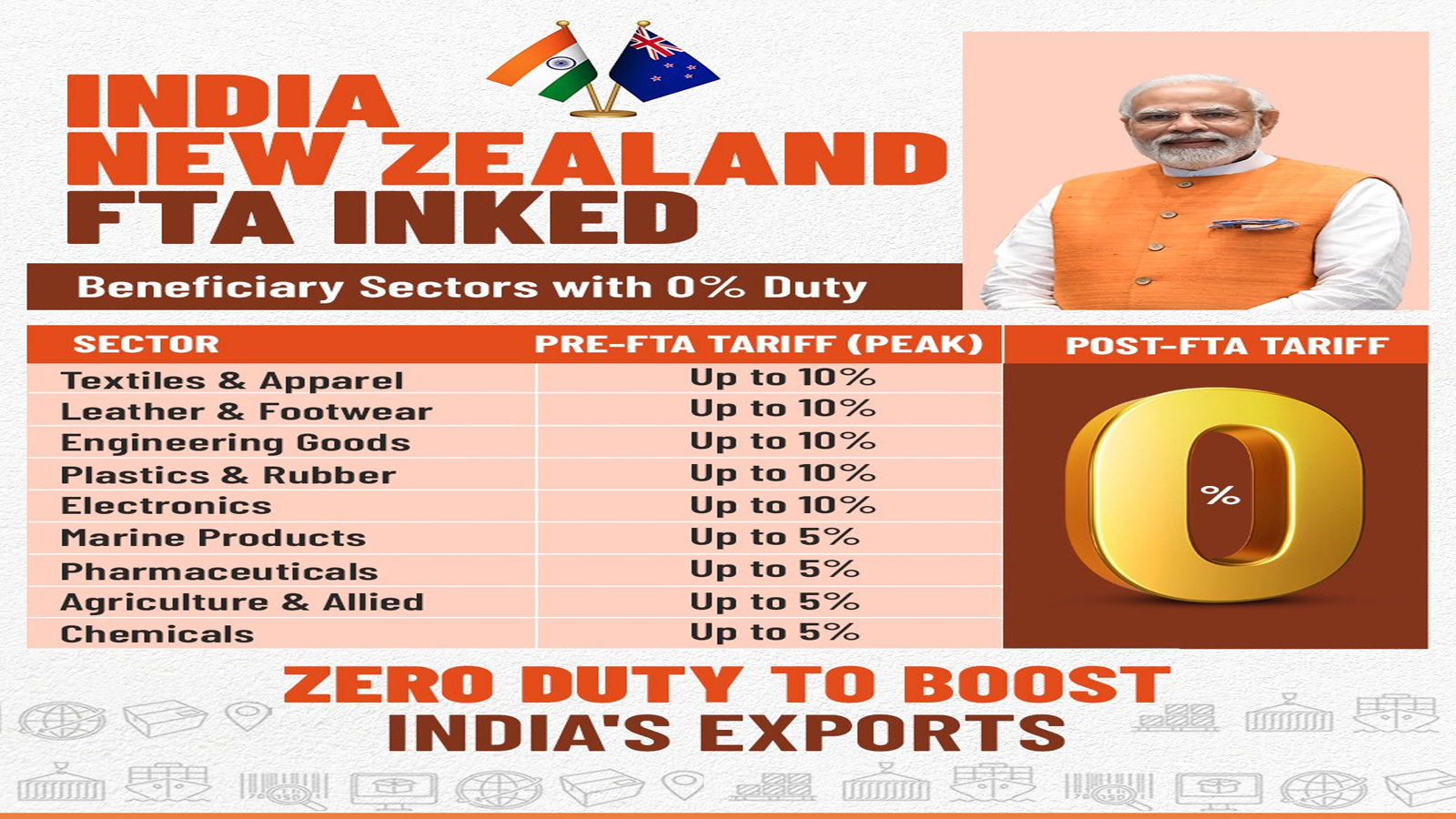
Described as a “once-in-a-generation” agreement by the New Zealand side, the pact introduces sweeping changes across goods, services, investment, and people-to-people exchanges. At its core lies an unprecedented commitment: New Zealand will provide 100% duty-free access to all Indian exports from the date the agreement comes into force.
This eliminates tariffs of up to 10% that previously applied to key products such as textiles, carpets, automobiles, and engineering goods, giving Indian exporters a level playing field and significantly enhancing their competitiveness.
Labour-intensive sectors including textiles, leather, footwear, gems and jewellery, and processed foods are expected to see strong growth, driving employment and strengthening MSMEs across India.
On the other side, India has adopted a calibrated liberalisation strategy. It has opened 70.03% of tariff lines, covering 95% of bilateral trade value, while excluding 29.97% of tariff lines to safeguard sensitive domestic sectors.
Dairy products, edible oils, sugar, onions, spices, and several agricultural and industrial items remain protected, reflecting a clear effort to balance trade expansion with the interests of farmers and domestic industry. Tariff elimination will be immediate for 30% of tariff lines, while 35.60% will see phased reductions over periods ranging from three to ten years, and a small share of products will fall under tariff rate quotas.
Agriculture has been handled with particular care, combining limited market access with productivity partnerships. Imports of products such as apples, kiwifruit, Mānuka honey, and milk albumin will be regulated through tariff rate quotas and minimum import prices to prevent market disruption.
For example, apple imports from New Zealand will start at 32,500 metric tonnes in the first year and rise to 45,000 metric tonnes by the sixth year, while kiwifruit imports will increase from 6,250 metric tonnes to 15,000 metric tonnes over the same period, with zero duty within quota. Mānuka honey, currently taxed at 66%, will see phased tariff reductions to 16.5% over five years.
These market access provisions are linked with the creation of Centres of Excellence for apples, kiwifruit, and beekeeping, as well as joint research, capacity building, and supply chain improvements aimed at boosting farmer productivity and incomes.
The agreement marks a significant breakthrough in services trade, an area of major strength for India. New Zealand has opened access to 118 service sectors, including computer-related services, professional services, telecommunications, construction, tourism, and education, while also offering Most-Favoured Nation treatment in about 139 sub-sectors. This is complemented by far-reaching mobility provisions.
A dedicated Temporary Employment Entry visa pathway will allow up to 5,000 Indian professionals to work in New Zealand for up to three years in sectors such as IT, engineering, healthcare, education, and even traditional professions like yoga and AYUSH practitioners. In a first, the agreement removes numerical caps on Indian students and provides post-study work rights of up to three years for STEM graduates and four years for doctoral scholars, along with permission to work 20 hours per week during studies. Additionally, 1,000 working holiday visas annually will promote youth mobility and cultural exchange.
Investment is another cornerstone of the deal, with New Zealand committing to facilitate USD 20 billion in investments into India. These investments are expected to flow into agriculture, manufacturing, infrastructure, startups, and emerging technologies, reinforcing India’s growth trajectory under initiatives such as Make in India.
The agreement also includes mechanisms to ensure accountability in delivering these investments, along with provisions for collaboration in innovation, renewable energy, and digital services.
Indian industry stands to benefit not only from export opportunities but also from cheaper inputs. The agreement allows duty-free imports of key raw materials such as wooden logs, coking coal, and metal scrap, which are essential for manufacturing. This is expected to lower production costs and strengthen India’s integration into global value chains.
In parallel, pharmaceutical and medical device exporters gain a major advantage through fast-track market access provisions. New Zealand will recognise approvals from global regulators such as the US FDA and European agencies, reducing duplication, lowering compliance costs, and speeding up product entry into the market.
The FTA also breaks new ground in intellectual property and cultural cooperation. New Zealand has committed to amending its Geographical Indications law within 18 months to allow registration of a broader range of Indian products, supporting rural artisans and traditional industries.
A dedicated chapter on culture and traditional knowledge promotes cooperation in areas such as AYUSH systems, audiovisual industries, sports, and tourism. For the first time, India’s traditional medicine systems – including Ayurveda and Yoga – will gain structured access in a trade agreement, enhancing India’s global leadership in wellness services.
Trade facilitation measures further modernise the framework, with commitments to clear standard cargo within 48 hours and perishable goods within 24 hours, alongside paperless systems and single-window clearances. These steps are expected to reduce transaction costs and improve ease of doing business.
The agreement also includes robust rules of origin, safeguard measures, and regulatory cooperation under sanitary and phytosanitary and technical barriers to trade provisions, ensuring both trade expansion and domestic protection.
The broader economic context underscores the significance of the agreement. Bilateral trade between India and New Zealand reached USD 2.4 billion in 2024, with merchandise trade at USD 1.3 billion in 2024-25, marking a 49% increase over the previous year.
India’s trade with the Oceania region stood at approximately USD 26 billion, with New Zealand emerging as a key partner. With tariffs eliminated, services expanded, and investment flows strengthened, the FTA is expected to accelerate this momentum substantially.
The benefits of the agreement are likely to be widely distributed across India’s economic landscape. Export-oriented states such as Gujarat, Maharashtra, Tamil Nadu, Uttar Pradesh, Karnataka, and West Bengal are poised to gain from improved market access in sectors ranging from textiles and leather to pharmaceuticals and engineering goods.
Coastal states may see a boost in marine exports, while the North-East could benefit from increased demand for tea, spices, bamboo, and organic products. MSMEs, startups, women entrepreneurs, and farmers are expected to gain from enhanced global integration and reduced trade barriers.
Negotiated in just nine months across five formal rounds, the India–New Zealand FTA stands out as one of the fastest trade agreements concluded by India with a developed country. It reflects not just economic ambition but also a strategic alignment between two democracies seeking resilient supply chains, diversified partnerships, and deeper engagement in the Indo-Pacific region.
As both countries move toward ratification and implementation, the agreement is set to become a cornerstone of a modern, inclusive, and forward-looking economic partnership.


