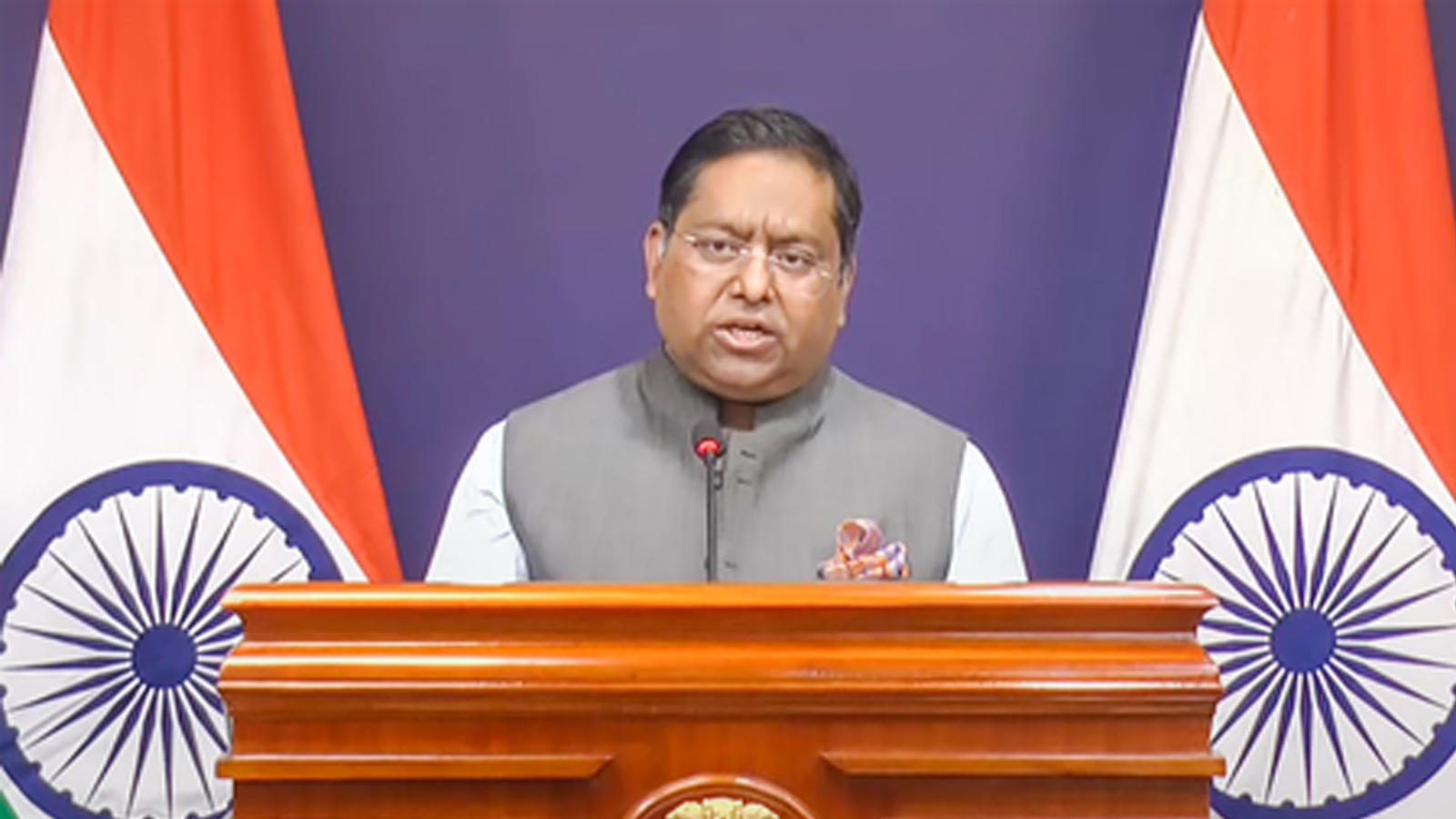
India on Wednesday welcomed the ceasefire agreement between the United States and Iran, expressing hope that the development would pave the way for lasting peace and stability in West Asia.
The Ministry of External Affairs (MEA) said, “We welcome the ceasefire reached and hope that it will lead to a lasting peace in West Asia. As we have continuously advocated earlier, de-escalation, dialogue and diplomacy are essential to bring an early end to the ongoing conflict.”
“The conflict has already caused immense suffering to people and disrupted global energy supply and trade networks. We expect that unimpeded freedom of navigation and global flow of commerce would prevail through the Strait of Hormuz,” the MEA added.
The ceasefire announcement came after US President Donald Trump declared a conditional two-week suspension of military operations against Iran.
In a post on Truth Social, Trump said that the United States would pause its “bombing and attack” campaign if Iran agreed to the “complete, immediate, and safe opening” of the Strait of Hormuz. He described the move as a “double-sided ceasefire,” noting that Washington had already met its key military objectives.
“The reason for doing so is that we have already met and exceeded all Military objectives, and are very far along with a definitive agreement concerning long-term peace with Iran, and peace in the Middle East,” Trump said, adding that a 10-point proposal from Iran provided a workable basis for negotiations.
Iran responded positively to the overture. Iranian Foreign Minister Seyed Abbas Araghchi indicated that Tehran would halt its military operations if attacks against it ceased.
“If attacks against Iran are halted, our powerful armed forces will cease their defensive operations,” Araghchi said, adding that safe passage through the Strait of Hormuz would be ensured for two weeks through coordination with Iranian forces, subject to technical considerations.
The ceasefire, however, remains conditional and temporary, with both sides using the two-week window to negotiate a more permanent agreement.
Diplomatic efforts are set to continue, with talks scheduled in Islamabad between the Iranian delegation led by Mohammad Bagher Ghalibaf and the US delegation headed by Vice President JD Vance.
The development has been widely seen as a significant step toward de-escalation in a region that plays a crucial role in global energy security. India, like many countries, is closely monitoring the situation, given its dependence on energy imports and the strategic importance of stability in West Asia.
(With agency inputs)