India’s fisheries sector is undergoing a significant transformation, marked by record budgetary support, rising production, and expanding institutional frameworks aimed at strengthening livelihoods and boosting global competitiveness.
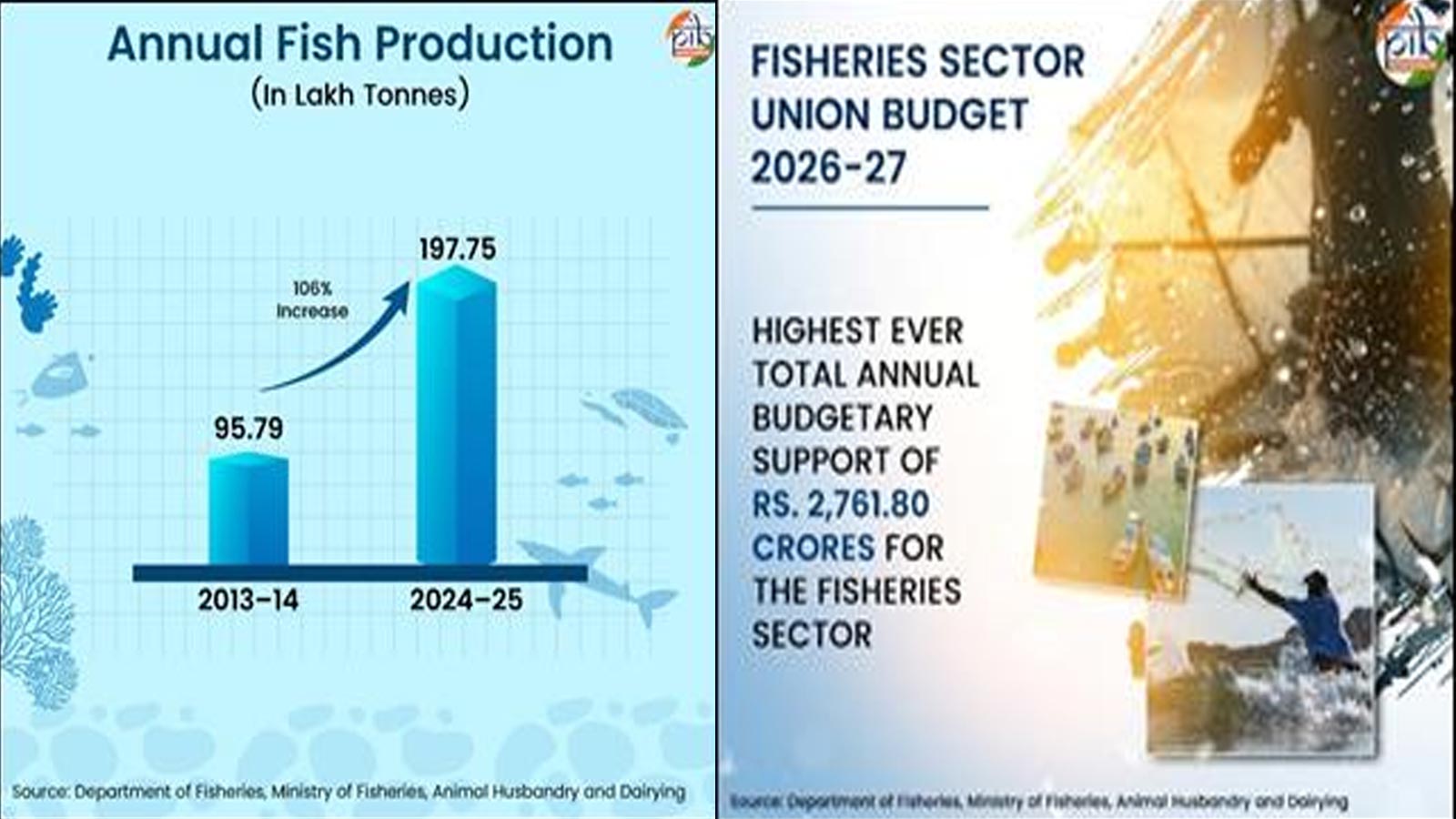
The Union Budget 2026-27 has proposed the highest-ever allocation of ₹2,761.80 crore for the sector, underlining its growing importance in the country’s economic and food security framework. Of this, ₹2,500 crore has been earmarked for the flagship Pradhan Mantri Matsya Sampada Yojana (PMMSY), which continues to anchor the sector’s development.
India has consolidated its position as the world’s second-largest fish producer, contributing nearly 8% of global output. Fish production has more than doubled over the past decade – from 95.79 lakh tonnes in 2013-14 to 197.75 lakh tonnes in 2024-25 – reflecting a growth of 106%. The surge has been accompanied by robust export performance, with seafood exports reaching ₹62,408 crore, driven largely by frozen shrimp shipments to key markets such as the United States and China.
The fisheries sector now contributes around 7.43% to the Agricultural Gross Value Added (GVA), the highest among allied agricultural sectors. This growth is being supported by sustained policy interventions and investments across the value chain, from production and processing to marketing and export facilitation.
Policy Push Driving Structural Transformation
The sector’s evolution has been shaped by a series of policy initiatives over the past decade. Beginning with the Blue Revolution in 2015, the government has steadily moved towards a more structured, technology-driven and sustainability-focused approach.
The launch of PMMSY in 2020 marked a major milestone, introducing a comprehensive framework to enhance productivity, modernise infrastructure, and improve governance. Complementing this, the Fisheries and Aquaculture Infrastructure Development Fund (FIDF) has supported the development of fishing harbours, cold chains, and processing units, while facilitating concessional financing.
The Pradhan Mantri Matsya Kisan Samridhi Sah-Yojana (PM-MKSSY), introduced in 2023–24, has further strengthened financial inclusion, insurance coverage, and formalisation across the sector.
Technology and Innovation at the Core
Modern aquaculture technologies are increasingly being adopted to boost efficiency and sustainability. Systems such as Recirculatory Aquaculture Systems (RAS) and bio-floc technology are enabling high-density fish farming with optimal resource use.
As of March 2026, over 12,000 RAS units and more than 4,200 bio-floc units have been approved under PMMSY, reflecting a growing shift towards technology-driven practices.
Artificial intelligence, digital platforms, and advanced analytics are also being integrated into fisheries management, improving traceability, monitoring, and decision-making.
Strengthening Financial Security and Inclusion
Efforts to enhance financial resilience among fishers have yielded notable results. The extension of the Kisan Credit Card (KCC) scheme to fisheries has benefited over 4.39 lakh fishers, while insurance coverage has reached 3.3 million beneficiaries.
Additionally, livelihood support during lean fishing periods has assisted around 7.44 lakh fisher families, ensuring income stability and social protection.
Institutional strengthening has also been a focus area, with the formation of over 2,195 Fisheries Farmer Producer Organizations (FFPOs), improving market access and collective bargaining power.
Digital Governance and Data-Driven Growth
The launch of the National Fisheries Digital Platform (NFDP) in 2024 marks a significant step towards digital governance. The platform has already registered over 30 lakh stakeholders and integrates services such as credit access, insurance, and performance-based incentives.
Meanwhile, the Marine Fisheries Census 2025 has introduced a fully digital, geo-referenced data collection system, enabling more precise policy planning and targeted interventions.
Expanding Infrastructure and Value Chains
Infrastructure development continues to be a key priority. Under FIDF, 225 projects worth ₹6,685.78 crore have been approved, creating modern facilities for fish landing, processing, and storage.
Initiatives such as Mission Amrit Sarovar are also integrating fisheries into water body development, promoting inland aquaculture and livelihood diversification.
India’s extensive coastline and Exclusive Economic Zone (EEZ) are being leveraged through sustainable fishing practices, supported by newly notified regulations for responsible resource management.
Towards a Sustainable Blue Economy
With nearly three crore people dependent on the sector, fisheries play a crucial role in employment generation and rural livelihoods. The government’s focus on sustainability, traceability, and regulatory compliance is aligned with global standards and the Sustainable Development Goals (SDGs), particularly SDG 14 (Life Below Water).
As India continues to scale up investments, adopt modern technologies, and strengthen institutional frameworks, the fisheries sector is poised to emerge as a key driver of inclusive growth and a cornerstone of the country’s blue economy.