







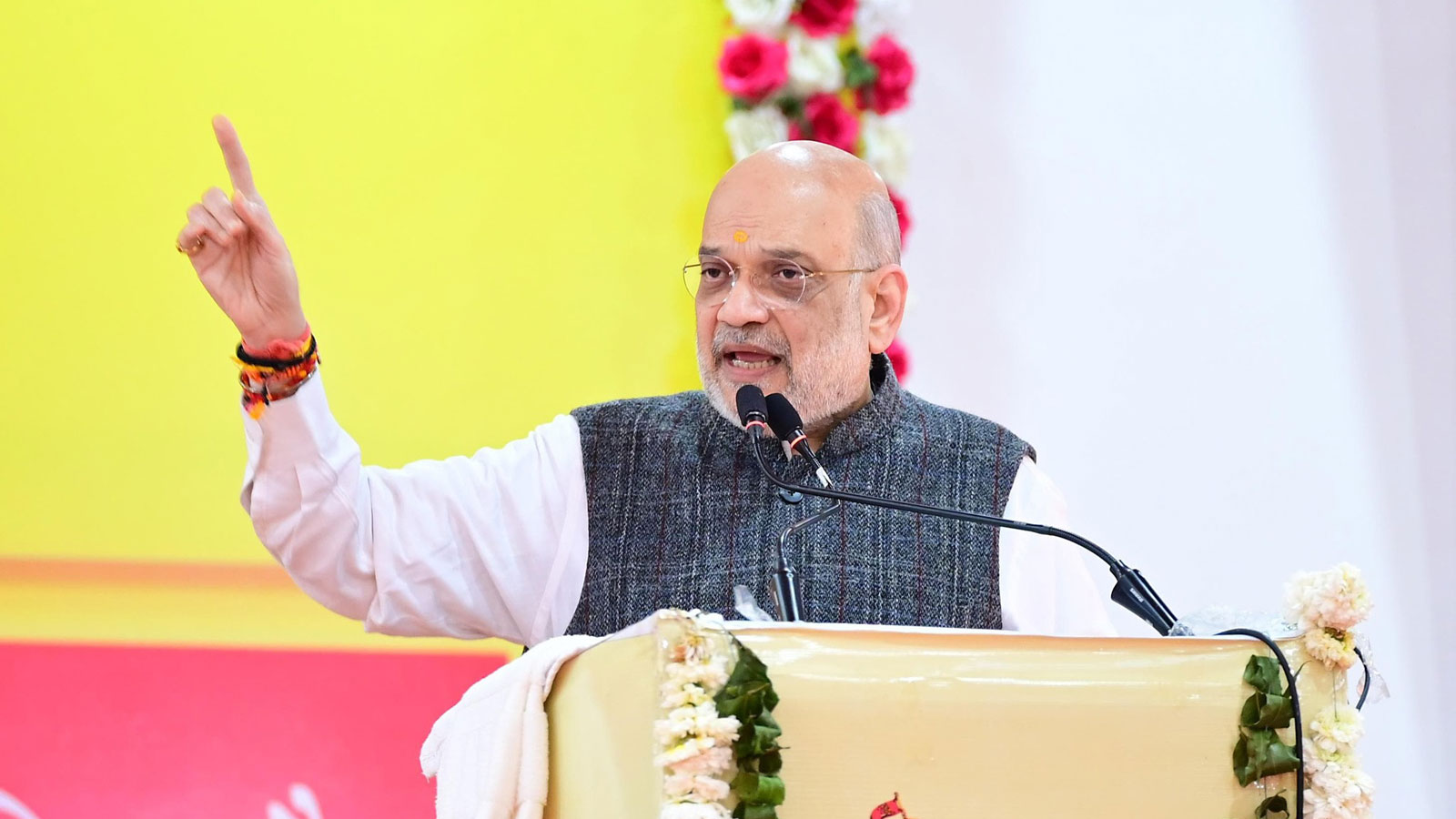
Union Home Minister Amit Shah on Monday declared that India has become “Naxal-free”, asserting that the Narendra Modi government achieved in just three to four years what once appeared impossible even over decades.
Addressing families of martyrs, Central Armed Police Forces (CAPFs) personnel, and victims of Naxal violence in Jagdalpur, Chhattisgarh, HM Shah said the country had finally overcome one of its biggest internal security challenges after six decades of violence and underdevelopment in Naxal-affected regions.
“I can proudly say today that India has now become free from Naxalism,” HM Shah said, adding that the success was made possible by the sacrifices of thousands of security personnel and the resilience of tribal communities.
The Union Home Minister said the campaign to eradicate Naxalism would be remembered through three key dates – January 21, 2024, August 24, 2024, and March 31, 2026.
“After the formation of our government in Chhattisgarh, the first major meeting on Naxalism was held on January 21, 2024. On August 24, 2024, we resolved to eliminate Naxalism by March 31, 2026, and we fulfilled that pledge before the deadline,” HM Shah said.
He said that the Narendra Modi government had successfully addressed the country’s three major internal security challenges – Jammu and Kashmir, the Northeast, and Naxalism.
“Kashmir, the Northeast, and Naxalism – the Narendra Modi government has triumphed over all three challenges and firmly put the country on the path of development,” he added.
HM Shah credited the success of anti-Naxal operations to the combined efforts of the CRPF, BSF, ITBP, SSB, Chhattisgarh Police, District Reserve Guard (DRG), Special Task Force (STF), Bastar Fighters, CoBRA commandos, and police forces from several states.
“The greatest contribution to making India Naxal-free comes from our brothers and sisters in the DRG and our brave CoBRA commandos,” he said.
The Home Minister also launched the “Shaheed Veer Gunda Dhur Seva Dera” project in Bastar and announced that 70 out of nearly 200 CAPF camps in Chhattisgarh would be transformed into development-oriented service centres for tribal communities.
These centres, he said, would provide access to over 370 government schemes, including Aadhaar and ration card services, banking facilities, healthcare support, agricultural guidance, skill development, and adult education programmes.
HM Shah said the initiative would send a strong message that development, not violence, was the path forward for Bastar.
“Maoism did not spread because there was no development; rather, armed Naxals themselves obstructed development,” he said.
HM Shah added that the government’s objective was not merely to eliminate Naxals but to ensure that development and welfare reached every tribal household in Bastar.
The Home Minister said Bastar’s art, music, dance, cuisine, and traditions had suffered under Naxal violence but were now witnessing “a new dawn.”
“Over the next five years, Bastar is set to emerge as the most developed tribal region in the country,” he said.
HM Shah also spoke about rehabilitation efforts for surrendered Naxals, stating that around 3,000 former cadres would receive skill training, education, and support to reintegrate into mainstream society with dignity.
“A detailed rehabilitation plan has been prepared and ₹20 crore allocated initially for their skilling and education,” he said.
Recalling his interaction with tribal residents in Netanar village, HM Shah said the experience gave him “far greater inner satisfaction” than addressing massive political rallies.
“I derived far greater inner satisfaction from interacting with 400 tribal people in Netanar village in Bastar than addressing rallies of hundreds of thousands,” he said.
The Home Minister praised the sacrifices made by security forces during major anti-Naoist operations such as Operation Black Forest, Operation Prahar, Operation Octopus, and Operation Double Bull.
He said these operations dismantled Maoist strongholds stretching from Jharkhand and Bihar to Bastar and Telangana and paved the way for peace and development in the region.
HM Shah assured the people of Bastar that innocent tribal families would no longer suffer violence, schools would remain functional, electricity supply would improve, and welfare benefits would reach directly into bank accounts.
He also highlighted initiatives such as the Bastar Olympics and Bastar Pandum, aimed at reviving and promoting Bastar’s cultural heritage and tribal identity.


