







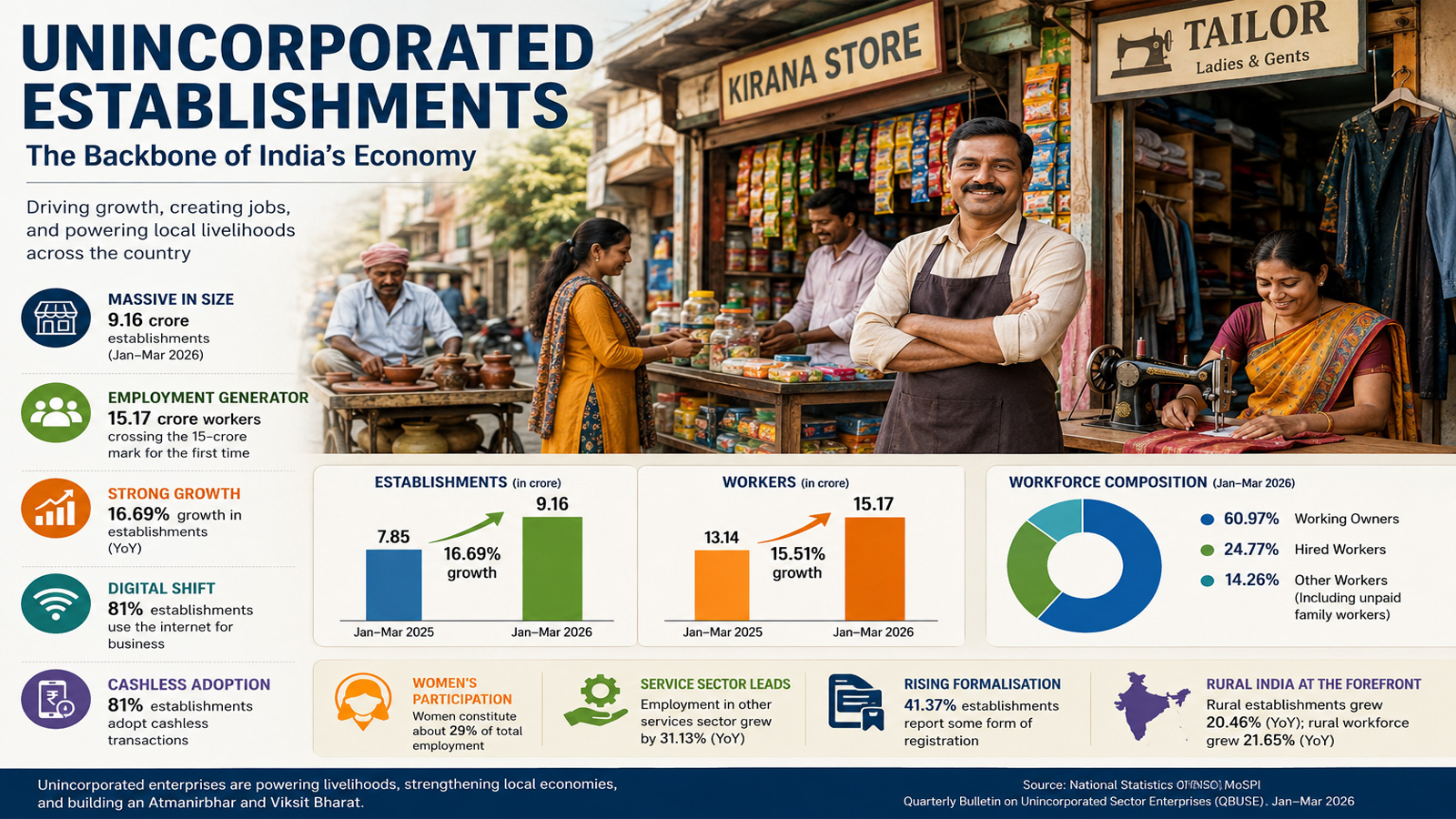
India’s vast unincorporated non-agricultural sector has registered strong growth momentum, with the number of establishments crossing 9 crore and employment surpassing the 15-crore mark for the first time, according to the latest Quarterly Bulletin on Unincorporated Sector Enterprises (QBUSE) released by the National Statistics Office (NSO).
The data for the January-March 2026 quarter paints a picture of a rapidly expanding grassroots economy increasingly driven by rural entrepreneurship, services-sector growth and accelerating digital adoption.
The estimated number of unincorporated establishments rose to 9.16 crore during the quarter, marking a robust year-on-year growth of 16.69 per cent compared to 7.85 crore in the same quarter last year. Rural India emerged as the primary engine of this expansion, recording a significant 20.46 per cent growth, while urban areas posted a 12.59 per cent increase.
Employment in the sector also witnessed a sharp rise, crossing 15 crore for the first time to reach an estimated 15.17 crore workers — a 15.51 per cent increase over the corresponding period of the previous year.
The NSO noted that the services segment has become the biggest growth driver within the unincorporated economy. The number of establishments in the sector increased by 24.82 per cent, while employment surged by over 31 per cent, reflecting rising demand for local services and growing entrepreneurial activity across the country.
The report highlighted the increasing role of the unincorporated sector in supporting rural livelihoods and local economic ecosystems. Rural workforce growth stood at 21.65 per cent, more than double the urban growth rate of 10.39 per cent.
A changing workforce composition also emerged from the survey findings. Working owners accounted for nearly 61 per cent of the total workforce, up from 58.29 per cent a year ago, indicating a rise in self-employment and owner-driven enterprises. Meanwhile, the share of hired workers dipped marginally to 24.77 per cent.
According to the NSO, many unincorporated businesses depend on seasonal and migrant labour, with workers frequently moving between agricultural activities and small enterprises depending on economic conditions and local demand cycles.
One of the most striking findings of the quarterly survey was the rapid digital transformation taking place within the sector. Around 81 per cent of establishments reported using the internet for entrepreneurial purposes, while a similar proportion adopted cashless transaction methods such as UPI, online banking and point-of-sale systems.
The findings suggest that digital infrastructure and financial technology are increasingly reshaping India’s informal and semi-formal business ecosystem, helping enterprises expand market access, improve efficiency and integrate more closely with formal economic networks.
The survey also showed increasing formalisation, with over 41 per cent of establishments reporting some form of official registration.
Women continued to maintain a significant presence in the sector, accounting for nearly 29 per cent of total employment, underlining the role of small enterprises in supporting women’s economic participation and livelihood generation.
The quarterly bulletin is part of the NSO’s broader effort to provide high-frequency economic indicators through the Annual Survey of Unincorporated Sector Enterprises (ASUSE), launched in 2021–22. The survey captures trends across manufacturing, trade and services establishments in the unincorporated non-agricultural economy, excluding construction.
Data for the latest quarter was collected through Computer Assisted Personal Interviewing (CAPI) using tablet-based surveys across nearly 6,000 first-stage units nationwide, covering more than 1.72 lakh establishments in rural and urban India.
The NSO said the quarterly estimates should be interpreted with caution because of smaller sample sizes and recent classification changes under NIC 2025. However, the survey continues to offer important insights into one of the country’s largest employment-generating segments and a key contributor to local entrepreneurship, supply chains and economic activity.


