







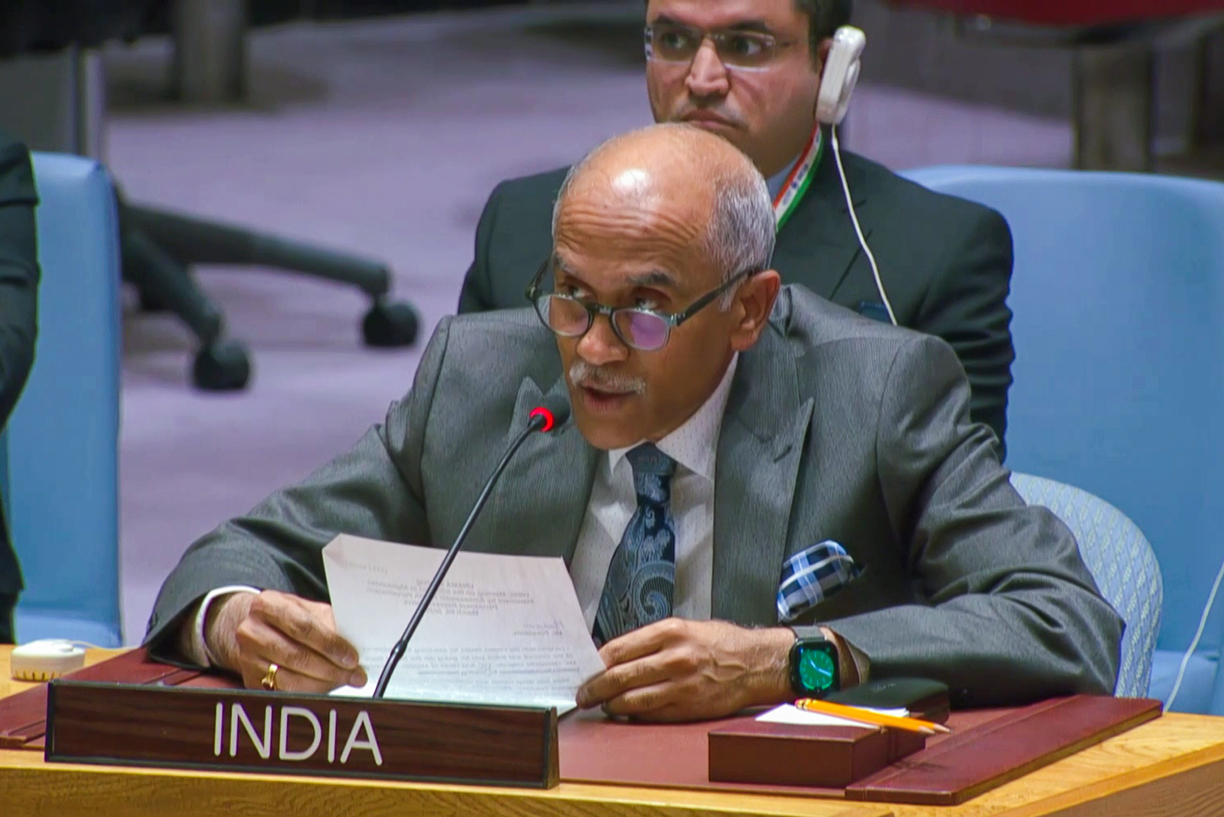
India’s Permanent Representative to the United Nations, Parvathaneni Harish, has reaffirmed India’s commitment to supporting the Afghan people, highlighting the country’s humanitarian and development assistance amid Afghanistan’s ongoing challenges.
Speaking at the UNAMA briefing during a UN Security Council meeting on the situation in Afghanistan, Harish described India and Afghanistan as “contiguous neighbours” and “civilizational states” linked by centuries-old ties.
“India and Afghanistan are contiguous neighbors, and as civilizational states, our ties have spanned centuries. Our history of close cooperation continues to guide our modern-day relationship. The proud people of Afghanistan have endured a lot in this century, and the Government of India will continue to stand in favor of peace and stability to foster development in this nation,” he said.
Harish noted that India’s participation in the Doha Working Group meetings and its strong bilateral development partnership reflected its continued support for Afghanistan.
He said India’s humanitarian and capacity-building initiatives extend across all 34 provinces of Afghanistan through more than 500 development projects, focusing on healthcare, public infrastructure, and skill development.
“We are intensifying our cooperation with UN agencies, as well as others such as the Afghan Red Cross Society, in priority areas for the Afghan people. The visits to India of Afghan ministers last year ensured the necessary planning and coordination so that our support reaches the intended beneficiaries,” he said.
Highlighting recent assistance, Harish said India delivered three tonnes of specialised flood relief supplies in April 2026, including kitchen sets, hygiene kits, plastic sheets, tarpaulins, and sleeping bags for communities affected by floods.
He also noted that India recently supplied 33 tonnes of BCG, tetanus, and diphtheria vaccines, along with related materials, to strengthen Afghanistan’s child immunisation programme.
“It gives us great satisfaction to report that Afghan children suffering from acute congenital heart diseases are now being treated in India,” he said.
Harish said India’s support for Afghan women and children includes the establishment of maternity clinics in rural areas of Paktika, Khost, and Paktia, the upgradation of the Indira Gandhi Institute of Child Health, and the construction of oncology and trauma centres in Kabul.
He thanked partner organisations, including UNICEF and the Afghan Red Cross Society, for supporting healthcare initiatives in the country.
According to Harish, the planned installation of advanced medical equipment in hospitals, along with the construction of a 30-bed hospital in Kabul and a thalassemia centre in Herat, will further strengthen healthcare services in Afghanistan.
Detailing India’s broader humanitarian assistance, he said that since August 2021, India has supplied more than 50,000 tonnes of wheat, 420 tonnes of medicines and vaccines, including anti-cancer medicines and treatments for vector-borne diseases, as well as 40,000 litres of pesticide.
Referring to the earthquakes that struck Afghanistan last year, Harish said India was among the first countries to respond, providing 60 tonnes of food aid, 42 tonnes of earthquake relief materials, and 73 tonnes of essential medicines.
He added that, in partnership with the UN Office on Drugs and Crime, India had also supplied 68 tonnes of medical aid and 34 tonnes of social support materials for the rehabilitation of people affected by drug addiction.
On education, Harish said India’s scholarship and fellowship programmes continue to attract strong interest from Afghan students.
“Since 2023, about 3,000 students have availed themselves of these opportunities, including 1,000 Afghan women. Another 1,000 scholarships will soon be offered for undergraduate and master’s degree programmes,” he said.
He added that India continues to provide financial and logistical support to women-led self-help groups in Afghanistan.
-ANI


