









From legislative reforms and intelligence integration to cross-border operations and global diplomacy, India’s counter-terrorism strategy has undergone a sweeping transformation over the past 12 years. The government says the results are visible in declining terror incidents, reduced casualties, stronger institutions, and a more secure environment for development and growth.
A Shift from Reaction to Prevention
When the Narendra Modi-led government assumed office in 2014, India faced a complex and deeply entrenched security challenge. Terrorism, insurgency, separatist violence, and cross-border infiltration posed persistent threats across multiple regions, particularly Jammu and Kashmir.
According to official figures, more than 7,200 terrorist incidents were recorded between 2004 and 2014, while nearly 92,000 people had lost their lives over four decades due to terrorism, extremism, and insurgency-related violence.
Against this backdrop, the government adopted a policy of “zero tolerance” towards terrorism, seeking not merely to respond to attacks but to dismantle the ecosystem that sustains them. Over the next twelve years, this approach evolved into a comprehensive national security framework built on stronger laws, modern institutions, intelligence integration, decisive military responses, and international cooperation.
Four Pillars of a New Counter-Terror Framework
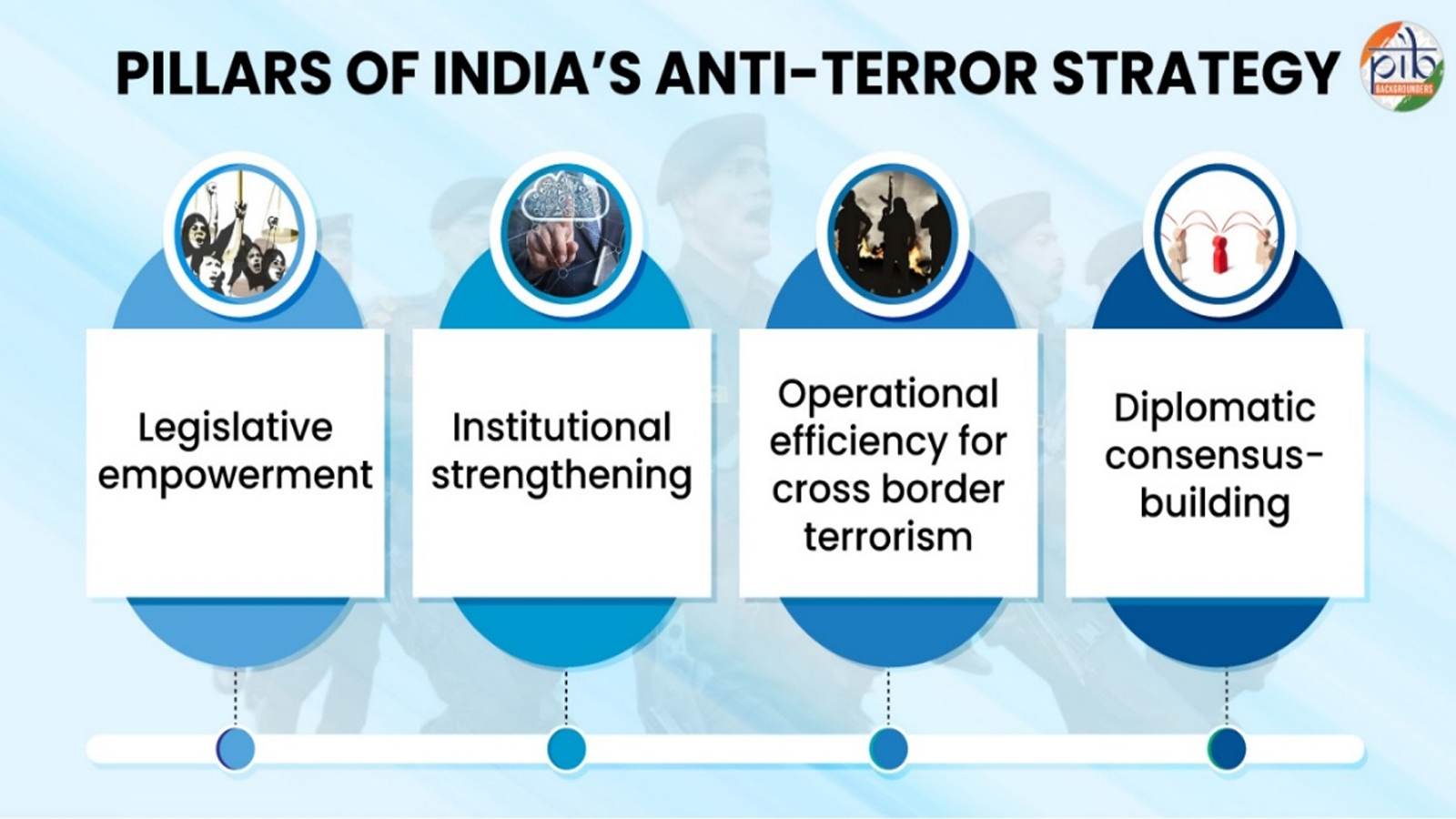
The government’s counter-terrorism strategy rests on four broad pillars: legislative empowerment, institutional strengthening, operational action against cross-border terrorism, and multilateral diplomatic engagement.
Together, these measures have culminated in the formulation of PRAHAAR, India’s National Counter-Terrorism Policy and Strategy, which seeks to formalise and consolidate practices developed over the past decade.
Stronger Laws, Sharper Tools
One of the most significant aspects of India’s counter-terror transformation has been the strengthening of legal frameworks.
The Unlawful Activities (Prevention) Amendment Act, 2019 empowered the government to designate individuals, and not just organisations, as terrorists. The amendment also expanded the powers of the National Investigation Agency (NIA) and enhanced the government’s ability to seize assets linked to terrorism.
Since the amendment came into force, more than 57 individuals have been designated as terrorists, including leaders of internationally proscribed organisations and key figures associated with separatist and extremist movements.
The National Investigation Agency (Amendment) Act, 2019 broadened the agency’s jurisdiction to include offences such as cyber terrorism, human trafficking linked to terror activities, and crimes committed outside India that affect Indian interests.
Further legal reforms included strengthening provisions under the Prevention of Money Laundering Act (PMLA) to target terror financing networks and the introduction of the Bharatiya Nyaya Sanhita (BNS), 2023, which for the first time explicitly defines terrorism and organised crime within India’s criminal code.
The Arms (Amendment) Act, 2019 also tightened penalties for illegal weapons trafficking and sought to disrupt supply chains that fuel terrorist and insurgent groups.
Building Modern Security Institutions
The second pillar of India’s counter-terror strategy has focused on strengthening institutions responsible for intelligence gathering, investigation, and law enforcement.
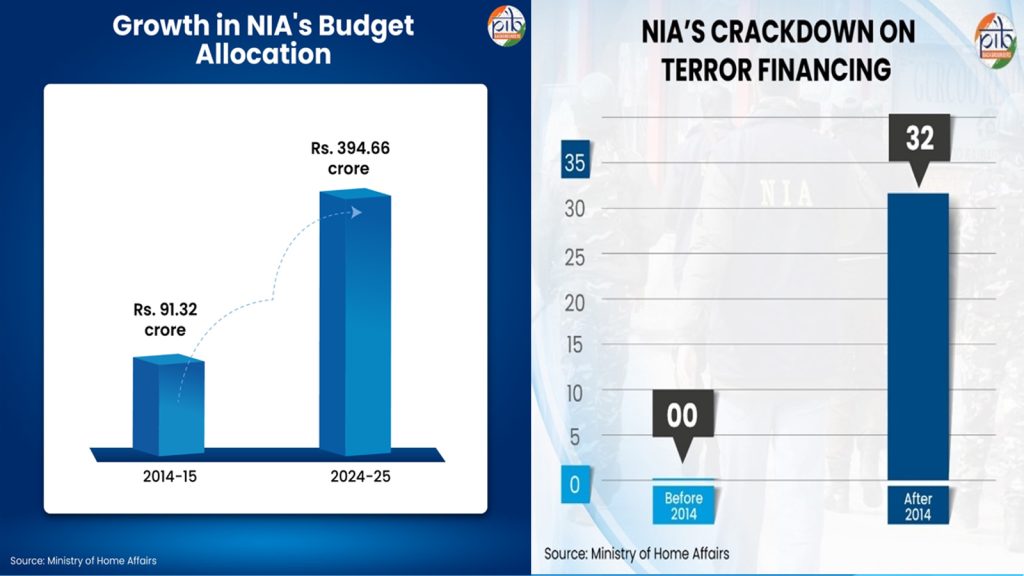
The National Investigation Agency (NIA), established after the 2008 Mumbai terror attacks, has seen a significant expansion in resources and operational reach. Its budget has increased more than fourfold over the past decade, while a nationwide network of special NIA courts has been created to expedite terror-related trials.
The agency now operates through 21 branch offices across the country and has invested heavily in training, data analytics, and forensic capabilities. The government points to the NIA’s conviction rate of over 92 per cent as evidence of its growing effectiveness.
Parallel efforts have strengthened the Multi-Agency Centre (MAC), which serves as the country’s central platform for intelligence sharing among 28 central and state agencies. Recent investments have enhanced its technological infrastructure, incorporating artificial intelligence and machine learning tools to improve threat detection and intelligence analysis.
The creation of the Cyber Multi-Agency Centre (CyMAC) in 2025 reflects growing recognition of cyber threats, online radicalisation, and digital terror financing.
The National Intelligence Grid (NATGRID) has also emerged as a critical component of the security architecture, integrating databases related to immigration, banking, telecommunications, and travel to support intelligence-led investigations.
Meanwhile, the nationwide rollout of the Crime and Criminal Tracking Network and Systems (CCTNS) has enabled seamless sharing of criminal and terror-related data among police forces across states.
A New Doctrine on Cross-Border Terrorism
Perhaps the most visible change in India’s counter-terror posture has been its response to cross-border terrorism.
The government’s security doctrine evolved significantly following major terror attacks during the past decade.
In September 2016, Indian forces conducted surgical strikes across the Line of Control following the Uri terror attack, targeting launch pads used by terrorists preparing to infiltrate into India.
Three years later, after the Pulwama attack claimed the lives of 40 CRPF personnel, India carried out the Balakot airstrike, targeting a major Jaish-e-Mohammed training facility in Pakistan.
The doctrine was reinforced again in 2025 through Operation Sindoor, launched after the Pahalgam terrorist attack. The operation targeted terrorist infrastructure in Pakistan and Pakistan-occupied Jammu and Kashmir.
Together, these actions signalled a shift from strategic restraint to a policy of calibrated and proactive responses against cross-border terrorism.
Taking the Fight to Global Platforms
Recognising that terrorism is a transnational challenge, India has simultaneously expanded its diplomatic efforts to build international consensus against terrorism and terror financing.
India has actively leveraged platforms such as the Financial Action Task Force (FATF) to highlight concerns over terror financing and push for greater accountability. It has also established a dedicated Combating Financing of Terrorism Cell within the Ministry of Home Affairs (MHA).
The country hosted the No Money for Terror Ministerial Conference in New Delhi in 2022, where it outlined a six-pillar strategy to counter terror financing and called for stronger global cooperation.
India has also continued to advocate for the adoption of the Comprehensive Convention on International Terrorism (CCIT) at the United Nations, a proposal first introduced by New Delhi in 1996.
A notable diplomatic success came in 2019 when Jaish-e-Mohammed chief Masood Azhar was designated a global terrorist by the United Nations Security Council after years of diplomatic efforts.
The extradition of Tahawwur Rana, an accused conspirator in the 2008 Mumbai terror attacks, from the United States in 2025 marked another milestone in international counter-terror cooperation.
India today maintains dedicated counter-terrorism dialogues and joint working groups with dozens of countries and multilateral organisations, including the United States, United Kingdom, European Union, BRICS, BIMSTEC, and the Shanghai Cooperation Organisation.
Measuring the Impact
The government said that the success of these reforms is reflected in measurable improvements across several security indicators.
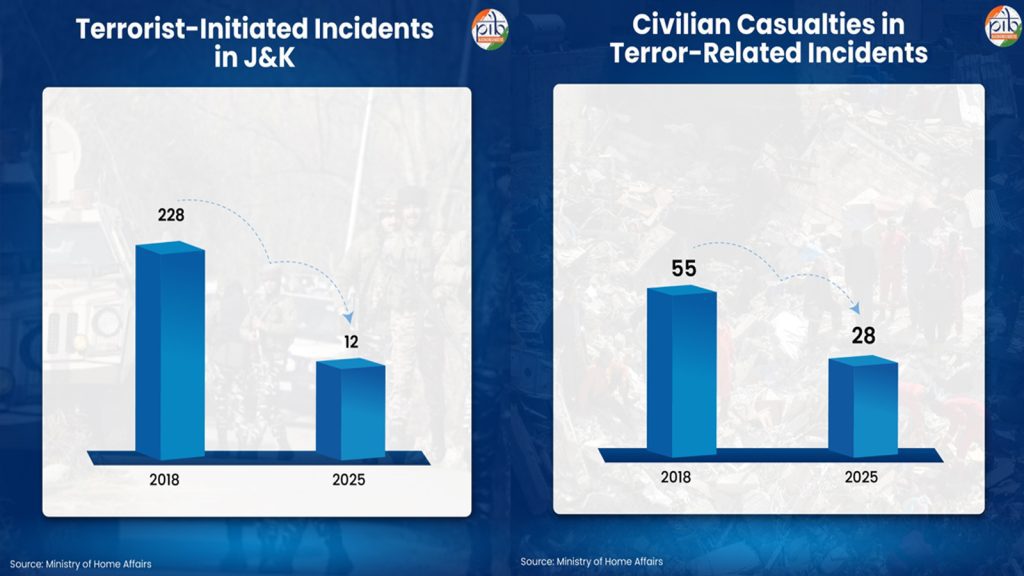
In Jammu and Kashmir, terrorist incidents reportedly declined from 7,217 during 2004–2014 to 2,242 between 2014 and 2024. Terrorist-initiated incidents fell sharply from 228 in 2018 to just 12 in 2025.
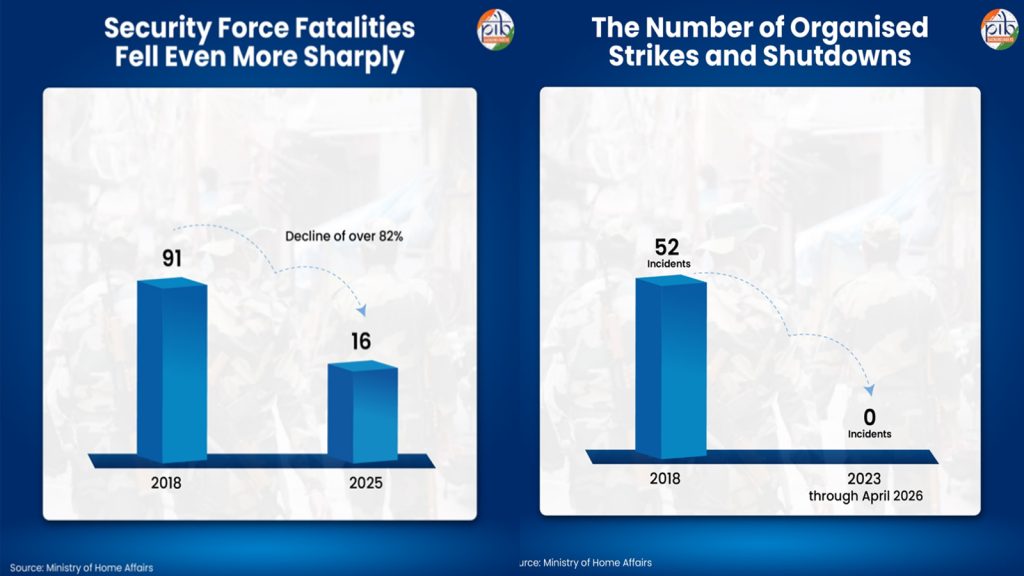
Civilian casualties and security force fatalities have also declined significantly. Security personnel deaths dropped from 91 in 2018 to 16 in 2025, while civilian fatalities fell by nearly half during the same period.
Stone-pelting incidents, once a recurring feature of unrest in Kashmir, have almost disappeared. Official data indicates that such incidents have remained near zero since 2022.
The government said improved security conditions have also coincided with increased development activity. More than ₹80,000 crore worth of major development projects have been approved in Jammu and Kashmir, while investment inflows have accelerated.
Tourism has emerged as one of the clearest indicators of changing ground realities. The Union Territory recorded more than 2.3 crore tourist arrivals in 2024, the highest in its history.
The government also points to the near absence of major urban terrorist attacks in mainland India over the past decade. Enhanced intelligence gathering, better coordination among agencies, and proactive disruption of extremist networks have helped prevent several planned attacks, including plots linked to the Islamic State (ISIS).
Security as a Foundation for Development
The government describes the transformation through three interconnected outcomes – Vishwas (trust), Vikas (development), and Jan-Kalyan (public welfare).
The government adds that improved security creates conditions for economic growth, investment, tourism, employment generation, and better quality of life. Reduced violence and stronger institutions, they contend, have helped restore public confidence and create an environment conducive to long-term development.
Looking Ahead
As terrorism evolves through new technologies, cyber networks, encrypted communications, and digital financing channels, India’s security agencies continue to adapt.
The introduction of AI-driven intelligence platforms, cyber-security coordination mechanisms, and integrated data networks suggests that future counter-terror efforts will increasingly rely on technology alongside conventional security measures.
Twelve years after adopting a policy of zero tolerance, India’s counter-terrorism architecture today bears little resemblance to the one it inherited in 2014. Whether through legislative reform, institutional capacity-building, operational doctrine, or international engagement, the country has sought to create a security framework designed not merely to respond to threats but to anticipate and prevent them.
The government emphasizes that this transformation has strengthened national resilience, enhanced public safety, and laid the foundation for a more secure and confident India in the years ahead.
The above information is sourced from the MHA, Ministry of External Affairs (MEA), Ministry of Defence (MoD), National Investigation Agency (NIA), Enforcement Directorate (ED), and United Nations (UN).


