







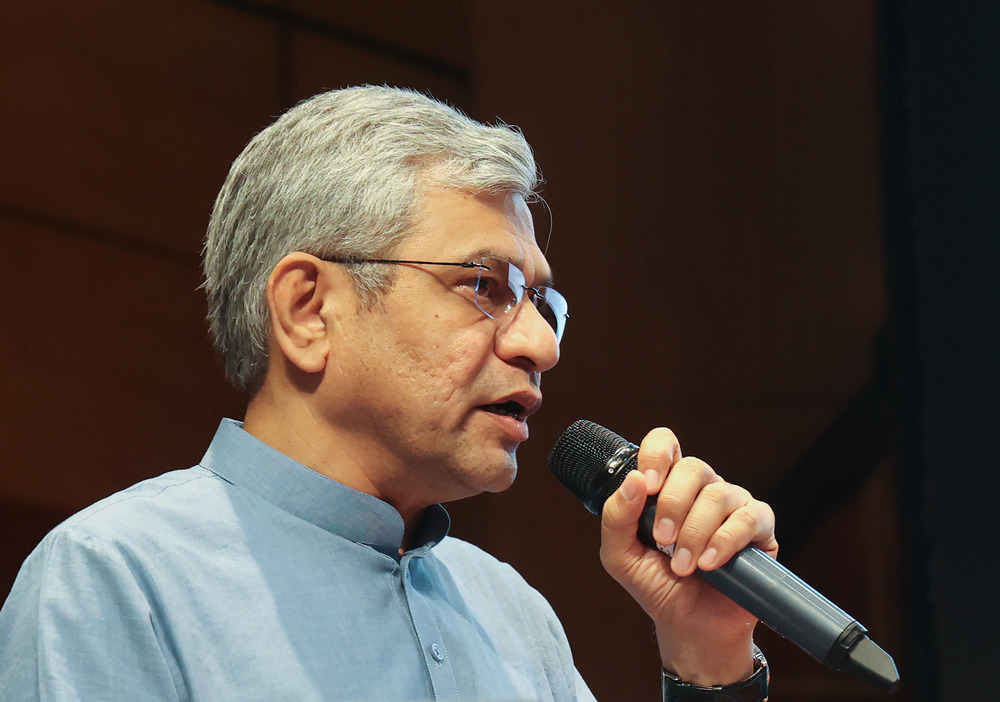
Union Minister for Railways, Information and Broadcasting, and Electronics and Information Technology Ashwini Vaishnaw on Thursday called on students to play a leading role in developing next-generation technologies, as he inaugurated a state-of-the-art Makers Lab at the Malaviya National Institute of Technology (MNIT) Jaipur.
Addressing students and faculty members at the Vivekananda Lecture Theatre Complex, Vaishnaw underscored the importance of innovation, technological advancement and startup-led growth in shaping India’s future. He also announced plans to establish advanced laboratories focused on semiconductor technology, quantum computing and artificial intelligence (AI) at the institute.
Highlighting opportunities in emerging technology sectors, the minister said India is witnessing rapid technological transformation under the Digital India initiative, creating new avenues for employment and entrepreneurship.
During an interactive session with students, Vaishnaw discussed developments in semiconductor technology and noted that nano-SIM cards are now being manufactured in India, describing it as a milestone in the country’s drive towards technological self-reliance.
Encouraging students to explore cutting-edge fields, he said the global semiconductor industry offers significant career opportunities and urged young engineers to become active contributors to India’s technology ecosystem.
The minister announced that MNIT Jaipur would be equipped with advanced semiconductor infrastructure, including simulation systems for hands-on training in chip design and fabrication. Students and researchers will also gain access to industry-standard semiconductor design tools.
The proposed facilities are expected to strengthen research and skill development in some of the fastest-growing areas of science and technology.
Referring to the Centre’s broader efforts to promote semiconductor education, Vaishnaw said similar initiatives are being implemented across 323 colleges nationwide. He challenged MNIT students to design indigenous semiconductor chips and take their innovations from concept to manufacturing.
“India should not only consume technology but also create it. Our students must lead the next generation of innovation,” he said.
The minister also highlighted infrastructure initiatives being undertaken by the Centre, including increased railway funding for border regions, accelerated station redevelopment projects across Rajasthan and plans to improve rail connectivity. He said a daily Darbhanga-Ajmer train service is expected to be introduced within the next two months.
In addition, Vaishnaw outlined plans for an AI data centre and expanded academic and research facilities at MNIT Jaipur.
Earlier in the day, the minister visited the Akashvani station in Jaipur and virtually inaugurated a 20-kW FM transmitter at Ramgarh in Rajasthan’s Jaisalmer district.
He said the government is strengthening Akashvani and Doordarshan infrastructure across border regions to improve communication and public broadcasting services.
“From Kashmir to Kutch, efforts are underway to ensure robust FM radio and television broadcasting networks. As part of this initiative, a new 20-kW FM transmitter has been commissioned in Jaisalmer today,” Vaishnaw said.
The new transmitter is expected to enhance the reach and quality of radio broadcasting in Rajasthan’s border areas, improving access to public broadcasting services and strengthening communication infrastructure in remote regions.
(With inputs from IANS)


