







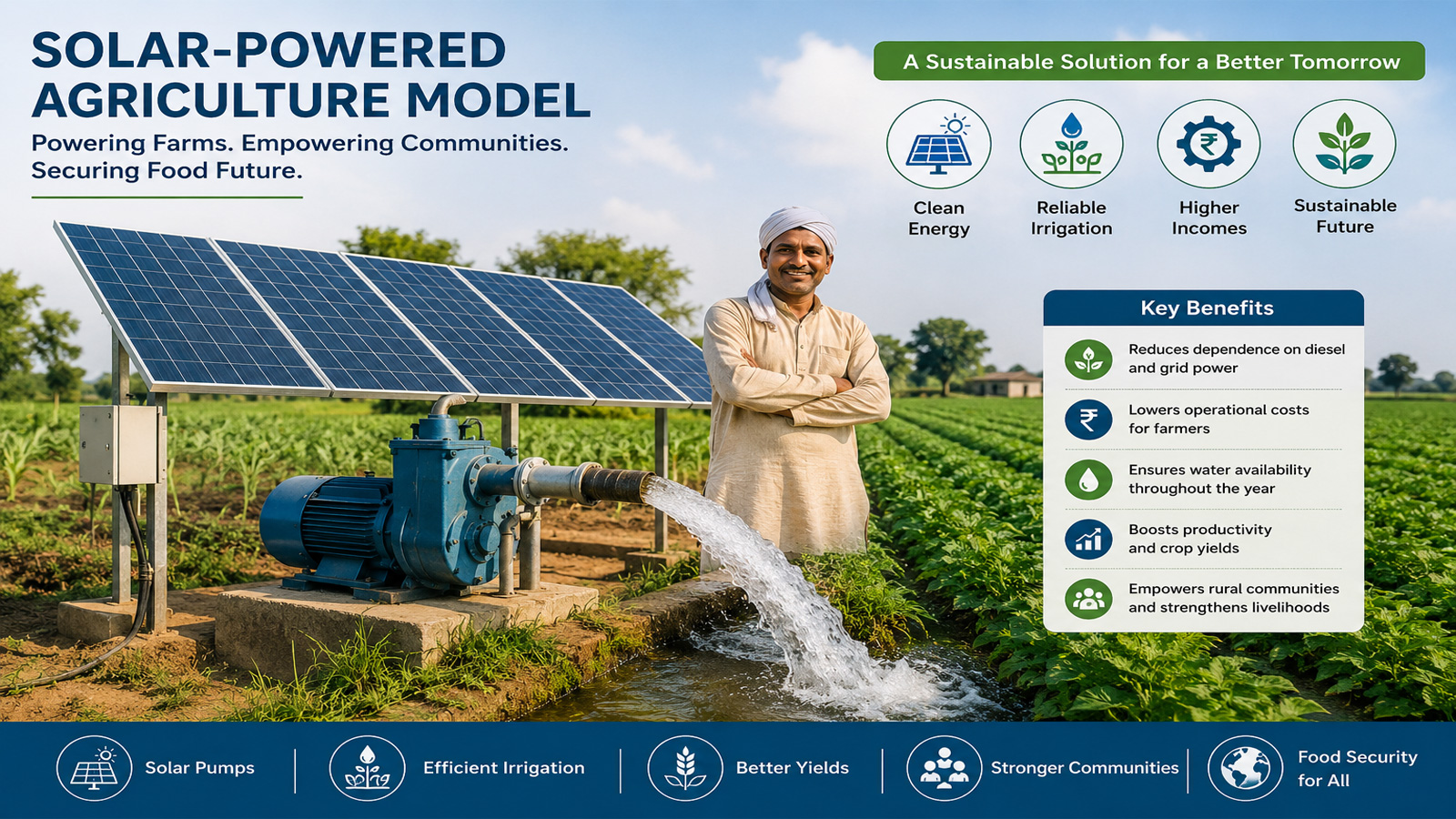
Prime Minister Narendra Modi on Wednesday highlighted India’s success in using solar energy to transform agriculture, describing the country’s clean-energy-driven farming model as a scalable solution for improving food security, farmer incomes, and sustainable development across Africa.
Sharing an article authored by Union Minister for New and Renewable Energy Pralhad Joshi and Director General of the International Solar Alliance (ISA) Ashish Khanna, PM Modi said, “Solar power is emerging as a transformative force. India’s model of harnessing clean energy for agriculture offers a scalable model for Africa, strengthening shared prosperity, empowering communities and promising food security. Truly a matter of pride for our farmers and all of us.”
India’s Solar Revolution Inspiring Global Partnerships
Joshi said India’s renewable energy journey is increasingly serving as a model for international cooperation, particularly in Africa, where access to reliable energy remains a major challenge.
Joshi said that initiatives such as the PM-KUSUM scheme and the International Solar Alliance are helping demonstrate how solar-powered agriculture can improve livelihoods, enhance food security, and expand access to clean energy.
“India’s solar revolution is creating pathways far beyond its borders. Through initiatives like PM-KUSUM and the ISA, India’s proven model of solar-powered agriculture is helping strengthen food security, improve farmer incomes and expand clean energy access across Africa,” the minister said.
Solar Irrigation Offers Solution to Africa’s Agricultural Challenges
The article said that one of the biggest barriers to agricultural productivity in many African countries is limited irrigation infrastructure.
While India irrigates nearly 55 per cent of its cropland, irrigation coverage in Sub-Saharan Africa remains around 4 per cent. This gap contributes to lower agricultural productivity, food shortages, and greater dependence on imports.
The authors cite the example of a Ugandan coffee farmer who significantly increased his income after replacing a diesel-powered irrigation pump with a solar-powered alternative. The switch reduced operating costs, improved water availability during dry seasons, and enhanced agricultural productivity.
According to the article, such examples demonstrate how solar-powered irrigation can become a key driver of rural development and food security across Africa.
Mission 300 and the Role of Renewable Energy
The article identifies Mission 300, a joint initiative of the World Bank and the African Development Bank aimed at providing electricity access to 300 million Africans by the end of the decade, as a potential platform for scaling solar-powered agriculture.
The authors noted that access to electricity becomes transformative when it supports productive economic activities. Solar irrigation systems, they note, can not only power farms but also provide electricity for homes, healthcare facilities, electric mobility, and local power networks.
The article outlines five priority areas for Africa’s clean energy transition expanding last-mile renewable energy access; scaling solar-powered agriculture and value chains; developing utility-scale solar projects and regional grids; promoting solar-powered mobility solutions; and building digital systems to integrate these initiatives.
PM-KUSUM Showcased as Global Model
A central focus of the article is India’s Pradhan Mantri Kisan Urja Suraksha evam Utthaan Mahabhiyan (PM-KUSUM) scheme, described as the world’s largest distributed solar programme for agriculture.
The programme has already facilitated the installation of approximately 2.7 million solar pumps, with a target of deploying an additional 5 million by 2030.
The authors highlight Maharashtra’s large-scale solar feeder initiative, under which agricultural electricity demand is being shifted to dedicated daytime solar power systems. The programme has reduced the cost of irrigation power and improved the reliability of electricity supply for farmers.
The initiative has generated multiple benefits, including lower subsidy burdens, improved agricultural productivity, greater crop diversification, and enhanced rural incomes.
Policy, Finance and Skills Key to Scaling Solar Agriculture
The article identifies three critical factors necessary for expanding solar-powered agriculture in Africa.
First, governments need supportive policy frameworks, including technical standards, dedicated funding, and regulatory mechanisms that facilitate rapid adoption of solar technologies.
Second, financing solutions must be tailored to the needs of farmers, including small and marginal landholders. The authors suggest that the ISA’s Global Solar Facility can help reduce credit risks and attract greater investment into the sector.
Third, investment in local skills and technical expertise is essential to ensure the long-term maintenance and operation of solar infrastructure. The ISA’s STAR Centres have been established to build technical capacity and support the deployment of distributed solar systems.
India’s Renewable Energy Growth
The article also highlights India’s remarkable progress in renewable energy over the past decade.
India’s solar capacity has increased from 2.8 gigawatts in 2014 to more than 157 gigawatts today, while the country’s total renewable energy capacity has crossed 282 gigawatts.
This rapid expansion has positioned India among the world’s leading renewable energy producers and strengthened its role in promoting sustainable development globally.
Strengthening India-Africa Cooperation
The authors conclude that the growing link between energy security and food security presents a major opportunity for deeper India-Africa cooperation.
Through solar-powered irrigation, decentralized renewable energy systems, and skills development initiatives, India and African nations can work together to address agricultural challenges, improve rural livelihoods, and strengthen food security.


