







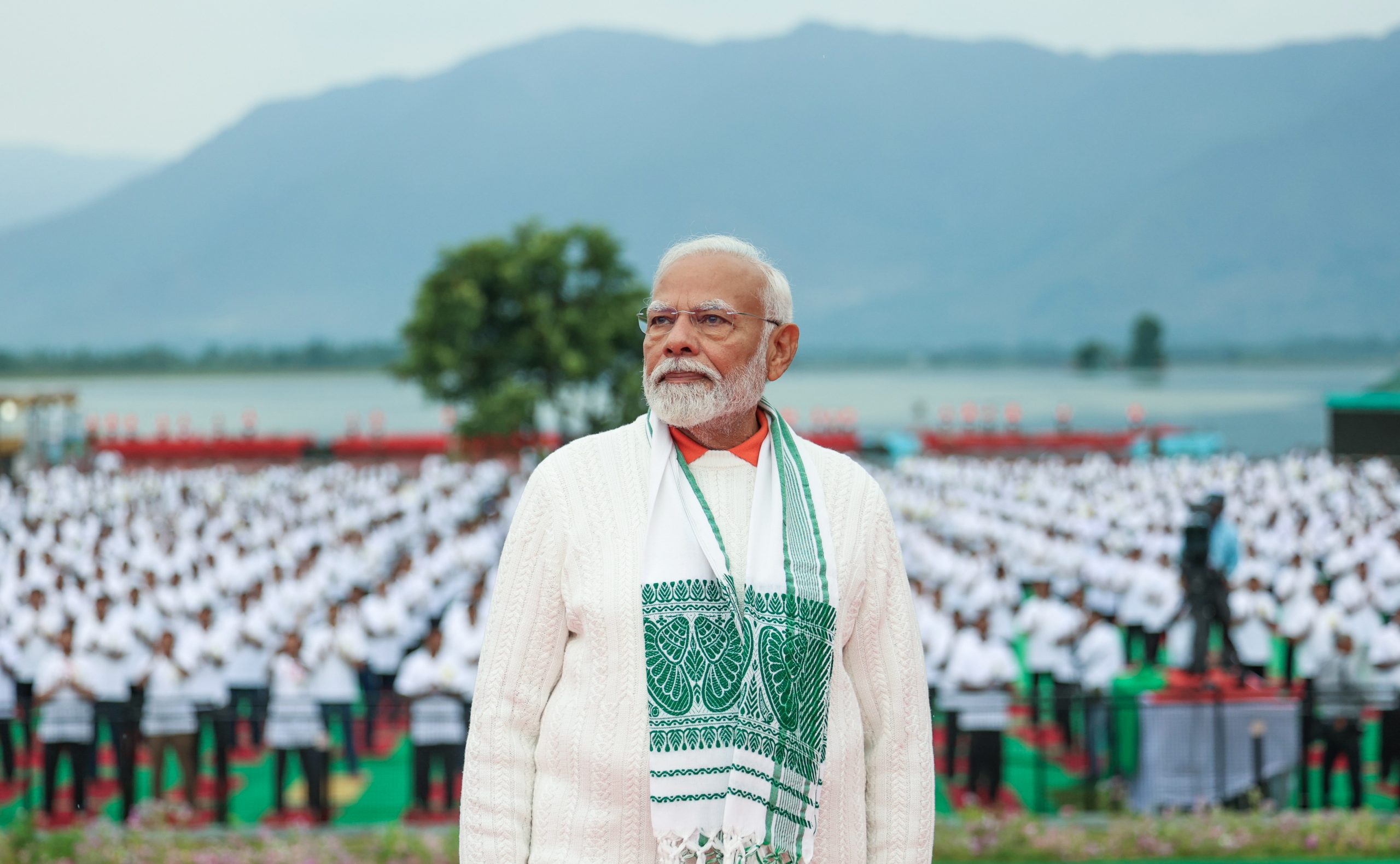
Prime Minister Narendra Modi on Thursday shared an article written by Union Minister of State for Ayush, Prataprao Jadhav, highlighting yoga’s remarkable journey from ancient Indian scriptures to worldwide recognition while remaining deeply rooted in India’s spiritual and cultural heritage.
Sharing the article on X, the Prime Minister said, “Union MoS Shri Prataprao Jadhav elaborates how, from ancient scriptures to global recognition, yoga has travelled across boundaries while remaining rooted in India’s spiritual and cultural heritage. Today, its worldwide celebration reflects a renewed appreciation of this timeless tradition.”
Yoga’s Origins in Ancient India
In his article, Jadhav traced yoga’s origins to India’s earliest scriptures, explaining that the term “yoga” is derived from the Sanskrit root yuj, meaning “to unite” or “to yoke.” He described yoga as a comprehensive system of philosophical inquiry and practical discipline aimed at uniting the individual self with the universal consciousness.
The Minister noted that references to meditation (dhyana) and austerity (tapas) can be found in the Rig Veda, while the Upanishads further developed the philosophical foundations of yoga. It was later systematized through the Yoga Sutras of Maharishi Patanjali, which outlined the classical eight-fold path of yoga, known as Ashtanga Yoga.
Jadhav also highlighted the role of the Bhagavad Gita in presenting yoga as a practical philosophy for life. Through the dialogue between Lord Krishna and Arjuna, the text elaborates on the paths of Karma Yoga, Jnana Yoga and Bhakti Yoga as means of spiritual growth and liberation.
Swami Vivekananda’s Global Influence
A significant portion of the Jadhav’s article focused on the contribution of Swami Vivekananda in introducing yoga and Vedantic philosophy to the world during a period when traditional Indian knowledge systems were often undervalued under colonial influence.
The Minister noted that Swami Vivekananda’s historic address at the World’s Parliament of Religions in Chicago in 1893 brought global attention to India’s spiritual heritage and helped revive confidence among Indians in their own traditions.
Through his lectures and writings, including the influential book Raja Yoga published in 1896, Swami Vivekananda introduced Western audiences to various streams of yogic philosophy, including Raja Yoga, Karma Yoga, Jnana Yoga and Bhakti Yoga. His work sparked widespread interest in Indian spiritual thought across the United States and Europe.
Jadhav said Swami Vivekananda’s success abroad also triggered a cultural renaissance within India, encouraging Indians to rediscover and take pride in their spiritual and philosophical heritage.
Belur Math and Yoga’s Continuing Legacy
The Minister highlighted that after returning to India in 1897, Swami Vivekananda established the Ramakrishna Mission at Belur Math near Kolkata. The institution became a global center for promoting Vedanta, service to humanity and the practical application of yoga philosophy.
Jadhav observed that although yoga’s public visibility in Bengal diminished over time due to changing lifestyles and social priorities, its traditions remained alive through spiritual institutions and dedicated practitioners.
Drawing a symbolic connection between Swami Vivekananda’s Chicago address and the upcoming celebration of yoga in Kolkata, the Minister described the global recognition of yoga as a “homecoming” to the banks of the Hooghly River, where Belur Math continues to stand as a testament to Vivekananda’s vision.
International Recognition and Global Impact
Jadhav noted that yoga is now practiced across the world and has gained recognition as an important part of humanity’s cultural heritage. He emphasized that while yoga’s international popularity continues to grow, its origins remain firmly anchored in India’s ancient civilizational traditions.
The Minister described yoga’s evolution from “Chicago to Hooghly” not merely as the journey of a practice, but as the journey of an idea that continues to connect humanity through balance, compassion, self-awareness and inner harmony.
Referring to the celebration of the International Day of Yoga in Kolkata, Jadhav said the occasion represents a symbolic return of yoga to the land from which its message first reached the global stage, carrying with it greater recognition, respect and acceptance around the world.


