







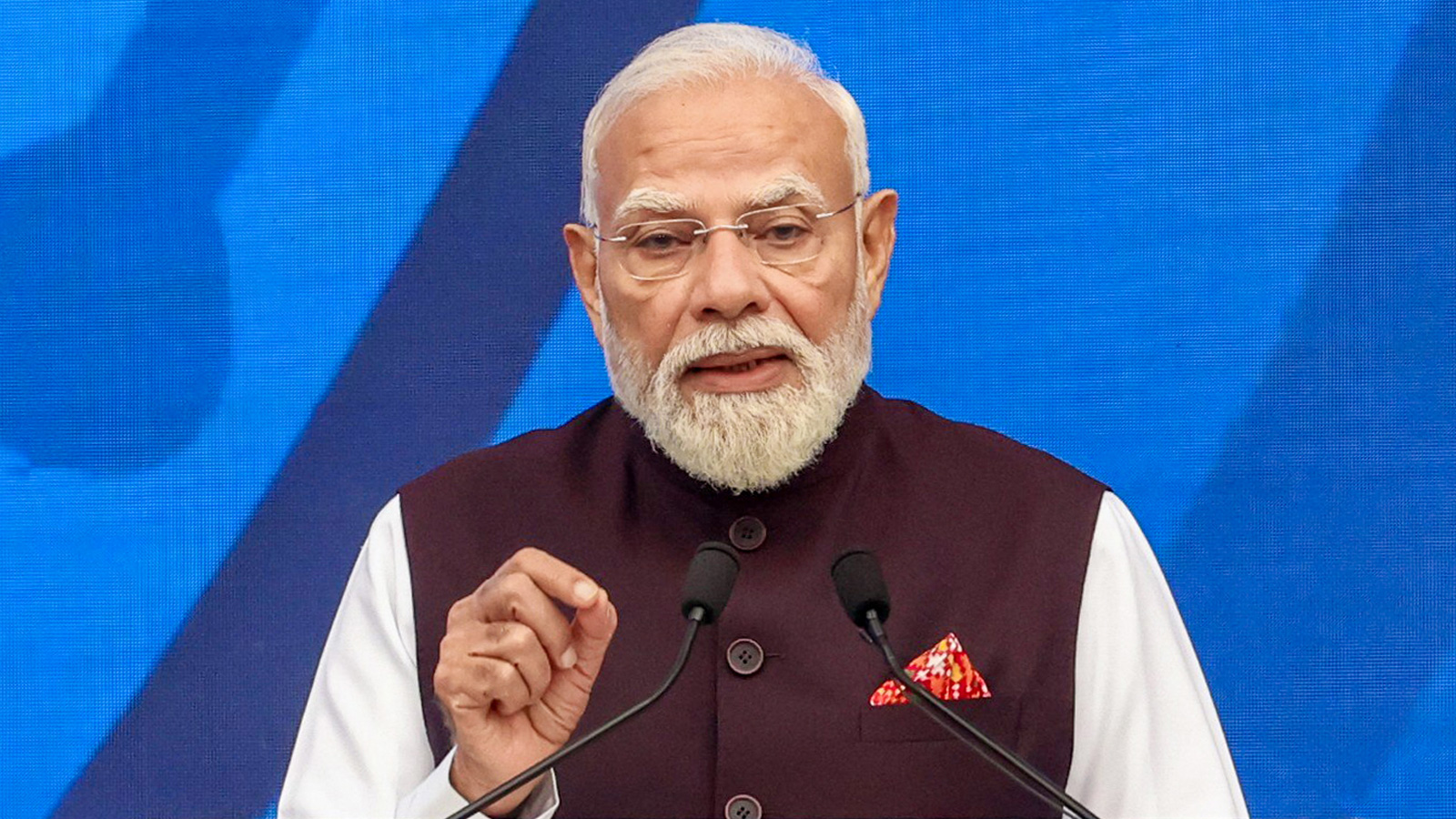
Prime Minister Narendra Modi on Thursday shared an article by Union Minister for Youth Affairs and Sports Mansukh Mandaviya, highlighting the pivotal role of India’s youth in shaping the country’s journey towards becoming a developed nation by 2047.
Mandaviya’s article, titled “Developed India Rests on the Youth’s Well-Being”, outlines how unprecedented investments in education, skilling, entrepreneurship, sports and civic participation over the past twelve years have created new opportunities for India’s young population, whom the government refers to as the “Amrit Peedhi.”
Sharing the article on X, PM Modi said, “The story of India’s transformation over the last 12 years is also the story of its youth. Guided by our vision, unprecedented investments in skilling, innovation and entrepreneurship, we are creating opportunities for the Amrit Peedhi to realise their aspirations and contribute to nation-building.”
Union Minister Mansukh Mandaviya said the vision of a developed India rests on the well-being and empowerment of its youth.
He noted that PM Modi has consistently emphasized that India’s young population will be the driving force behind the Viksit Bharat mission and highlighted how government policies over the last twelve years have sought to channel the energy of young Indians towards innovation, achievement and national development.
The article paints a picture of a rapidly changing India where young entrepreneurs from small towns are building globally competitive businesses, rural women are winning medals on national and international sporting platforms, and students from Tier-II and Tier-III cities are directly engaging with policymakers, investors and industry leaders.
Mandaviya said this is no longer an aspirational vision but an emerging reality in a country where nearly 65 per cent of the population is below the age of 35, giving India one of the world’s largest demographic advantages.
He said that education has been at the centre of this transformation.
The National Education Policy (NEP) 2020 has introduced major reforms focused on experiential learning, multidisciplinary education and skill integration. As a result, higher education enrolment has increased by more than 30 per cent, reflecting both greater access and rising aspirations among students.
Mandaviya also highlights efforts to make education more inclusive through residential schooling initiatives, scholarship programmes and institutional support mechanisms designed to reduce financial barriers and expand opportunities for students from diverse backgrounds.
Technology has played a crucial role in democratizing access to education. Digital learning platforms such as SWAYAM, DIKSHA and PM e-VIDYA have brought quality educational content to millions of students across the country, reducing geographical barriers and expanding learning opportunities.
Mandaviya stresses that education alone is insufficient in a rapidly evolving global economy and that continuous skill development has become equally important.
Under the Skill India Mission, more than six crore young people have received training across various sectors. The Pradhan Mantri Kaushal Vikas Yojana (PMKVY) has focused on industry-aligned and future-ready skills, while Jan Shikshan Sansthans have been reoriented to provide locally relevant vocational training.
The National Apprenticeship Promotion Scheme has expanded apprenticeship-based learning opportunities, with the government providing support for stipend payments. Simultaneously, Industrial Training Institutes (ITIs) are being modernized to align with emerging technologies and evolving industry requirements.
Mandaviya notes that these efforts are particularly important at a time when sectors such as Artificial Intelligence, semiconductors and sustainability technologies are reshaping the global economy. He said India’s challenge is to equip its youth to become leaders in the industries of the future.
One of the most significant developments of the past decade has been the rise of entrepreneurship among young Indians.
Mandaviya said India had only around 350 startups before 2014. Today, the country has more than 2.3 lakh recognized startups, making it the world’s third-largest startup ecosystem. India is also home to more than 120 unicorns, reflecting the growing maturity and depth of its innovation landscape.
Initiatives such as Startup India have simplified regulations, reduced compliance burdens, supported incubation and enabled faster formalisation of new enterprises. As a result, increasing numbers of young Indians are turning innovative ideas into businesses and creating employment opportunities rather than merely seeking jobs.
Access to finance has also improved substantially.
Through the Pradhan Mantri MUDRA Yojana, more than 57 crore collateral-free loans worth over ₹40 lakh crore have been sanctioned, empowering first-generation entrepreneurs, self-employed youth and small business owners across the country.
Complementing this effort, the Stand-Up India scheme has expanded credit support for women entrepreneurs and individuals from marginalized communities, helping ensure that entrepreneurial opportunities are not limited by social or economic circumstances.
India’s digital public infrastructure has further accelerated this transformation. Platforms such as UPI, Aadhaar-enabled services, digital payments and e-governance systems have reduced transaction costs, improved access to markets and enabled even small enterprises to participate in the formal economy.
Mandaviya notes that together with innovation hubs, incubation centres and state-level startup policies, these initiatives have created an ecosystem where ideas can be tested, scaled and sustained. Importantly, entrepreneurship is increasingly emerging from Tier-II and Tier-III cities, indicating a broad-based democratization of economic opportunity.
Sports and youth well-being also feature prominently in the article.
The Khelo India programme has strengthened grassroots sporting infrastructure across the country, with more than 1,000 Khelo India Centres now operational. These centres are supporting thousands of young athletes and contributing to India’s improved performance in international sporting competitions.
Recognizing that development extends beyond economic indicators, the government has also invested in mental health and social well-being initiatives. The Tele-MANAS programme has expanded access to mental health counselling and support services, while the Nasha Mukt Bharat Abhiyaan has reached crores of young people through awareness campaigns aimed at preventing substance abuse.
Mandaviya said that a truly developed India must be built on the physical, emotional and social well-being of its youth.
He also highlighted efforts to increase youth participation in governance and nation-building.
In his Independence Day address in 2024, PM Modi called for bringing one lakh young people from non-political backgrounds into mainstream politics. The Viksit Bharat Young Leaders Dialogue has emerged as a major platform for youth engagement, allowing young Indians to contribute ideas and perspectives on national development.
At the same time, the MY Bharat initiative has evolved into one of the country’s largest youth volunteer movements. According to the article, the platform has built a network of more than 2.18 crore registered youth volunteers, encouraging service, civic participation and community engagement.
Mandaviya describes this as a broader shift in the understanding of citizenship, where young people view themselves not only as beneficiaries of rights but also as active contributors to national development.
Mandaviya concludes that India is currently experiencing a rare convergence of demographic strength, technological advancement and youthful aspiration.
“History offers nations only a few moments when demographics, technology and aspiration converge. India stands at such a moment today,” Mandaviya writes.
He said that the future of India will not merely be created for its youth but will be shaped by them. As the country advances towards its goal of becoming a developed nation by 2047, the aspirations, innovation and leadership of young Indians will play a defining role in determining the character and success of Viksit Bharat.
With nearly two-thirds of its population under the age of 35, expanding educational opportunities, more than six crore youth trained under Skill India, over 2.3 lakh recognized startups, 57 crore MUDRA loans worth over ₹40 lakh crore, more than 120 unicorns and a volunteer network of 2.18 crore young people, India’s youth are increasingly emerging as the central force driving the country’s developmental ambitions for the coming decades.


