







Over the last twelve years, India has undertaken one of the most ambitious defence transformations in its modern history. What began as a determined push to reduce dependence on imported weapons and military systems has evolved into a broad national effort to build indigenous capability, strengthen military preparedness, expand industrial capacity, and establish India as a credible security partner on the global stage.
Between 2014 and 2026, the country’s defence landscape witnessed sweeping changes. Defence spending rose to historic levels, domestic manufacturing expanded rapidly, exports reached record highs, and indigenous technologies moved from laboratories to operational deployment. At the same time, India strengthened strategic partnerships across the world while preserving its long-standing principle of strategic autonomy.
The transformation has been driven by a combination of policy reforms, technological innovation, industrial participation, and military modernization. Together, these efforts have laid the foundation for a self-reliant defence ecosystem that is expected to play a central role in India’s journey towards becoming a developed nation by 2047.
Rising Investments Fuel Military Modernisation
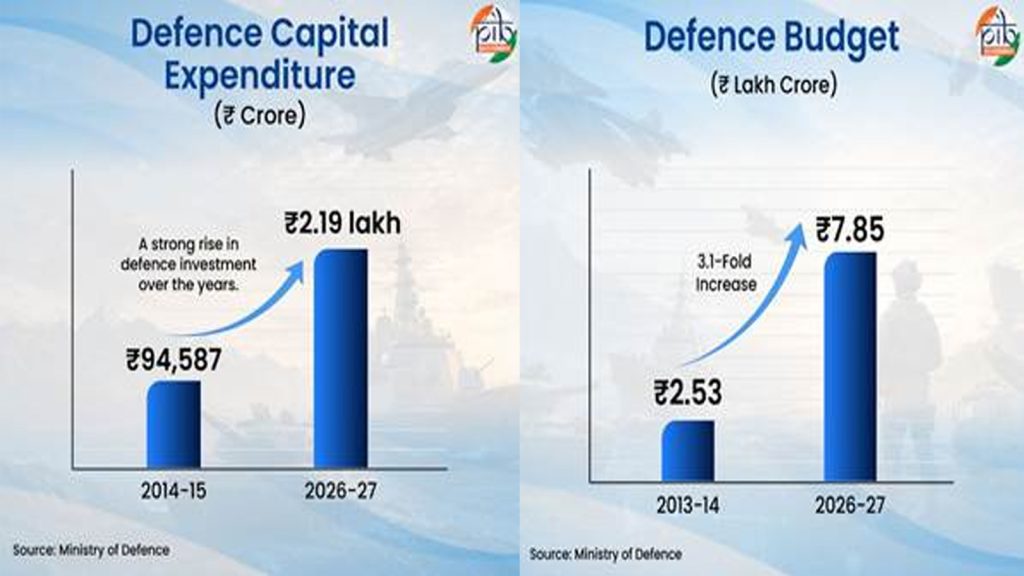
One of the clearest indicators of India’s changing defence profile is the scale of investment directed towards national security. The overall defence budget has increased from ₹2.53 lakh crore in 2013-14 to ₹7.85 lakh crore in 2026-27, reflecting the government’s sustained commitment to strengthening military capability and preparedness.
Capital expenditure, which finances major acquisitions, military infrastructure, weapons systems and future capabilities, has also witnessed remarkable growth. From ₹94,587.95 crore in 2014-15, capital expenditure has expanded to ₹2.19 lakh crore in 2026-27. This rise reflects a strategic focus on building long-term military strength through investments in advanced platforms, indigenous manufacturing, modern weapon systems and technological upgrades.
The increased allocation has enabled India to pursue a comprehensive modernization agenda that combines military readiness with industrial development and technological self-sufficiency.
Building a Self-Reliant Defence Ecosystem
India’s defence transformation has been closely linked to the broader vision of Aatmanirbhar Bharat and Make in India. Through a series of policy reforms, the government has sought to shift the country from being one of the world’s largest arms importers to becoming a major defence manufacturing nation.
Central to this effort have been initiatives such as the Defence Acquisition Procedure (DAP) 2020, the Defence Procurement Manual (DPM) 2025, Positive Indigenisation Lists, the SRIJAN Portal, liberalized foreign investment policies have opened new opportunities for private sector involvement.
The impact of these reforms is becoming increasingly visible. Nearly 65 percent of defence equipment is now produced domestically, a significant reversal from the earlier situation when India depended on imports for approximately 65 to 70 percent of its military requirements. This structural shift reflects the growing maturity of India’s defence industrial ecosystem and its expanding ability to design, develop and manufacture complex military systems.
Research and Development Moves to the Centre Stage
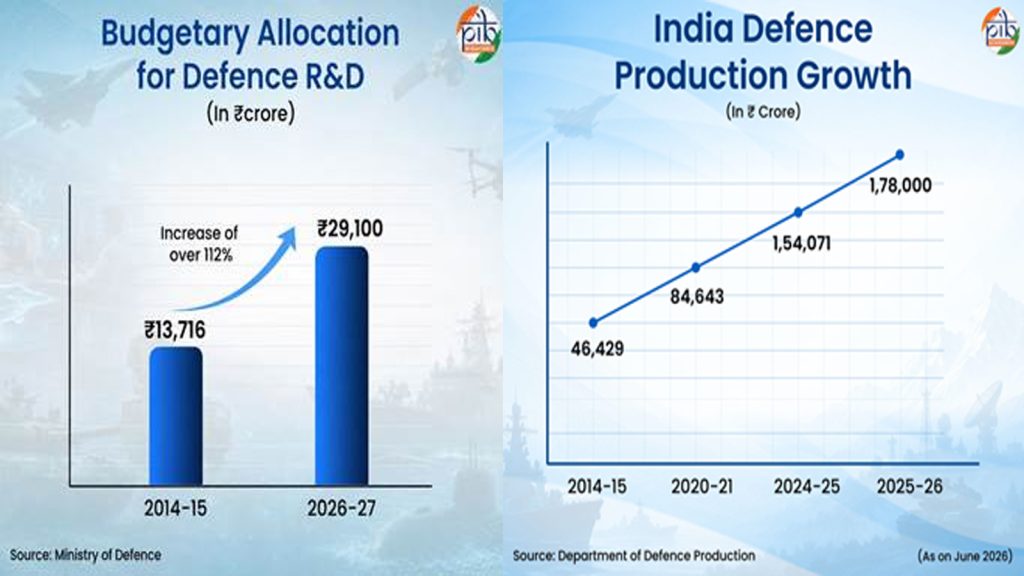
Technological innovation has become a cornerstone of India’s defence strategy. Defence research and development expenditure has increased from ₹13,716.14 crore in 2014-15 to ₹29,100.25 crore in 2026-27, representing growth of more than 112 percent over the period.
Recognizing that innovation cannot be driven by government institutions alone, the Ministry of Defence took a landmark step in 2022 by opening 25 percent of the defence R&D budget to industry, start-ups and academia. The decision was intended to bring fresh ideas, advanced technologies and entrepreneurial energy into the defence innovation ecosystem.
The Department of Defence alone spent ₹1,757 crore on research and development activities in 2024. Simultaneously, several world-class DRDO testing facilities were opened to private industry. Through the Defence Testing Portal, innovators and companies now have access to the infrastructure of 24 DRDO laboratories, enabling them to validate and refine indigenous technologies for defence applications.
Start-Ups Become Strategic Partners
A major feature of India’s defence transformation has been the emergence of start-ups as contributors to national security. The Innovations for Defence Excellence (iDEX) initiative has played a pivotal role in creating a bridge between innovators and the armed forces.
Launched to encourage indigenous technology development, iDEX has become one of the most successful defence innovation programmes in the country. The scheme received a budgetary allocation of ₹498.78 crore for the period from 2021-22 to 2025-26. Complementing it is the ADITI scheme, which was approved with an outlay of ₹750 crore between 2023-24 and 2025-26.
By March 2026, iDEX had engaged 676 start-ups, MSMEs and innovators. During the same period, 551 design and development contracts were signed, highlighting the growing confidence of the armed forces in indigenous innovation.
The programme has encouraged entrepreneurs to develop solutions in areas ranging from autonomous systems and artificial intelligence to advanced sensors, surveillance technologies and battlefield applications.
Strengthening Industry Partnerships
The Defence Research and Development Organisation has also strengthened its collaboration with industry through the Development-cum-Production Partner model. Under this framework, DRDO identifies capable manufacturing partners and transfers technologies for production.
By March 2026, 134 companies had partnered with DRDO as Development-cum-Production Partners or production agencies. More than 2,180 technology transfer agreements had been signed, while over 2,780 intellectual property rights had been opened for industry use. These initiatives are supported by a network of more than 2,200 industries capable of manufacturing defence systems, sub-systems and equipment.
Alongside this effort, the Technology Development Fund has emerged as another important instrument for promoting indigenous innovation. Administered by DRDO, the fund provides grants of up to ₹50 crore for the development of critical technologies. Several technologies supported under the programme have already achieved significant milestones, including participation in PSLV space missions.
To further accelerate innovation, the government approved an additional corpus of ₹500 crore under the scheme. As of June 2026, eighty projects with a combined value of ₹334 crore were being implemented.
Creating the Next Generation of Defence Scientists
The country’s defence transformation has not been limited to technology and manufacturing. Significant investments have also been made in human capital.
In January 2020, DRDO established five Young Scientists Laboratories dedicated to emerging and futuristic technologies. A sixth laboratory is expected to become operational in 2026. Newly recruited scientists now undergo a two-year M.Tech programme in defence technology at the Defence Institute of Advanced Technology before being assigned to laboratories.
India has also expanded opportunities for engineering students and young researchers. More than 3,500 engineers and technicians join DRDO laboratories every year as paid apprentices. A nationwide internship programme provides practical exposure to defence research, while fifteen DRDO Industry-Academia Centres of Excellence are supporting 281 projects worth ₹967 crore across fifty-two institutions.
These initiatives are creating a pipeline of skilled talent capable of supporting India’s future defence requirements.
Procurement Reforms Drive Indigenous Manufacturing
Major procurement reforms have reshaped the way India acquires military equipment. The Defence Procurement Procedure 2016 introduced mechanisms to streamline acquisitions and promote domestic manufacturing. This was followed by the Defence Acquisition Procedure 2020, which placed greater emphasis on indigenous design, development and production.
The Defence Procurement Manual 2025 further improved transparency and efficiency by streamlining revenue procurement worth nearly ₹1 lakh crore through faster approvals and simplified procedures.
The draft Defence Acquisition Procedure 2026 proposes even stronger support for domestic manufacturing by recommending indigenous content requirements of up to 60 percent.
These reforms have significantly strengthened India’s defence manufacturing ecosystem and accelerated the transition towards self-reliance.
Indigenous Orders Reach Record Levels
The Defence Acquisition Council (DAC), India’s apex defence procurement body, has been a key driver of Aatmanirbhar Bharat in defence.
Through DAP 2020 reforms, it prioritised indigenous procurement, domestic manufacturing, and higher indigenous content.
DAC has accorded Acceptance of Necessity (AoN) for DRDO-designed and Indian industry-manufactured systems worth over ₹6 lakh crore, many of which have been inducted or are under induction.
Major approvals include 97 Light Combat Aircraft Tejas Mk-1A fighter jets worth ₹62,000 crore, 156 Light Combat Helicopters (LCH) Prachand valued at about ₹62,700 crore, 26 Rafale Marine aircraft etc.
Defence Production Crosses Historic Milestone
India’s defence production has witnessed remarkable growth over the last decade. From ₹46,429 crore in 2014-15, indigenous defence production reached ₹1.78 lakh crore in 2025-26.
The latest figure represents a 15.6 percent increase over the previous year’s production of ₹1,54,071 crore. Compared to ₹84,643 crore recorded in 2020-21, defence production has expanded by more than 110 percent.
The achievement reflects the growing strength of India’s defence manufacturing ecosystem. Defence Public Sector Undertakings and other public-sector entities accounted for around 76 percent of production in 2025-26, while the private sector contributed approximately 24 percent, highlighting increasing industry participation.
The defence manufacturing ecosystem now includes sixteen Defence Public Sector Undertakings, around five hundred licensed defence companies and nearly seventeen thousand MSMEs.
Defence Exports Rewrite the Record Books
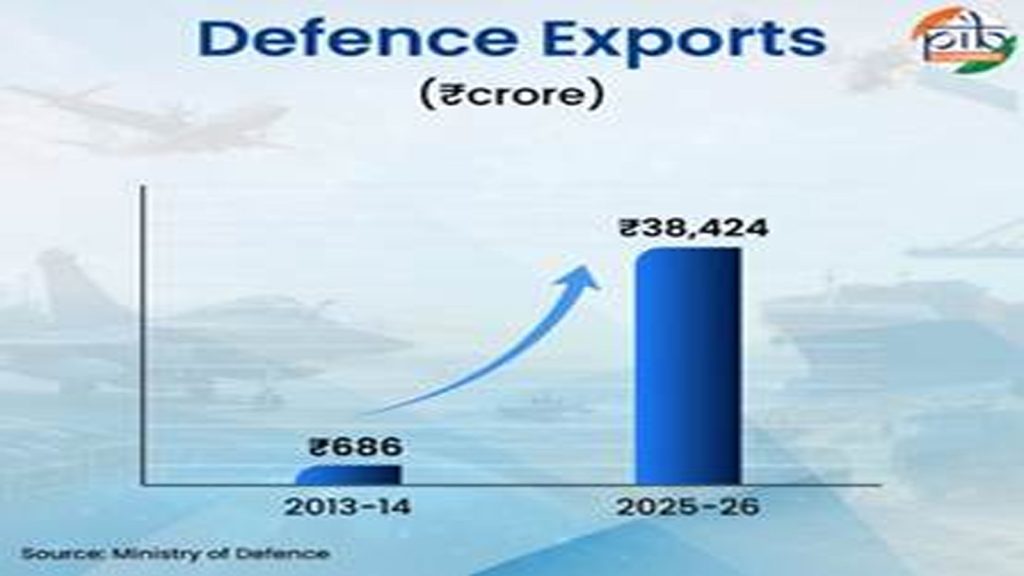
India’s emergence as a defence exporter has been one of the most dramatic developments of the past decade. Defence exports increased from just ₹686 crore in 2013-14 to a record ₹38,424 crore in 2025-26.
The increase of more than 5,500 percent reflects growing international confidence in Indian defence products and technologies.
Indian military equipment is now exported to more than eighty countries, while the defence exporter base has expanded to 145 companies. The government has set an ambitious target of achieving ₹50,000 crore in defence exports by 2029.
The export success demonstrates that India is no longer viewed merely as a defence consumer but increasingly as a supplier of reliable and cost-effective military systems.
Expanding Industrial Capacity
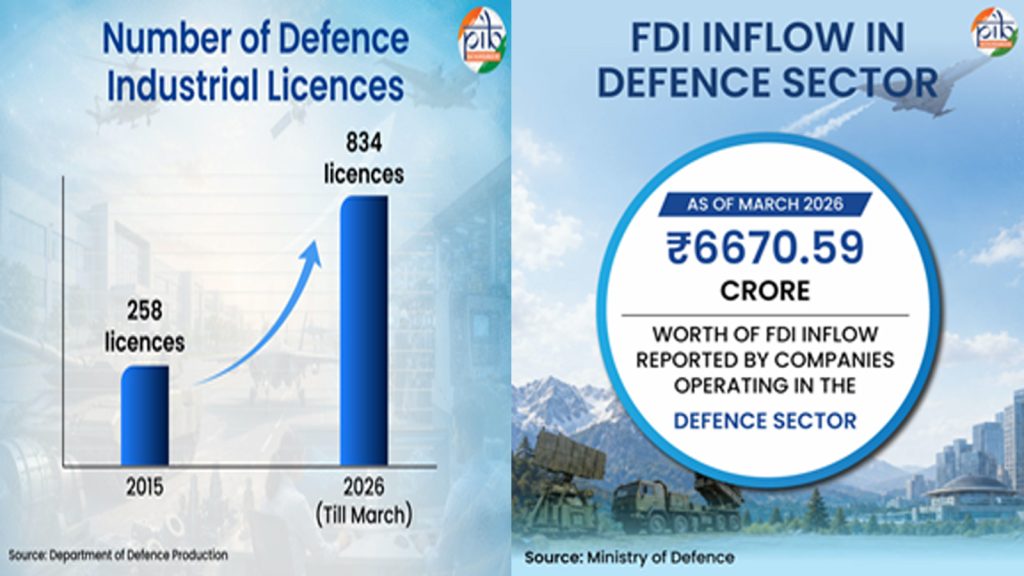
India’s defence industrial capacity has expanded rapidly. The number of industrial licences in the sector increased from 258 in 2015 to 834 by March 2026.
The rise reflects growing investor confidence and greater private-sector participation. Public-sector enterprises have also increased their exports by 151 percent during this period.
A major structural reform came in October 2021 when the government dissolved the two-century-old Ordnance Factory Board. Its forty-one factories were reorganized into seven Defence Public Sector Undertakings. The restructuring aimed to improve efficiency, competitiveness and technological capability while strengthening indigenous production.
Defence Corridors Create New Manufacturing Hubs
The Uttar Pradesh and Tamil Nadu Defence Industrial Corridors have emerged as important centres of defence manufacturing.
By April 2026, the Uttar Pradesh corridor had attracted investment commitments worth ₹42,057 crore and grounded investments of ₹4,409 crore. The corridor has also benefited from the establishment of the Defence Technology and Test Centre, which supports innovation and testing activities.
During the same period, the Tamil Nadu corridor attracted investments worth ₹32,699 crore, with actual investments reaching ₹6,446 crore.
Together, these corridors are helping create integrated defence ecosystems, expanding manufacturing capacity and generating employment.
Indigenisation Gains Momentum
The Ministry of Defence’s SRIJAN initiative has become a major driver of indigenisation. Since its launch in 2020, the programme has encouraged industries, start-ups and MSMEs to develop indigenous alternatives to imported components and systems.
Five Positive Indigenisation Lists containing 5,012 items have been notified. More than 15,700 defence items, including 3,204 items from the Positive Indigenisation Lists, have already been indigenised. Defence Public Sector Undertakings have placed domestic orders worth ₹9,782 crore under the programme.
The SRIJAN DEEP platform has further strengthened the ecosystem by creating a digital repository of defence manufacturers and suppliers. By May 2026, over 41,000 vendors and 270,000 products had been registered on the platform.
Foreign Investment Supports Technology Access
The government has also liberalized foreign investment norms to attract advanced technologies and manufacturing partnerships. The FDI limit in defence was raised to 74 percent through the automatic route and up to 100 percent through the government route in cases involving access to modern technology.
As of March 2026, defence companies had reported FDI inflows worth ₹6,670.59 crore.
Demonstrating Strategic Capability
India’s growing defence capability has been reflected in several major operational achievements.
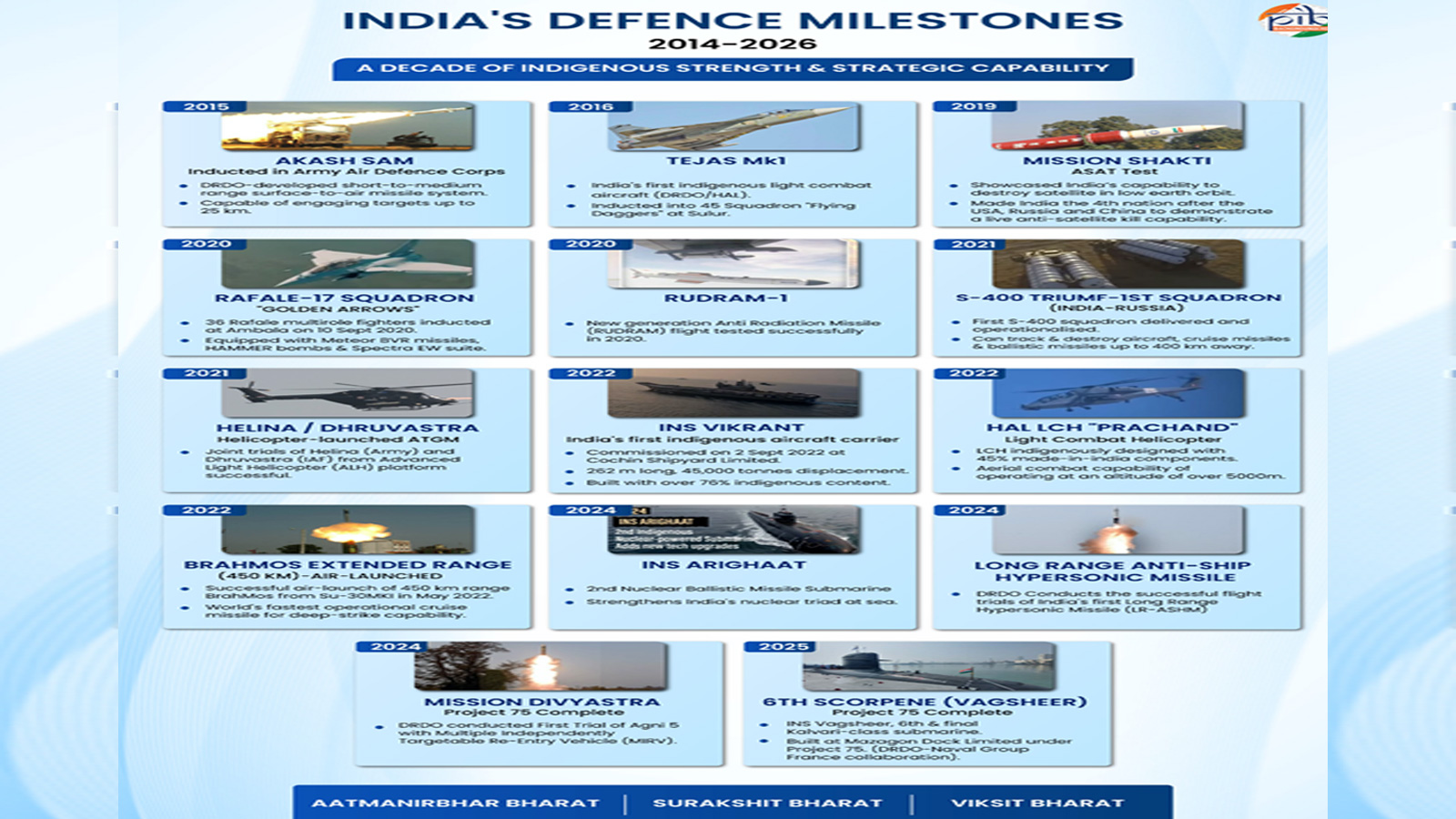
On 27 March 2019, India successfully demonstrated anti-satellite capability through Mission Shakti, joining a select group of nations capable of destroying satellites in space.
On 11 March 2024, Mission Divyastra successfully tested a long-range missile capable of carrying multiple warheads to different targets.
Indigenous systems including Akash air defence missiles, BrahMos missiles, anti-drone systems and airborne surveillance platforms played important roles during Operation Sindoor.
On 23 August 2025, DRDO successfully tested an advanced integrated air defence system that combines missile interceptors, short-range air defence weapons and laser technologies.
Indigenous Platforms Strengthen Military Power
Several indigenous platforms achieved major milestones during the decade. The Tejas fighter aircraft received final operational clearance in February 2019, while eighty-three aircraft were approved for induction into the Indian Air Force.
The Arjun Mk-IA main battle tank was inducted into the Indian Army in February 2021.
India also accelerated the integration of artificial intelligence into military operations. In 2022, seventy-five AI-based technologies were introduced across surveillance, logistics, cybersecurity, autonomous systems and battlefield support.
The country has simultaneously advanced next-generation missile technologies. A major breakthrough came on 9 January 2026 when DRDO successfully conducted a long-duration ground test of an actively cooled scramjet combustor for more than twelve minutes, marking a significant milestone in hypersonic missile development. A new Hypersonic Wind Tunnel established in Hyderabad is expected to further accelerate future programmes.
Building a Younger Armed Force
The Agnipath Scheme, launched on 15 June 2022, aims to recruit young men and women into the Armed Forces as Agniveers for a four-year service period. The scheme aims to create a youthful, tech-savvy, and combat-ready military force with a modern outlook.
Agniveers receive military training, specialised skill development, and educational opportunities through partnerships with institutions such as IGNOU and NIOS. The scheme also provides nationally recognised skill certificates and career pathways after service.
Agnipath is enhancing India’s defence capability by building a younger, skilled, disciplined, and technology-oriented force prepared for future warfare challenges.
Defence Diplomacy Expands Global Influence
India’s defence diplomacy has evolved into a major pillar of national security. The country has strengthened ties with major powers while expanding engagement across regional and multilateral platforms.
The India-United States defence partnership deepened through agreements such as LEMOA, COMCASA and BECA. India was designated a Major Defence Partner and granted Strategic Trade Authorization-1 status. The launch of iCET in 2023 and its evolution into TRUST in 2025 expanded cooperation in artificial intelligence, semiconductors and space technologies. In October 2025, the two countries signed a ten-year defence partnership framework.
India’s longstanding defence relationship with Russia continued through cooperation on S-400 systems, Su-30MKI upgrades, joint production initiatives and the Indra military exercise.
Relations with Europe also expanded significantly. In January 2026, India and the European Union signed a Security and Defence Partnership covering maritime security, cyber defence, counter-terrorism and space cooperation.
France remained one of India’s closest strategic partners. The delivery of all six Kalvari-class Scorpene submarines, the induction of Rafale fighters, approval of Rafale-Marine aircraft and collaborations involving Dassault, Tata, Safran and HAL strengthened bilateral defence ties. These initiatives support the Horizon 2047 Defence Industrial Roadmap and co-production goals.
Partnerships with Japan, Australia, the UAE and ASEAN nations expanded through logistics agreements, defence dialogues, maritime exercises and industrial cooperation. Through forums such as the Quad, SCO and ADMM-Plus, India increasingly shaped discussions on maritime security, terrorism, supply chains and regional stability.
The Road Ahead
India’s defence transformation over the past twelve years represents far more than military modernization. It reflects the emergence of an integrated national ecosystem where research institutions, armed forces, start-ups, MSMEs, private industry and public-sector enterprises work together to strengthen national security.
The country has dramatically expanded defence production, achieved record exports, built advanced military capabilities, strengthened innovation networks and enhanced strategic partnerships across the world. The foundations laid during this period have positioned India not only as a stronger military power but also as an emerging defence manufacturing hub and a credible security provider.
As the country advances towards Vision 2047, defence preparedness will increasingly be shaped by innovation, indigenous capability, technological leadership and strategic resilience. The transformation of the past decade suggests that India is no longer merely responding to global security developments – it is steadily positioning itself to help shape them.


