







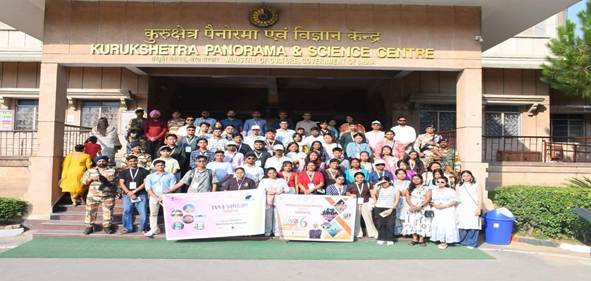
A delegation from Tripura visited Haryana under the Yuva Sangam Phase-VI programme being conducted as part of the Ek Bharat Shreshtha Bharat initiative, the Ministry of Education said on Wednesday.
The programme, facilitated by the Department of Higher Education under the Ministry of Education, aims to promote cultural exchange, experiential learning and national integration among youth from different parts of the country.
The delegation, led by the National Institute of Technology (NIT) Agartala, was hosted by the National Institute of Technology (NIT) Kurukshetra. During the visit, the participants interacted with Haryana Governor Ashim Kumar Ghosh at Lok Bhavan in Chandigarh on June 4. The interaction focused on leadership, national unity, nation-building and India’s cultural diversity.
The programme began with an interaction between the delegates and previous Yuva Sangam participants, followed by the inaugural function at NIT Kurukshetra. Cultural performances by Haryana Kala Parishad showcased the state’s traditions and cultural heritage.
As part of the exposure visit, the delegation toured several cultural and heritage sites, including the Kurukshetra Panorama and Science Centre, Sri Krishna Museum and Bhadrakali Temple. The visit concluded in Kurukshetra with a light and sound show at Jyotisar, regarded as the site where Lord Krishna delivered the Bhagavad Gita to Arjuna.
The participants also visited prominent landmarks in Chandigarh, including Sukhna Lake, Rock Garden and Elante Mall.
On World Environment Day on June 5, the delegation took part in a plantation drive and quiz competition at NIT Kurukshetra. The group also visited the ICAR-National Dairy Research Institute in Karnal, a rice mill in Taraori and the historic Taraori Fort, gaining exposure to agricultural innovation, rural economy and Haryana’s cultural heritage.The programme concluded with a valedictory session on June 8.
According to the Ministry of Education, Yuva Sangam Phase-VI seeks to strengthen the spirit of Ek Bharat Shreshtha Bharat by fostering mutual understanding, cultural appreciation and youth engagement while promoting the values of “Paraspar Sampark, Pragati and Paryatan” across regions of the country.


