







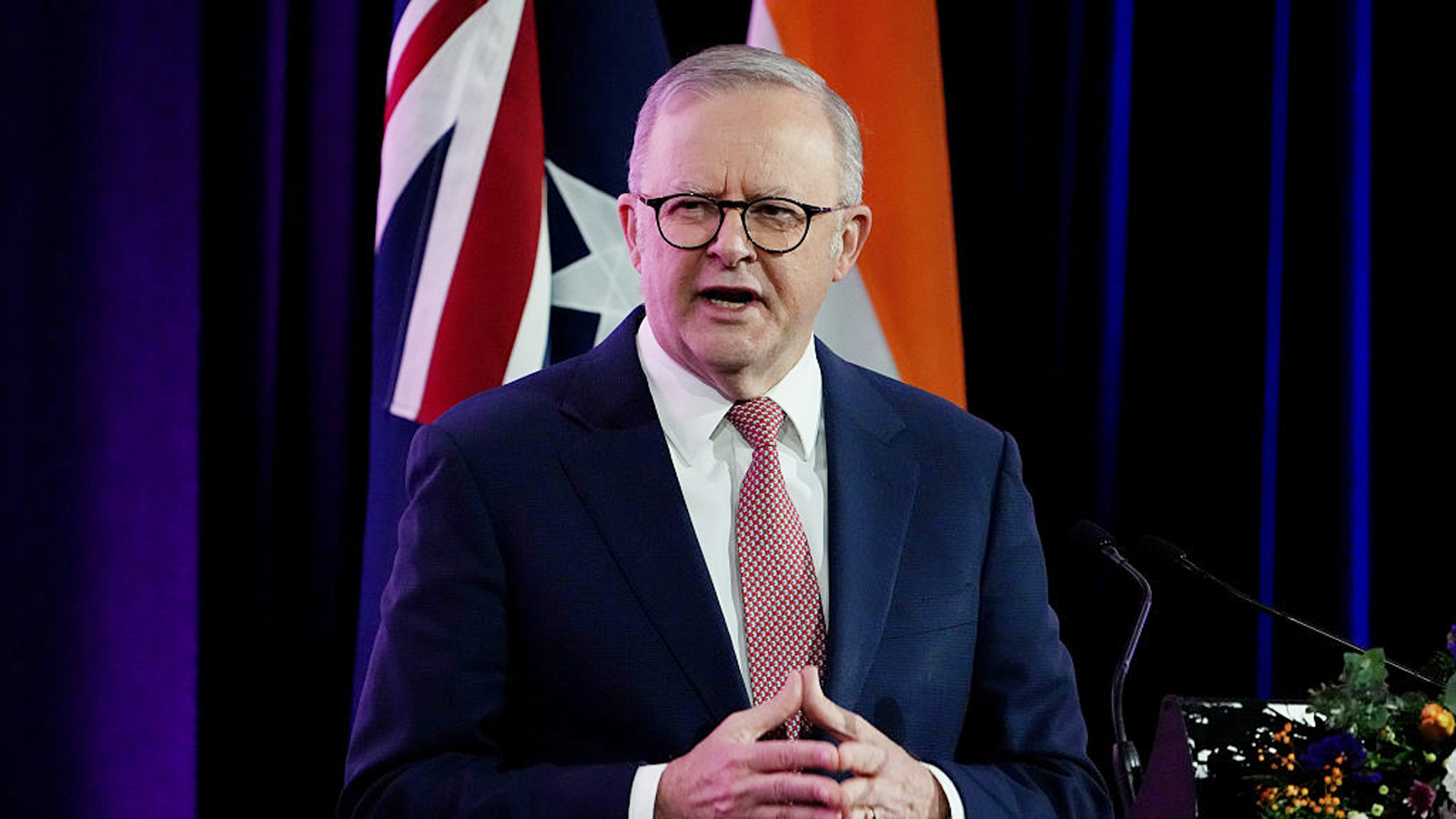
Australian Prime Minister Anthony Albanese on Thursday described India as a “top-tier security partner” and announced a series of major initiatives spanning defence, space, energy, technology and people-to-people ties, underscoring the growing strategic partnership between the two countries during Prime Minister Narendra Modi’s visit to Australia.
Addressing a joint press conference after the third India-Australia Annual Summit in Melbourne, Albanese said the two countries had taken significant steps to deepen cooperation across a wide range of sectors.
“With new landmark agreements, we are expanding our relationship across defence and security, education, science and technology, and energy security and critical minerals,” Albanese said.
Highlighting the importance of the newly announced defence cooperation framework, he said, “Australia values India as a top-tier security partner, and the declaration reflects our shared commitment to a peaceful, stable, and prosperous Indo-Pacific region.”
“We will boost strategic coordination, increase the complexity of our defence exercises, and further build interoperability between our defence forces. We undertake to consult on defence-related developments in the Indo-Pacific that affect our shared interests. In addition, we have endorsed a joint maritime security collaboration roadmap and agreed to a new Australia-India partnership on cyber, critical technologies, and supply chains,” he added.
Calling PM Modi “a true friend of Australia,” Albanese said it was “a great honour” to host the Indian leader for the annual summit.
“Six years into our Comprehensive Strategic Partnership, Australia’s relationship with India has never been more consequential than it is today. Our partnership has never been stronger,” he said.
“We share a focus on deepening and diversifying the relationship between our countries so we can continue to grow from strength to strength. Today, we have done exactly that across the breadth of our relationship,” Albanese added.
In a major boost to India’s human spaceflight programme, Albanese announced that Australia would establish a temporary space tracking terminal on the Cocos (Keeling) Islands to support the Gaganyaan mission.
“As we expand our cooperation in space and technology, we have agreed to commission a temporary space tracking terminal on the Cocos (Keeling) Islands, which will support India’s landmark Gaganyaan Human Space Flight Programme,” he said.
The announcement comes as the Indian Space Research Organisation (ISRO) continues preparations for the mission. Earlier this week, ISRO successfully carried out the fifth Integrated Main Parachute Airdrop Test (IMAT-05), validating the structural integrity and reliability of the crew module’s main parachute system for the first uncrewed Gaganyaan mission.
On energy cooperation, Albanese said both countries had agreed to strengthen energy security amid global geopolitical uncertainties.
“Today, we welcomed a joint statement on energy security. This statement recognises the importance of supply chain resilience and accelerating the energy transition, including promoting the uptake of renewable energy resources and the electrification of our energy systems.”
“For too long, we have worked with connected supply chains but disconnected approaches. This action is a step to bridge that divide,” he said.
Albanese also confirmed the signing of the administrative arrangement required to operationalise uranium exports to India under the 2015 Australia-India Nuclear Cooperation Agreement.
“Today, we can confirm the signing of the administrative arrangement to enable uranium exports to India for peaceful purposes under the 2015 Australia-India Nuclear Cooperation Agreement. The arrangement facilitates Australian uranium exports to India to help increase the share of non-fossil fuel power capacity, providing an additional market for the Australian resources sector,” he said.
Earlier in the day, Albanese also addressed thousands of members of the Indian diaspora at a community event in Melbourne, where he praised the Indian community for serving as a vital link between the two nations.
“As a true friend of Australia and a very dear friend of mine, it is an honour to host you this evening,” Albanese said while welcoming Prime Minister Modi.
“The energy that we feel in here tonight defines the Australia-India partnership. It is an enthusiasm and a dynamism that drives the positivity and promise of our two nations and peoples,” he said.
Recalling PM Modi’s visit to Australia in 2023, Albanese said, “When Prime Minister Modi hosted me three years ago, we did a lap of Ahmedabad’s Narendra Modi Stadium in a chariot. That was an experience I will never forget.”
“I can say without a shadow of a doubt, the depth of affection that I felt between our two peoples in Gujarat in 2023 is just as palpable and present tonight among this incredible crowd,” he added.
Reflecting on his first visit to India as a backpacker in 1991, Albanese said travelling across the country gave him a deeper understanding of India’s diversity.
“I learned there something very simple and clear that I have communicated to my fellow Australians. If you want to understand India, get on a train,” he said, recalling the warmth and hospitality he experienced during his travels.
Describing India and Australia as “two great democracies” and “two great multicultural societies,” Albanese highlighted the contribution of the more than one million Australians of Indian origin to Australia’s economic and social development.
“Your generosity of spirit shines through in every way. In times of trouble or national crisis, I have told Prime Minister Modi this in private before many times, but today I say it publicly as well. It is the Australian Indian community who are the first to volunteer their help and to lend a hand to their fellow community members,” he said.
“It is a generosity that extends to building the prosperity of our nation too, whether through boosting skills in critical industries like healthcare and IT, growing Australia’s dynamic small business sector, or the contribution that so many students from India make when they choose Australia as their destination to invest in themselves and their education. And that is especially true here in the education state of Victoria,” he added.
Albanese also highlighted the expanding education partnership between the two countries, noting that Victoria-based Deakin University became the first foreign university to establish a campus in India, paving the way for deeper academic collaboration.
Concluding his address, the Australian Prime Minister said Australians had been enriched by the Indian community’s cultural and economic contributions.
“We are a better nation because we have you in it. You are the living bridge between Australia and India,” Albanese said.
PM Modi’s three-day visit to Australia has resulted in a series of landmark outcomes, including a Joint Declaration on Defence and Security Cooperation, a Maritime Security Collaboration Roadmap, the Australia-India Partnership on Cyber, Critical Technologies and Supply Chains (PACTS), an energy security agreement, operationalisation of uranium exports to India for peaceful purposes, expanded cooperation in critical minerals, education, skill development, research, and maritime security, further strengthening the India-Australia Comprehensive Strategic Partnership.
(With agency inputs)


