







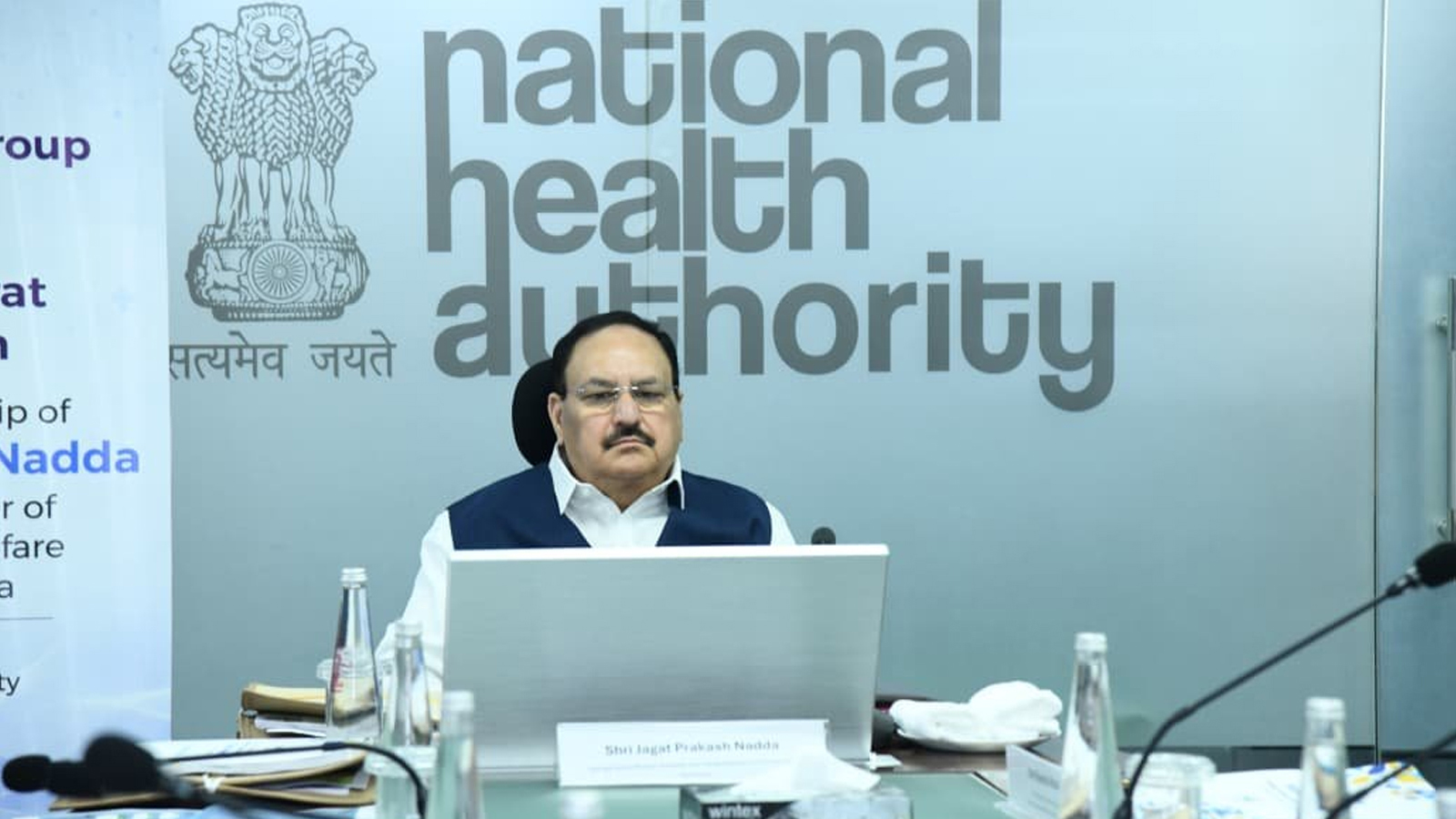
Union Health Minister Jagat Prakash Nadda on Friday said the Ayushman Bharat Digital Mission (ABDM) has emerged as one of the world’s largest digital health ecosystems, while stressing that the next phase of the mission should focus on maximizing its adoption and utilization across the country.
Chairing the third meeting of the Mission Steering Group (MSG), Nadda reviewed the progress of the flagship digital health initiative and outlined the roadmap for strengthening India’s digital health ecosystem through citizen-centric, interoperable and technology-driven healthcare.
The meeting was attended by Tripura Chief Minister Manik Saha, Madhya Pradesh Deputy Chief Minister Rajendra Shukla, Ministers of State Prataprao Jadhav, Anupriya Patel and Jitin Prasada, along with senior officials from the National Health Authority (NHA), NITI Aayog, the Ministries of Health, Electronics and Information Technology, and AYUSH.
Addressing the meeting, Nadda highlighted the transformative role of digital public infrastructure in expanding access to quality healthcare, improving continuity of care and empowering citizens through secure, consent-based access to their health records.
He said technology must continue to serve as a key enabler for achieving Universal Health Coverage while ensuring healthcare remains inclusive, accessible and easy to use for every citizen.
Reviewing the progress made since the previous Mission Steering Group meeting, members noted the significant expansion of India’s digital health ecosystem under the Ayushman Bharat Digital Mission.
According to the Health Ministry, the mission has generated more than 93.95 crore Ayushman Bharat Health Account (ABHA) numbers, linked over 105 crore digital health records, and registered 5.33 lakh health facilities and 9.85 lakh healthcare professionals on the national digital health registries.
The ministry said the mission has also enabled 2.72 lakh healthcare facilities to adopt ABDM-enabled software while generating nearly 24 crore Scan & Register tokens, facilitating faster outpatient department (OPD) registration and seamless, consent-based sharing of health information across healthcare providers.
The Mission Steering Group also reviewed progress made on key decisions taken during its previous meeting, including capacity-building initiatives, strengthening state-level implementation mechanisms, integration of digital health platforms with government health programmes, greater participation of private healthcare providers and international collaboration in digital health.
Members appreciated the rapid expansion of ABDM across states and Union Territories through initiatives such as Model Districts, Model Facilities and Aarogya Setu 2.0. They also welcomed deeper integration of the platform with flagship schemes, including Ayushman Bharat PM-JAY, the Central Government Health Scheme (CGHS), Employees’ State Insurance Corporation (ESIC) and Nikshay, noting that these initiatives are making healthcare more accessible, interoperable and citizen-centric.
The meeting deliberated on measures to accelerate nationwide adoption of ABDM by promoting nationally notified digital health standards, improving interoperability, strengthening governance mechanisms and enhancing citizen convenience through seamless digital access to healthcare services.
The members also discussed the future roadmap for the mission, with a focus on scaling up digital health adoption, leveraging emerging technologies such as artificial intelligence, strengthening institutional capacities and deepening collaboration with states and Union Territories.
Concluding the meeting, Nadda said that while India has successfully built a robust digital health infrastructure under ABDM, the next phase must focus on increasing its adoption and effective utilization across the country.
“Strengthening the health sector is integral to realizing the vision of Viksit Bharat by 2047, and ABDM will serve as a critical pillar in that journey,” he said.
The Minister expressed confidence that continued collaboration between the Centre, states, Union Territories and other stakeholders would help build a resilient, inclusive and future-ready digital health ecosystem, while ensuring seamless, secure and citizen-centric digital health services for every Indian.
The Mission Steering Group reaffirmed its commitment to advancing the objectives of the Ayushman Bharat Digital Mission and further strengthening India’s interoperable digital healthcare ecosystem.


