







As Indian athletes continue their campaign at the Commonwealth Games 2026 in Glasgow, the country’s sporting journey reflects a transformation that extends far beyond medal tallies. Over the past decade, sustained investment, expanded infrastructure and athlete-centric initiatives have reshaped India’s sporting ecosystem, with the Khelo India programme emerging as the cornerstone of this national effort.
India is making its 19th appearance at the Commonwealth Games, a journey that began in 1934. Weightlifting star Mirabai Chanu has already scripted history by winning her third consecutive Commonwealth Games gold medal, opening India’s gold medal account in Glasgow. Her achievement highlights the growing confidence and consistency of Indian athletes on the global stage.
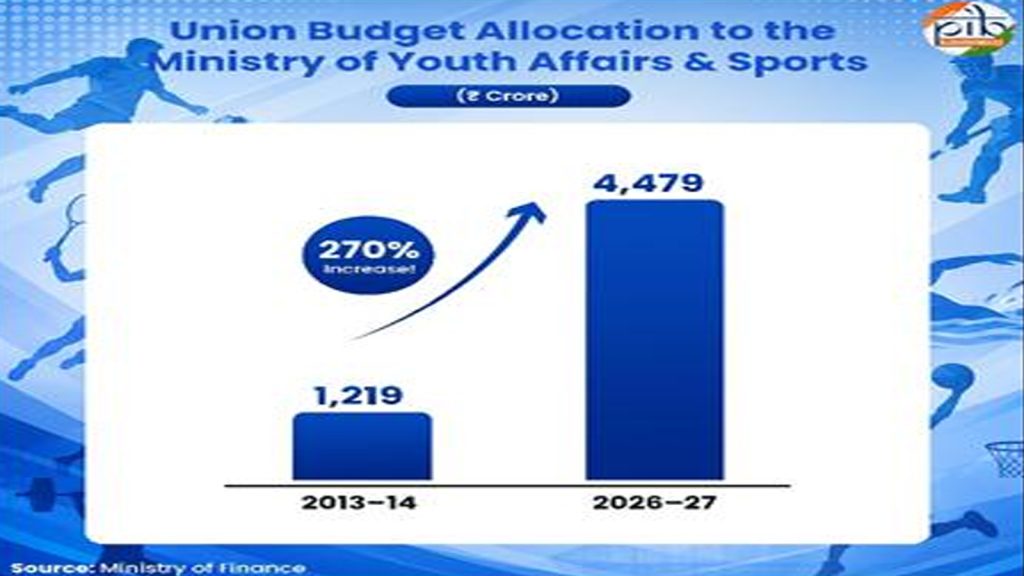
Recognising sport as a powerful instrument for nation-building, the Government has significantly increased investment in the sector. The Union Budget 2026–27 allocated a record ₹4,479.88 crore to the Ministry of Youth Affairs and Sports, a substantial rise from ₹1,219 crore in 2013–14. The investment reflects a long-term strategy to harness the country’s youthful demographic, with nearly 65 per cent of India’s population below the age of 35.
At the centre of this transformation is the Khelo India Scheme, launched in 2017 by integrating the Rajiv Gandhi Khel Abhiyan, Urban Sports Infrastructure Scheme and National Sports Talent Search Scheme into a unified framework for sports development.
The programme follows a comprehensive approach that spans talent identification, coach development, sports science, competitive opportunities and infrastructure creation. It aims to establish a Khelo India Training Centre in every district while promoting structured athlete development supported by sports science, nutrition, psychology and data-driven performance monitoring. The long-term objective is to position India among the world’s leading sporting nations by 2036.
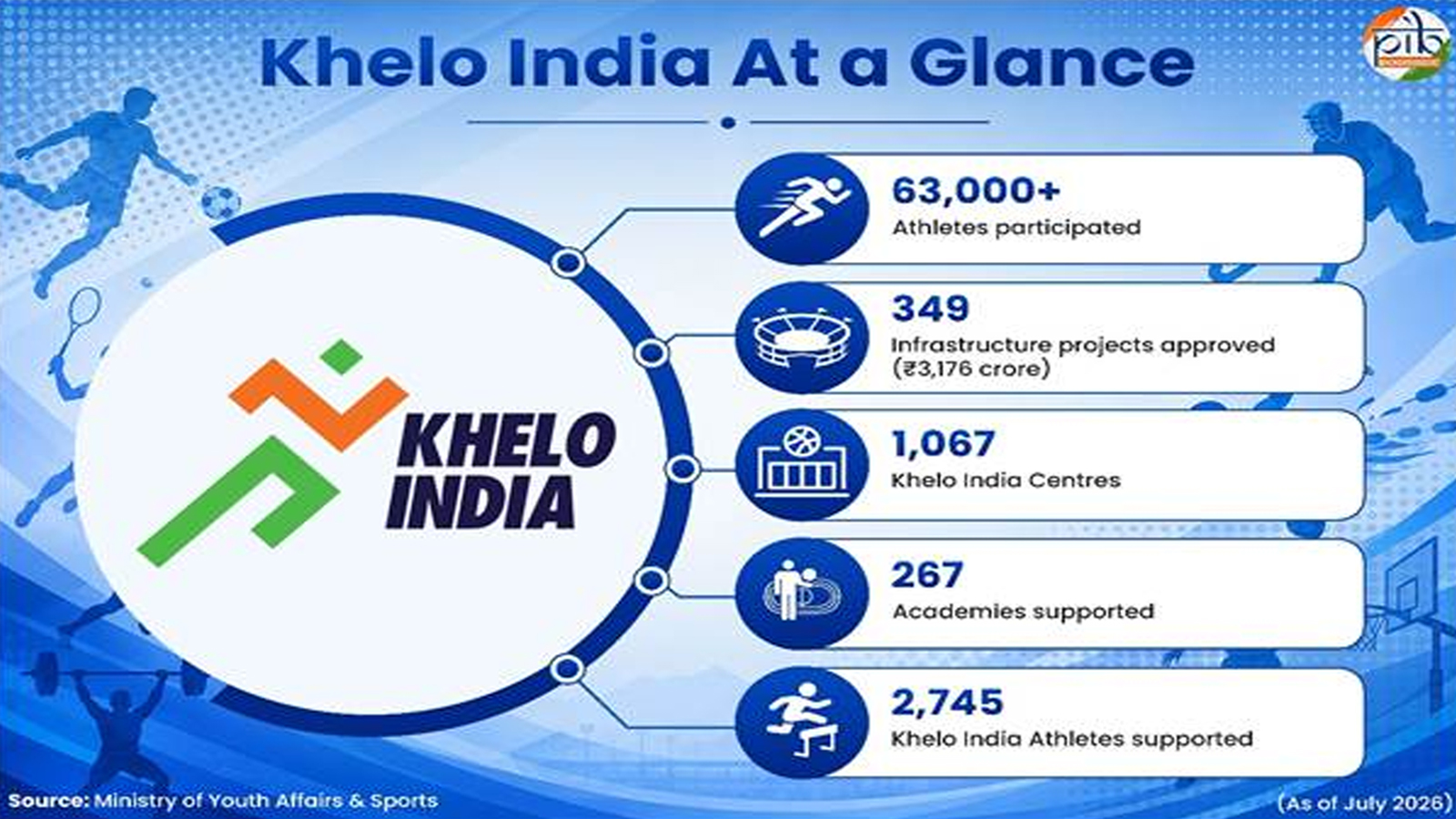
The scheme has already delivered significant results. As of July 2026, 349 sports infrastructure projects worth ₹3,176 crore have been approved across the country. The network now includes 1,067 Khelo India Centres and 267 academies, while 2,745 Khelo India Athletes receive coaching, equipment, medical support and a monthly out-of-pocket allowance.
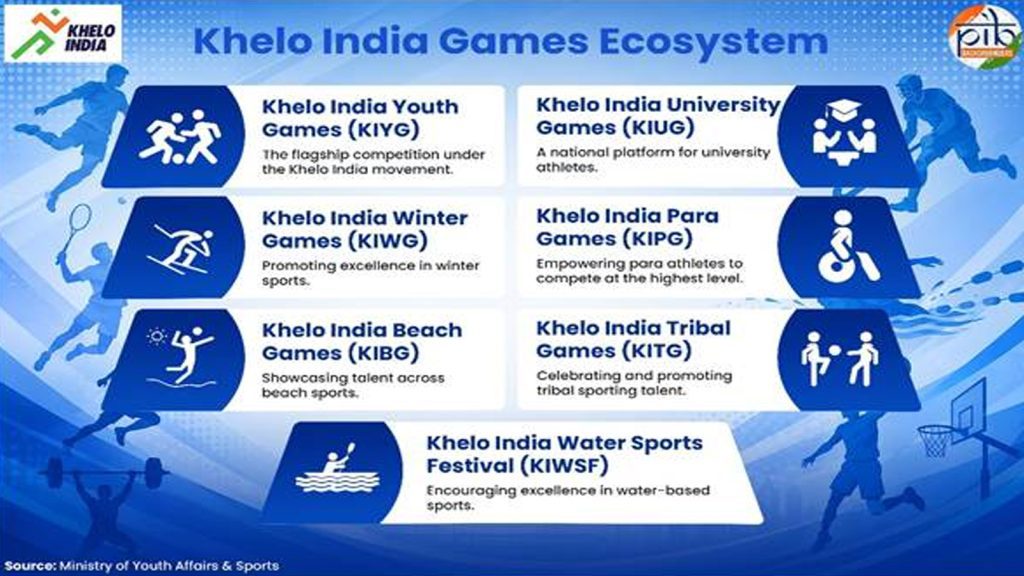
The competitive ecosystem under Khelo India has also expanded considerably. Beginning with the Khelo India School Games in 2018, the initiative evolved into the Khelo India Youth Games in 2019 and has since grown into a multi-format sporting movement. The Khelo India University Games and Winter Games were introduced in 2020, followed by the Para Games in 2023. In 2025, the Beach Games and Water Sports Festival were added, while the inaugural Tribal Games were launched in 2026. Since 2018, these events have brought together more than 63,000 athletes, providing young sportspersons with a national platform to compete and progress.
Supporting this ecosystem is the Target Olympic Podium Scheme (TOPS), launched in 2014 to improve India’s Olympic and Paralympic performance. Revamped in 2018, the scheme provides athletes with international exposure, foreign training, specialised coaching, advanced equipment and financial assistance. Core athletes receive a monthly stipend of ₹50,000, while athletes in the Development Group receive ₹25,000.
As of April 2026, TOPS supports 51 Core Athletes, 52 Para Core Athletes and 130 Development Athletes. The scheme has played a key role in India’s medal-winning performances at both the Tokyo 2020 and Paris 2024 Olympic Games.
Talent identification has also received a technological boost through the Khelo India Rising Talent Identification (KIRTI) initiative. Designed for children aged between 9 and 18 years, KIRTI uses Talent Assessment Centres, standardised testing protocols and advanced technologies, including artificial intelligence and data analytics, to identify promising athletes through a transparent and merit-based process.
The initiative currently operates 174 Talent Assessment Centres across three States and Union Territories and has completed 1,87,921 assessments. KIRTI aims to create a sustainable talent pipeline capable of helping India become a top-10 sporting nation by 2036 and a top-five sporting nation by 2047.
The Union Budget 2026–27 has also introduced a dedicated ₹500 crore initiative for sports goods manufacturing, aimed at strengthening domestic production, encouraging research and innovation, advancing material sciences and integrating India more deeply into global sports supply chains while generating employment.
The impact of these investments is increasingly visible in India’s international performances.
At the Olympic Games, India improved from two medals at Rio 2016 to seven medals at Tokyo 2020, before securing six medals at Paris 2024. The Paralympic Games have witnessed even more dramatic progress, with India’s medal tally rising from four medals at Rio 2016 to 19 at Tokyo 2020 and a record 29 medals at Paris 2024.
The country’s success has extended to other multi-sport events as well. At the Asian Games, India increased its medal tally from 57 medals at Incheon 2014 to 69 at Jakarta 2018, before achieving a historic 107 medals at Hangzhou 2023. The Commonwealth Games have also seen consistently strong performances, with India winning 64 medals in Glasgow 2014, 66 in Gold Coast 2018 and 61 medals in Birmingham 2022.
India’s campaign at the Commonwealth Games 2026 continues in Glasgow, where the Games are being held from 23 July to 2 August. The event features athletes from 74 countries competing across a 10-sport programme, including six fully integrated para sports.
India has fielded a 124-member contingent, comprising 78 men and 46 women, reflecting the country’s growing depth across sporting disciplines.
As of 27 July 2026, India has secured four medals—one gold, two silver and one bronze. Jhandu Kumar opened India’s medal account with a bronze in para powerlifting, while Rishikanta Singh claimed silver in the men’s 60 kg weightlifting event and set a new Commonwealth Games record in the snatch. Mirabai Chanu won India’s first gold medal in Glasgow, completing a remarkable hat-trick of Commonwealth Games titles, and Muthupandi Raja added another silver in the men’s 65 kg weightlifting event.
With several competitions still remaining, Indian athletes continue their pursuit of podium finishes. Their performances reflect the growing strength of India’s sporting ecosystem, built on sustained investment, improved infrastructure and structured athlete development. As the country looks ahead, the expanding network of talent identification, training and support programmes is laying the foundation for India’s ambition to emerge as one of the world’s leading sporting nations.


