







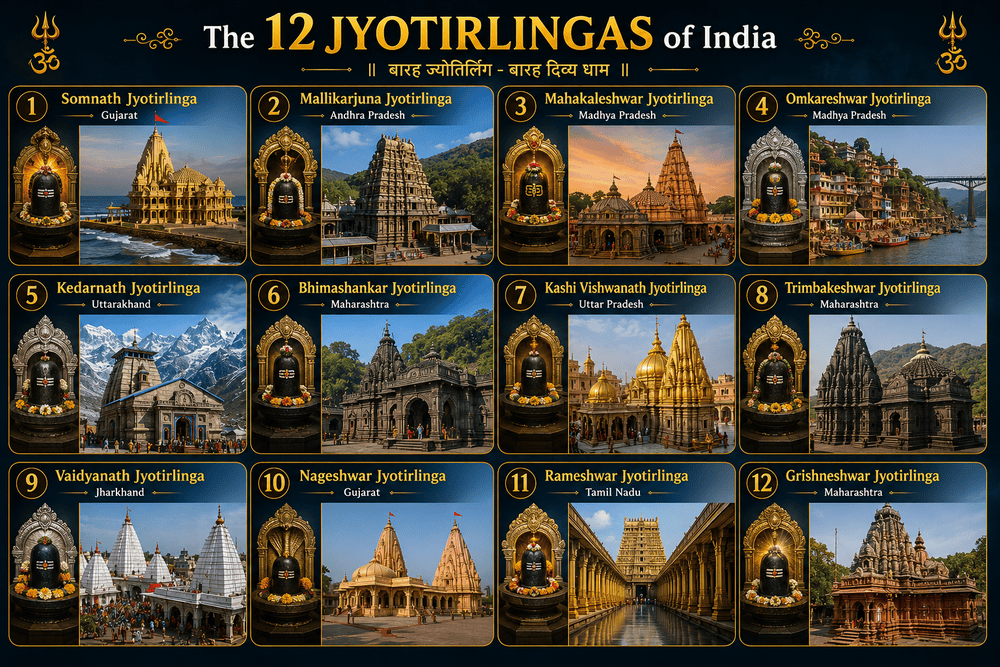
The 12 Jyotirlingas are among the most revered shrines dedicated to Lord Shiva and hold immense spiritual significance. These sacred sites represent manifestations of Lord Shiva in the form of self-emerged (Swayambhu) Jyotirlingas, symbolising his infinite divine light and cosmic presence.
Lord Shiva, one of the principal deities of the Trinity alongside Brahma and Vishnu, is worshipped in several forms, including Nataraja, Bholenath and Ardhanarishwar. His symbolic attributes—the Trishul, Damru, third eye, crescent moon, the river Ganga flowing from his matted locks, and the title Neelkanth—represent creation, destruction, wisdom, time and sacrifice.
For millions of devotees, undertaking a pilgrimage to the 12 Jyotirlingas is considered a sacred spiritual journey. Each temple has its own historical and religious significance and is associated with legends that have been passed down through generations. Devotees believe that visiting these shrines brings inner peace, spiritual fulfilment and divine blessings.
The 12 Jyotirlingas
1. Somnath Jyotirlinga – Gujarat
Located at Prabhas Kshetra near Veraval in Gujarat, Somnath is regarded as one of the oldest and most revered Shiva temples in India. According to Hindu belief, Lord Shiva relieved the Moon God (Chandra) of a curse at this sacred site, giving the temple immense religious significance.
The temple has been destroyed and rebuilt several times over the centuries, symbolising resilience, faith and devotion. The present structure reflects traditional Chalukya-style architecture and overlooks the Arabian Sea, offering a striking spiritual setting.
Somnath is one of the most visited pilgrimage destinations in western India, attracting devotees throughout the year. Nearby attractions include Gita Mandir, Triveni Sangam, Bhalka Tirth, Gir National Park and Diu Island.
2. Mallikarjuna Jyotirlinga – Andhra Pradesh
Situated at Srisailam in Andhra Pradesh, Mallikarjuna Jyotirlinga is nestled amid the scenic Nallamala Hills on the banks of the Krishna River. It is one of the few shrines where both Lord Shiva and Goddess Parvati are worshipped together, with the adjoining Bhramaramba Temple recognised as one of the 18 Shakti Peethas.
The temple is associated with the divine presence of Lord Shiva as Mallikarjuna and Goddess Parvati as Bhramaramba. Devotees believe that offering prayers here brings peace, prosperity and relief from life’s obstacles. Surrounded by forests and hills, the temple also serves as an important centre for spiritual retreats and meditation.
3. Mahakaleshwar Jyotirlinga – Madhya Pradesh
Located in the ancient city of Ujjain, Mahakaleshwar is one of the most prominent and revered Shiva temples in India. It is the only Jyotirlinga where Lord Shiva is worshipped in the form of Dakshinamukhi (south-facing), making it unique among the twelve sacred shrines.
The temple is particularly famous for its daily Bhasma Aarti, an early morning ritual performed before sunrise that attracts thousands of devotees. Hindu scriptures associate Mahakaleshwar with protection from fear, negative forces and the cycle of birth and death. Situated on the banks of the sacred Shipra River, the temple is also a major attraction during the Simhastha Kumbh Mela.
4. Omkareshwar Jyotirlinga – Madhya Pradesh
Omkareshwar is situated on Mandhata Island in the Narmada River in Madhya Pradesh’s Khandwa district. The island is believed to resemble the sacred symbol “Om” when viewed from above, adding to its spiritual importance.
The temple is one of the most visited pilgrimage centres dedicated to Lord Shiva and is surrounded by the serene waters of the Narmada. Pilgrims often perform the sacred parikrama of the island as part of their religious journey. The peaceful surroundings make Omkareshwar a popular destination for meditation, prayer and spiritual reflection throughout the year.
5. Kedarnath Jyotirlinga – Uttarakhand
Perched at an altitude of over 3,500 metres in the Garhwal Himalayas, Kedarnath is one of the most revered Shiva temples in India. It forms an important part of both the Char Dham and Panch Kedar pilgrimages.
Devotees undertake a challenging 16-km trek from Gaurikund to reach the shrine, although helicopter services are also available during the pilgrimage season. Due to heavy snowfall and extreme weather conditions, the temple remains open only for a few months each year, generally between April or May and October or November.
Surrounded by snow-clad peaks and breath-taking landscapes, Kedarnath offers both spiritual significance and natural beauty.
6. Bhimashankar Jyotirlinga – Maharashtra
Located in Pune district of Maharashtra, Bhimashankar Jyotirlinga is surrounded by the lush forests of the Western Ghats and the Bhimashankar Wildlife Sanctuary. The temple is believed to mark the origin of the Bhima River, adding to its religious significance.
Its peaceful environment and scenic surroundings attract both pilgrims and nature enthusiasts. The temple’s architecture reflects the Nagara style and showcases intricate stone carvings. Devotees visit the shrine throughout the year to seek Lord Shiva’s blessings and experience its tranquil spiritual atmosphere.
7. Kashi Vishwanath Jyotirlinga – Uttar Pradesh
Situated in the ancient city of Varanasi, Kashi Vishwanath is one of Hinduism’s holiest and most visited temples. Located close to the banks of the sacred Ganga River, the shrine holds immense spiritual importance for millions of devotees.
According to Hindu belief, visiting Kashi Vishwanath and taking a holy dip in the Ganga can help devotees attain spiritual liberation (moksha). The temple has been an important centre of learning, devotion and religious practices for centuries. Following recent redevelopment under the Kashi Vishwanath Corridor project, the temple has become more accessible to pilgrims while preserving its historical significance.
8. Trimbakeshwar Jyotirlinga – Maharashtra
Located near Nashik in Maharashtra, Trimbakeshwar Jyotirlinga is closely associated with the origin of the Godavari River, one of India’s most sacred rivers. The temple is situated at the foothills of the Brahmagiri Hills, creating a serene and picturesque setting.
It is unique because the sanctum houses a distinctive three-faced linga representing Lord Brahma, Lord Vishnu and Lord Shiva. The temple is also renowned for performing various Hindu rituals, including Narayan Nagbali and Kaal Sarp Dosh pujas. Thousands of devotees visit the shrine each year seeking spiritual peace, prosperity and blessings.
9. Vaidyanath Jyotirlinga – Jharkhand
Located in Deoghar, Jharkhand, Vaidyanath Jyotirlinga is widely regarded as a sacred centre of healing and devotion. It is said, Lord Shiva appeared here as the Divine Physician (Vaidyanath), blessing devotees with good health and well-being.
The temple complex includes several smaller shrines dedicated to various Hindu deities, making it an important pilgrimage destination. During the annual Shravan Mela, lakhs of Kanwariyas carry holy water from Sultanganj to offer at the shrine after undertaking a long pilgrimage on foot. The temple remains one of the busiest Shiva shrines in eastern India throughout the year.
10. Nageshwar Jyotirlinga – Gujarat
Situated near Dwarka on the coast of Gujarat, Nageshwar Jyotirlinga is regarded as a symbol of protection from evil, fear and negativity. It is said, Lord Shiva appeared here to rescue his devotee from a powerful demon, making the shrine an important place of worship.
The temple is known for its towering statue of Lord Shiva, which has become a prominent landmark for visitors. Its peaceful coastal surroundings enhance the spiritual experience for pilgrims. Nageshwar is often visited along with the Dwarkadhish Temple as part of a larger pilgrimage circuit in western India.
11. Rameshwar Jyotirlinga – Tamil Nadu
Located on Rameswaram Island in Tamil Nadu, Rameshwar Jyotirlinga is one of the most significant pilgrimage sites in southern India. The temple is closely associated with the Ramayana, where it is said that Lord Rama worshipped Lord Shiva before crossing the sea to Lanka.
The temple is renowned for its magnificent corridors, elaborate pillars and sacred water tanks, which hold great religious significance. It also forms an important part of the Char Dham pilgrimage, making it one of India’s most revered temples. Pilgrims from across the country visit Rameswaram to perform rituals, seek blessings and pay homage to Lord Shiva.
12. Grishneshwar Jyotirlinga – Maharashtra
Situated near the UNESCO World Heritage Site of Ellora Caves in Maharashtra’s Chhatrapati Sambhajinagar district, Grishneshwar is recognised as the twelfth and final Jyotirlinga.
Although comparatively smaller than several other Jyotirlinga temples, it is considered one of the holiest shrines dedicated to Lord Shiva. The temple displays beautiful red sandstone architecture with intricate carvings that reflect medieval craftsmanship.
Its proximity to the Ellora Caves makes it a popular destination for both pilgrims and tourists interested in India’s cultural heritage. Grishneshwar remains an important centre of worship and is often the concluding stop for devotees undertaking the pilgrimage to all twelve Jyotirlingas.
Significance of the 12 Jyotirlingas
Together, the twelve Jyotirlingas represent the most sacred centres of Lord Shiva worship across India and hold immense importance in Hindu tradition. Spread across different regions of the country, these temples reflect India’s rich spiritual, cultural and architectural heritage while attracting millions of pilgrims every year.
Each Jyotirlinga is associated with unique legends, rituals and local traditions, making every shrine distinct in its religious significance.
Devotees believe that visiting all twelve Jyotirlingas is an act of profound faith that brings spiritual fulfilment and divine blessings. Collectively, these sacred shrines continue to serve as enduring symbols of devotion, unity and India’s centuries-old religious heritage.


