







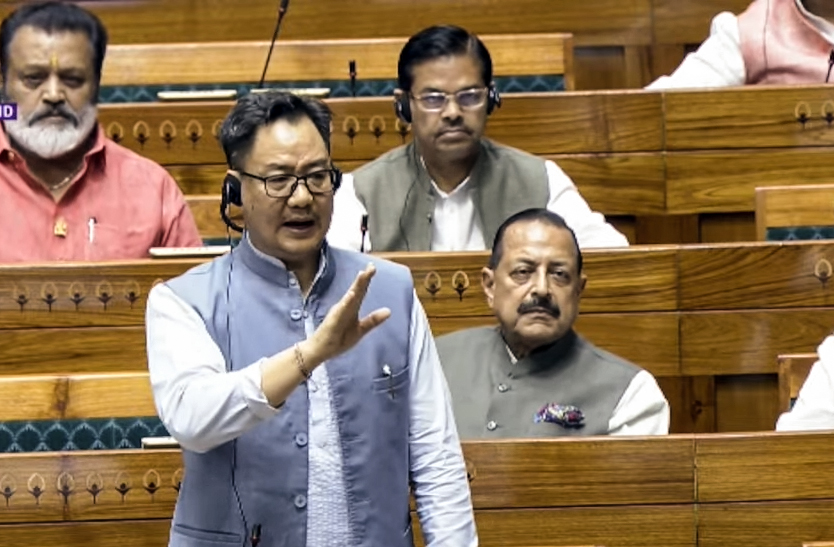
Parliamentary Affairs Minister Kiren Rijiju on Tuesday said the government was willing to extend the discussion on the Public Examinations (Prevention of Unfair Means) Amendment Bill, 2026 to as long as 10 hours, underscoring its readiness for a detailed debate on the proposed legislation.
Speaking in the Lok Sabha, Rijiju said he had held consultations with leaders of major political parties, including the Congress, Samajwadi Party, DMK and NCP, who agreed to extend the initially scheduled six-hour discussion by two hours.
“I spoke with the leaders of all parties, the Congress Chief Whip, the Samajwadi Party Chief Whip, the DMK and the NCP, and everyone agreed to extend the six-hour discussion by two hours to make it eight hours,” he said.
Rijiju added that the government had no objection to extending the debate even further if members required more time.
“If more time is needed beyond eight hours, we are ready for a 10-hour discussion,” he said, adding that the matter could be decided in consultation with the Speaker and floor leaders.
Earlier, Union Minister of State for Personnel, Public Grievances and Pensions Jitendra Singh initiated the discussion on the Bill, describing it as a “milestone legislation” that reinforces the government’s commitment to safeguarding the future of students and ensuring fairness in public examinations.
He said the amendment seeks to strengthen the Public Examinations (Prevention of Unfair Means) Act, 2024, India’s first dedicated central law to curb paper leaks and organised examination malpractice, by enhancing the credibility, transparency and integrity of the examination system.
Singh said the government introduced the 2024 Act after recognising the need for a dedicated legal framework to tackle unfair practices in public examinations. The legislation, introduced in January and notified in June 2024, was aimed at assuring students that their genuine efforts would be rewarded and their future protected.
Referring to incidents of paper leaks reported in different states over the years, the Minister said the experience gained from implementing the 2024 Act had highlighted the need for further reforms to ensure speedy justice and stronger enforcement.
He said the proposed amendment provides for stricter punishment for offenders and strengthens the legal framework to deal with organised examination fraud.
Highlighting the government’s broader efforts to reform the examination system, Singh noted that the National Testing Agency (NTA) was constituted in 2017 to advance the goal of a common testing mechanism, an idea that had been under consideration for decades.
“The earlier Act and this amendment are a reaffirmation of this governm


