







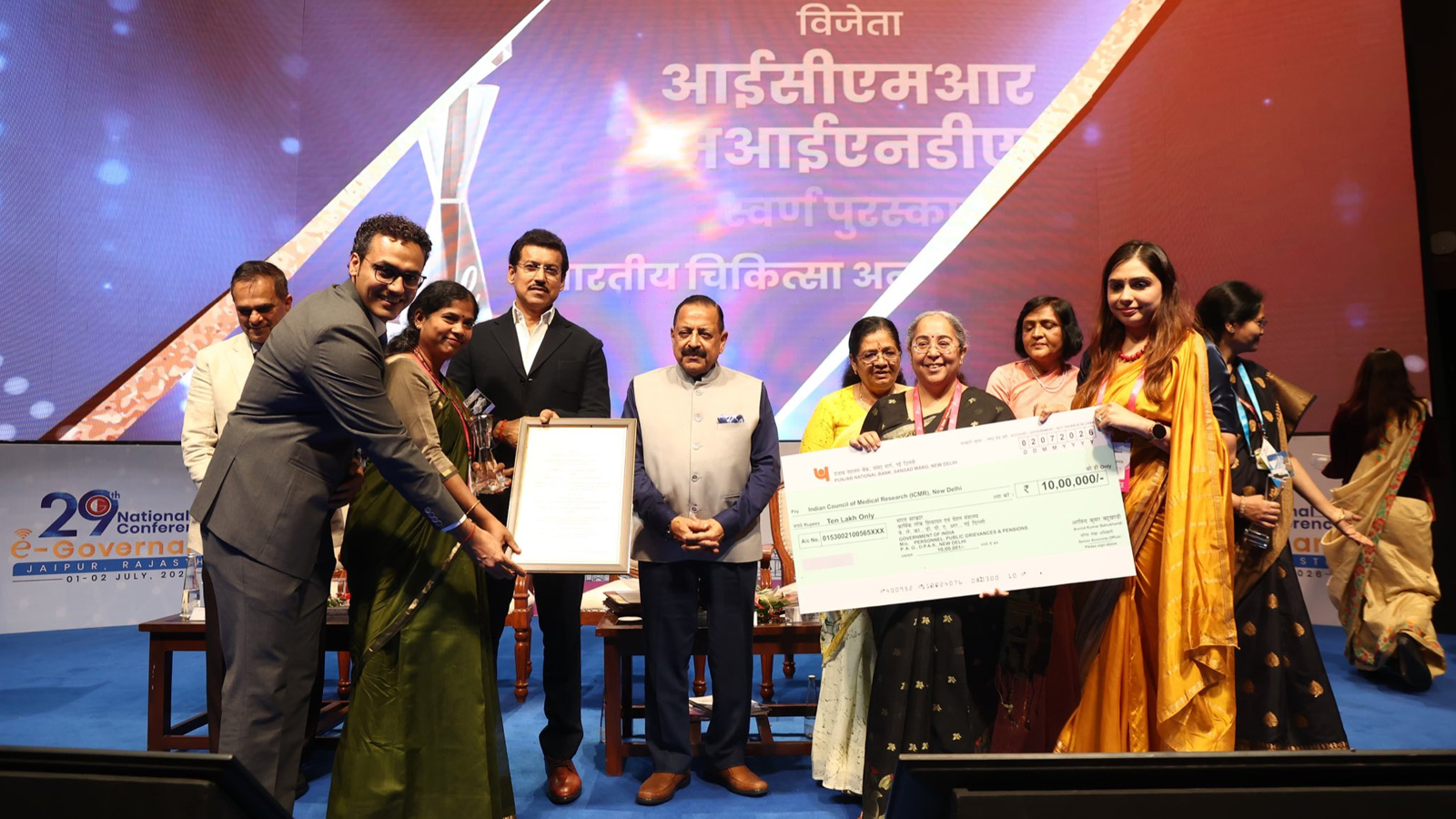
The Indian Council of Medical Research’s (ICMR) flagship digital mental healthcare initiative, ICMR-MINDS, has been awarded the Gold Award under the “Innovation by Use of AI and Other New Age Technologies for Providing Citizen-Centric Services” category at the National Awards for e-Governance 2026.
The award, instituted by the Department of Administrative Reforms and Public Grievances (DARPG) under the Ministry of Personnel, Public Grievances and Pensions, recognises the platform’s innovative use of artificial intelligence to improve access to mental healthcare and strengthen citizen-centric service delivery.
The honour was presented by Union Minister of State for Personnel, Public Grievances and Pensions Dr. Jitendra Singh during the 29th National Conference on e-Governance (NCeG) 2026, held in Jaipur, Rajasthan, on July 1 and 2. The ceremony was attended by Rajasthan Minister for Information Technology and Communication Col. Rajyavardhan Rathore, Rajasthan Chief Secretary V. Srinivas, and DARPG Secretary Nivedita Shukla Verma.
ICMR-MINDS is a National Health Research Priority project that focuses on integrating the screening and management of mental and substance use disorders with the treatment of other non-communicable diseases. At the core of the initiative is an Artificial Intelligence-enabled Clinical Decision Support System (CDSS) that enables trained frontline healthcare workers to provide standardised mental health screening, assessment, follow-up care and routine management with evidence-based digital guidance, reducing dependence on specialists.
The platform offers standardised digital screening and assessment workflows, role-based clinical guidance, multilingual interfaces, offline functionality and gamified features designed to improve user engagement. It also includes real-time administrative dashboards for monitoring healthcare delivery and strengthening programme implementation.
A key feature of the platform is its continuity-of-care framework, which facilitates structured referrals and two-way back-referral mechanisms. This allows patients with stable conditions to receive follow-up care at nearby health facilities while enabling specialists to focus on more complex cases. According to ICMR, the approach helps optimise specialist resources, empowers frontline healthcare providers, improves treatment adherence, reduces patient dropout and eases the burden on tertiary healthcare institutions.
The initiative is currently being implemented across seven states through seven collaborating institutions. These include the All India Institute of Medical Sciences (AIIMS), Guwahati in Assam, Gujarat Institute of Mental Health in Ahmedabad, AIIMS New Delhi for Haryana, St. John’s Medical College in Bengaluru, AIIMS Bhopal in Madhya Pradesh, AIIMS Bhubaneswar in Odisha, and the Postgraduate Institute of Medical Education and Research (PGIMER) in Chandigarh for Punjab.
Reacting to the recognition, Dr. Rajiv Bahl, Secretary, Department of Health Research, and Director General of ICMR, said the organisation would continue to develop scalable, data-driven technology solutions to address complex public health challenges. He added that ICMR remains committed to working closely with participating institutions and state health systems to provide affordable, standardised and high-quality healthcare platforms for people across the country.
ICMR said the success of the project has been made possible through close collaboration with the State Health Departments of Assam, Gujarat, Haryana, Karnataka, Madhya Pradesh, Odisha and Punjab, along with State Mental Health and Non-Communicable Disease programme teams, district health authorities, principal investigators, healthcare professionals and field teams involved in implementing the initiative.


