







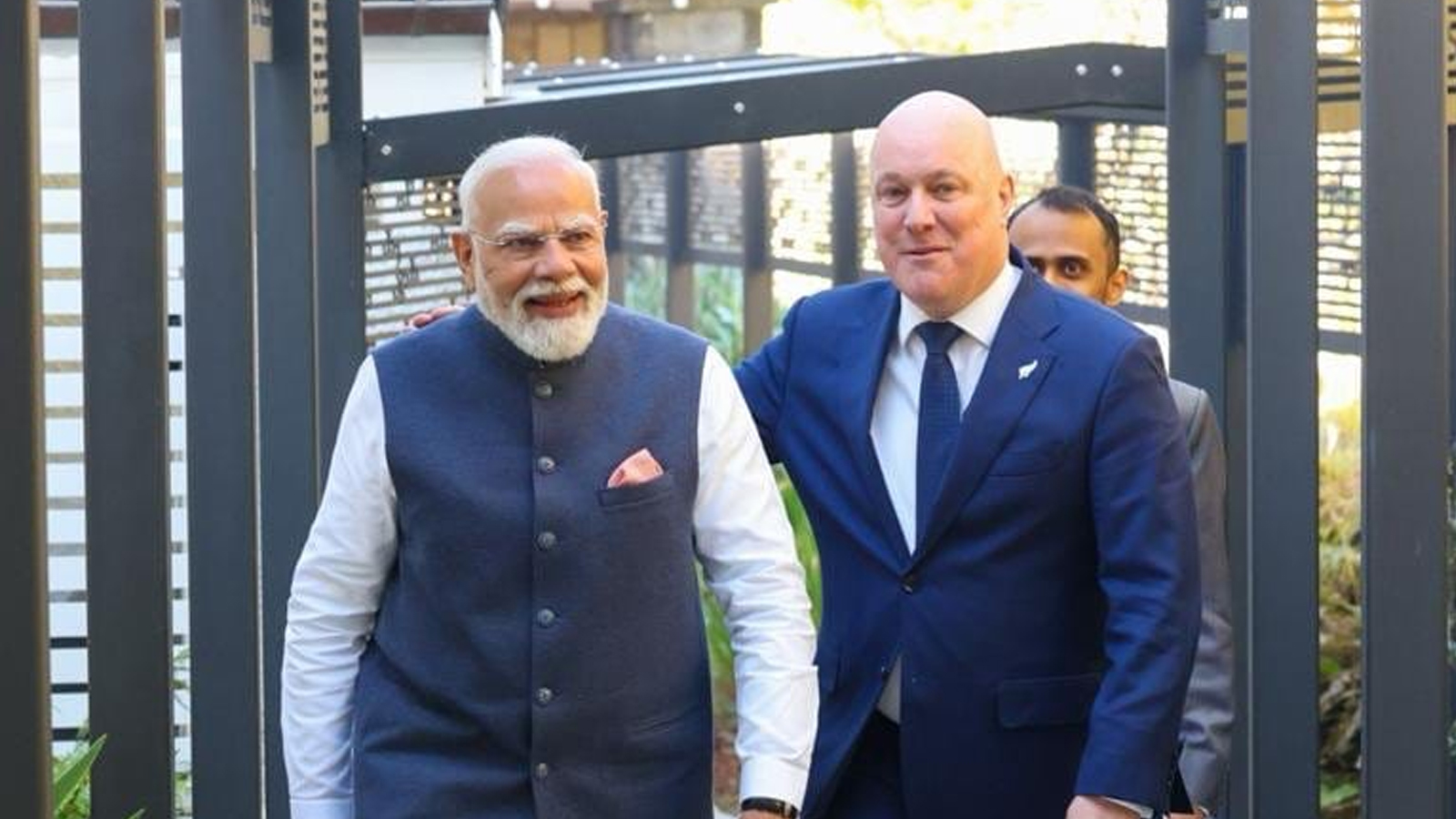
India and New Zealand have outlined an ambitious roadmap to strengthen their newly elevated Strategic Partnership, with trade, investment, security, education, traditional medicine, maritime cooperation and sports emerging as key pillars of future collaboration, the Ministry of External Affairs (MEA) said on Saturday.
Addressing a special media briefing during Prime Minister Narendra Modi’s historic visit to New Zealand, MEA Secretary (East) Rudrendra Tandon said the visit had imparted fresh momentum to bilateral ties and laid the foundation for long-term cooperation across multiple sectors.
Highlighting the economic agenda of the visit, Tandon said PM Modi held extensive discussions with New Zealand’s business community and made several suggestions to strengthen trade and investment.
“But of course, it’s also going to be intensive discussions on how to take the trade and economic relationship forward. The Prime Minister had an extensive interaction with the business community today, and in fact made several suggestions as to how to take the trade and economic relationship forward,” he said.
The MEA said the recently concluded India-New Zealand Free Trade Agreement (FTA) is expected to unlock new opportunities for businesses, farmers and young people in both countries.
Addressing a gala luncheon hosted by New Zealand Prime Minister Christopher Luxon, PM Modi noted that bilateral trade has grown by more than 50 per cent over the past three years and expressed confidence that the FTA would help double trade within the next five years. He also welcomed New Zealand’s commitment to invest USD 20 billion in India, saying it would provide opportunities for New Zealand companies to become long-term partners in India’s growth story.
Responding to questions about the proposed investment, Tandon said the FTA itself would create strong incentives for investors.
“The Prime Minister made it very clear that this is a long-term partnership. My suspicion is that when the India-New Zealand FTA is ratified and starts getting implemented, the opportunities will be so attractive. India is a very attractive investment destination in the emerging market space. So I suspect that monitoring will not really be required,” he said.
The two countries also agreed to expand cooperation in education, research, science, technology and innovation, describing these sectors as central pillars of the bilateral relationship.
According to the joint statement issued after the talks, both Prime Ministers encouraged institutions, industry and government agencies to build partnerships in agriculture, climate action, digital transformation, innovation and emerging technologies. They also agreed to strengthen student mobility, institutional collaborations and research partnerships under the 2025 Education Cooperation Arrangement.
The leaders welcomed New Zealand’s decision to join the Global Biofuels Alliance and reaffirmed cooperation through the International Solar Alliance and the Coalition for Disaster Resilient Infrastructure. They also welcomed the signing of a Memorandum of Cooperation between India’s National Disaster Management Authority and New Zealand’s National Emergency Management Agency to strengthen disaster preparedness and resilience.
Traditional medicine and indigenous knowledge systems also featured prominently in the discussions.
“Traditional medicine and celebrating indigenous cultures, and people-to-people connect will be an important underpinning of the relationship,” Tandon said.
He noted that India and New Zealand are building cooperation between India’s AYUSH systems and Maori traditional healing practices under the Health and Traditional Medicine Annex of the bilateral FTA.
“One of the things we are doing this time is that we are focusing on traditional medicine. As you know, the Prime Minister has always believed that traditional medicine in a public health care system is a very important preventive health care,” he said.
Describing the initiative as a significant opportunity, Tandon added, “Collaboration between New Zealand’s ancient Maori culture and India’s own traditional medicine is a very exciting area of cooperation and very relevant to contemporary times. This is certainly something that the Prime Minister himself is very interested in promoting.”
On strategic affairs, the MEA announced that India and New Zealand will establish a Joint Working Group on Counter-Terrorism as part of the newly adopted India-New Zealand Strategic Partnership: Roadmap to 2030.
“India’s position on terrorism and violent extremism is very well known. We will constantly remind the international community and our partners that this poses a significant threat to peace and security all over the world. We work with partners to tackle this scourge,” Tandon said.
He described New Zealand as a like-minded partner in combating terrorism and violent extremism.
“The Joint Working Group that we are establishing with New Zealand is just one of the many steps. But New Zealand and India are fairly like-minded and tough on this entire issue of terrorism and violent extremism and the need to ensure the closest collaboration to defeat this threat,” he said.
Stressing India’s consistent position on global security, Tandon added, “We also know that there can be no double standard when you are tackling such a grave threat.”
The Joint Statement issued after the summit condemned terrorism in all its forms, including cross-border terrorism, and specifically referred to the terrorist attacks in Pahalgam in April 2025 and near Delhi’s Red Fort in November 2025. Both countries committed to adopting a zero-tolerance approach towards terrorism, disrupting terror financing, eliminating safe havens and strengthening cooperation through multilateral platforms such as the Financial Action Task Force (FATF).
India and New Zealand also reaffirmed their commitment to a free, open, peaceful and prosperous Indo-Pacific, supporting freedom of navigation in accordance with the United Nations Convention on the Law of the Sea (UNCLOS) and calling for comprehensive reforms of the United Nations Security Council.
Tandon also said that the two countries would sign a maritime cooperation arrangement under the existing defence cooperation framework to enhance collaboration in the maritime domain.
Sports emerged as another priority area of cooperation, with the MEA noting that New Zealand’s sporting expertise could benefit India as it prepares to host the Commonwealth Games and pursues its Olympic ambitions.
“There are also areas like sports, where we intend to move forward. New Zealand is a sporting giant. Your per capita gold medal count is probably the highest compared to your population. India, as you know, is going to host the Commonwealth Games, and we also have aspirations to host the Olympics at some stage. There is much that we have to learn in sports, and that will be a focus in our relationship,” Tandon said.
He also identified higher education as an important growth area, citing India’s recent reforms allowing foreign universities to establish campuses in the country.
“There is a significant number of Indian students here. We have undertaken reforms in our legislation. So now foreign campuses are opening up their establishment in India. So this is another area that we will see further intensification going forward,” he said.
Responding to a question on New Zealand’s visa policy, Tandon said visa decisions were a sovereign matter for Wellington.
“On visas, this is actually a question you need to address to the New Zealand side. That’s a sovereign decision. As long as our businesses can work, our students get to study and exchanges planned by both sides are taking place, visa decisions are sovereign and we cannot really comment on them,” he said.
During the briefing, Tandon also responded to a question on why PM Modi had not held a press conference during the visit.
“It is not appropriate for me as a civil servant to question Mr. Modi’s political method. He’s a very successful politician. Prime Minister Modi is a quintessential Indian politician. By and large, Indian politicians favour direct contact with their electorate,” he said.
Explaining further, Tandon added, “The Indian electorate are predominantly rural folk. They want direct contact. They don’t like being spoken down to or through intermediaries. Mr. Modi has perfected the art of direct contact with his electorate, and he seems to be doing a rather good job of it, since he is now serving his third term and is one of the longest-serving Prime Ministers in our country.”
(With ANI inputs)


