







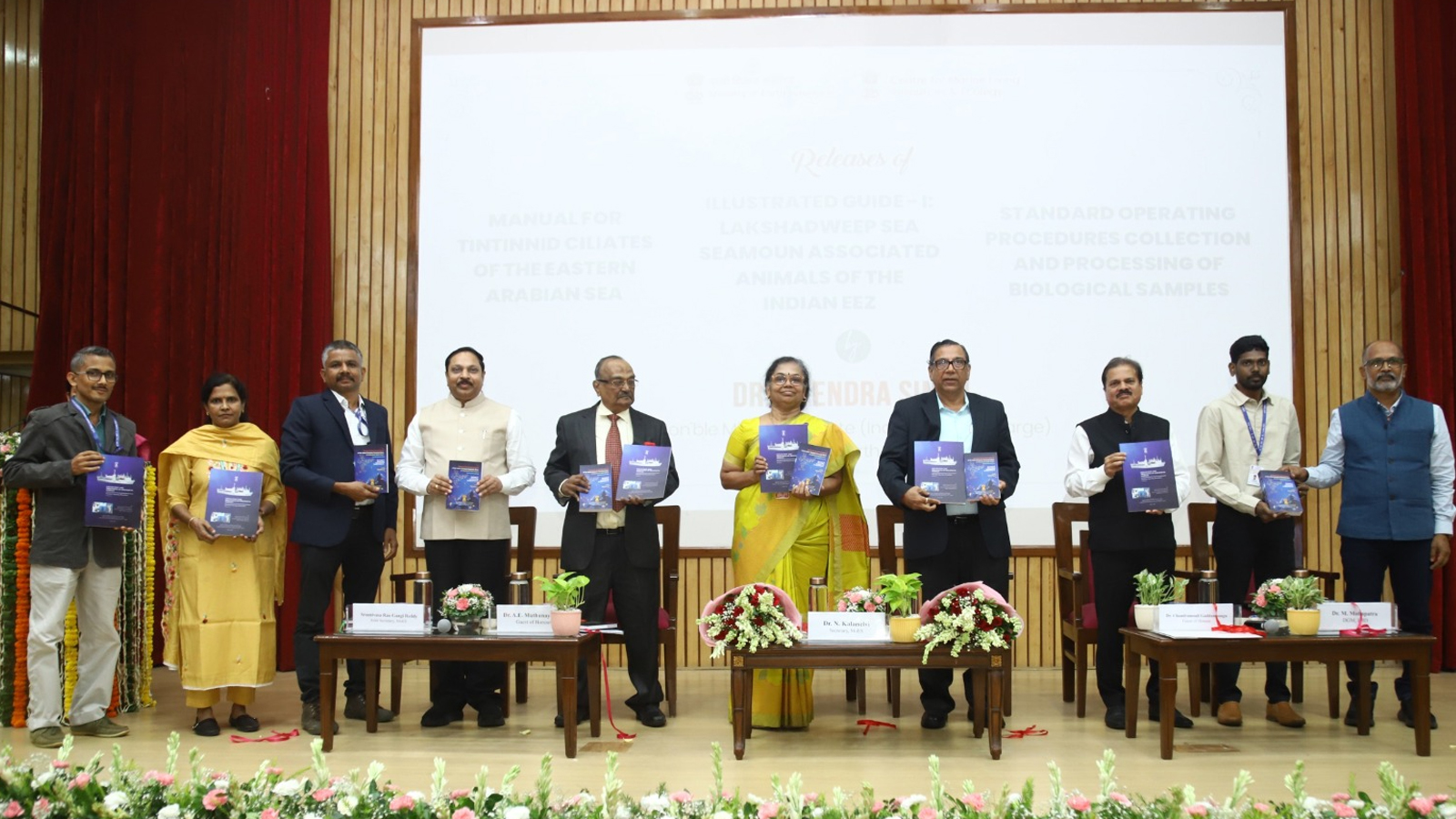
The Ministry of Earth Sciences (MoES) on Monday celebrated its 20th Foundation Day at Prithvi Bhawan in New Delhi, marking two decades of contributions to weather forecasting, earth systems science, oceanography, seismology and polar research. The occasion also saw the launch of several new scientific initiatives, digital platforms and research publications aimed at strengthening weather services, disaster preparedness and marine research.
The event was presided over by MoES Secretary Dr. N. Kalaiselvi, who described the Ministry as an indispensable pillar in the country’s scientific ecosystem.
Addressing scientists, policymakers and researchers, Dr. Kalaiselvi said the Ministry has evolved into a complete value chain by generating scientific data through its Prithvi systems, delivering public services through Mission Mausam and advancing technology through the Deep Ocean Mission. She also highlighted the close integration between the 20-year-old Ministry and the more than 150-year-old India Meteorological Department (IMD), describing it as a unique blend of experience and innovation.
The Foundation Day celebrations were attended by distinguished scientists, including Padma Shri awardee Dr. A.E. Muthunayagam, the founding Secretary of the erstwhile Department of Ocean Development, and Padma Shri awardee Dr. Chandramouli Gaddamanugu, a veteran defence scientist associated with the Akash missile programme.
Dr. Muthunayagam reflected on the evolution of India’s ocean research programme, tracing its beginnings to the establishment of the Department of Ocean Development in 1981. He highlighted milestones including India’s first Antarctic expedition, the establishment of permanent research stations such as Dakshin Gangotri, Maitri and Bharati, the creation of institutions including NIOT, NCPOR and INCOIS, and advances in ocean thermal energy conversion and desalination technologies.
Dr. Gaddamanugu drew parallels between defence technology and earth sciences, stressing the importance of indigenous innovation, multidisciplinary collaboration and rigorous scientific validation in addressing national challenges.
Among the major announcements, the India Meteorological Department (IMD) unveiled 13 Centres of Excellence dedicated to specialised areas such as desert meteorology, mountain meteorology, thunderstorm research and agrometeorology. The Ministry also announced the upgradation of the Cyclone Warning Centre in Thiruvananthapuram into an Area Cyclone Warning Centre, expanding its coverage to Kerala, Karnataka and Lakshadweep.
The IMD signed a memorandum of understanding with ICAR-NIVEDI to establish the Weather Driven Animal Disease Risk Forecasting Unit (WAADRU), which will provide district-level livestock disease risk forecasts up to two months in advance. The department also launched IMD NOVA, a web-based platform for tracking, validating and archiving thunderstorm nowcasts using lightning network and automatic weather station data.
The National Centre for Medium Range Weather Forecasting (NCMRWF) introduced the WINGS mobile application, offering numerical weather prediction, artificial intelligence and machine learning-based forecasts, and real-time weather analysis. It also launched the National Doppler Weather Radar Reflectivity Mosaic, a near real-time visualisation system developed under Mission Mausam for monitoring severe weather systems, along with an upgraded Open Data Portal featuring expanded weather and ocean datasets.
The National Centre for Seismology (NCS) released the Compendium of Monthly Seismological Bulletins for 2023 and 2024, providing validated earthquake catalogues and seismic data. It also published the Strong Motion Atlas of India (2010–2020), a compilation of strong ground-motion records to support earthquake engineering and hazard assessment.
The Centre for Marine Living Resources and Ecology (CMLRE) released new taxonomic manuals documenting marine biodiversity, including a pictorial identification guide covering 100 species of Tintinnid ciliates from the eastern Arabian Sea and a publication on 225 seamount-associated species from the Lakshadweep Sea. It also issued standard operating procedures for the collection and analysis of marine biological samples.
The National Centre for Coastal Research (NCCR) launched the Sagar Prahari App, an artificial intelligence-enabled mobile application that allows citizens to geo-tag beach clean-up activities and automatically identify marine litter. It also introduced SAHAV 2.0, an upgraded GIS-based decision-support platform for marine spatial planning featuring advanced geospatial analytics and ocean accounting modules.
The National Institute of Ocean Technology (NIOT) inaugurated new infrastructure for its Ballast Water Treatment Test Facility at Pamanji in Andhra Pradesh, including a marine pipeline trestle, boat landing facility, seawater intake system and an Internet of Things-enabled nearshore met-ocean observatory. The institute also deployed eight floating fish cages for open-sea mariculture of Asian seabass at Chidiyatappu in the Andaman and Nicobar Islands.
As part of its Deep Ocean Mission, NIOT announced industry outreach initiatives for exploring 75,000 square kilometres of the Central Indian Ocean Basin for polymetallic nodules. The Ministry also launched Ocean Olympiad India 2026, a national multi-stage competition designed to promote ocean literacy among undergraduate students.
The celebration concluded with a renewed commitment by the Ministry to advance atmospheric, oceanic, polar and cryospheric research while strengthening scientific services for disaster management, climate resilience and sustainable development.


