







The India Meteorological Department (IMD) has significantly improved the accuracy of its long-range monsoon forecasts since adopting an advanced Multi-Model Ensemble (MME) forecasting system in 2021, the government informed Parliament on Wednesday.
In a written reply to the Lok Sabha, Minister of State (Independent Charge) for Earth Sciences Dr. Jitendra Singh said the IMD’s operational long-range forecasts issued since 2021 have remained within the prescribed forecast error limits. The average absolute error of forecasts during the 2021-2025 period stood at 2.2 per cent of the Long Period Average (LPA), marking a substantial improvement over previous years.
The government said the IMD adopted the advanced MME approach in 2021 to enhance the reliability of seasonal monsoon forecasts. The system combines predictions from multiple coupled dynamical climate models, reducing uncertainties associated with individual models and improving forecast skill.
According to data shared in Parliament, the average absolute error of the first-stage monsoon forecast declined to 3.1 per cent of the LPA during 2021-2025, while the second-stage forecast recorded an average error of 2.2 per cent. In comparison, the average absolute forecast error during 2016-2020 was 7.8 per cent, indicating a significant improvement in forecast accuracy following the operational adoption of the MME system.
The government also noted that during the last ten years, the forecast error exceeded 10 per cent of the LPA only once, in 2019, when the absolute forecast error reached 14 per cent. Since 2021, however, all operational monsoon forecasts have remained within the model’s error limits.
The data presented in Parliament shows that India received 108 per cent of the Long Period Average rainfall in both 2024 and 2025, while the IMD’s second-stage forecasts for these years were 106 per cent of the LPA, demonstrating close alignment between predictions and actual monsoon performance.
The Ministry said the MME system has also improved the representation of major climate drivers such as the El Niño-Southern Oscillation (ENSO) and the Indian Ocean Dipole (IOD), leading to more consistent and reliable seasonal monsoon predictions.
The government informed Parliament that several initiatives are underway to further strengthen long-range weather forecasting and prediction of extreme weather events. These include continuous upgrades to numerical weather prediction models through improved model physics, higher spatial resolution, advanced data assimilation techniques and enhanced computing capacity.
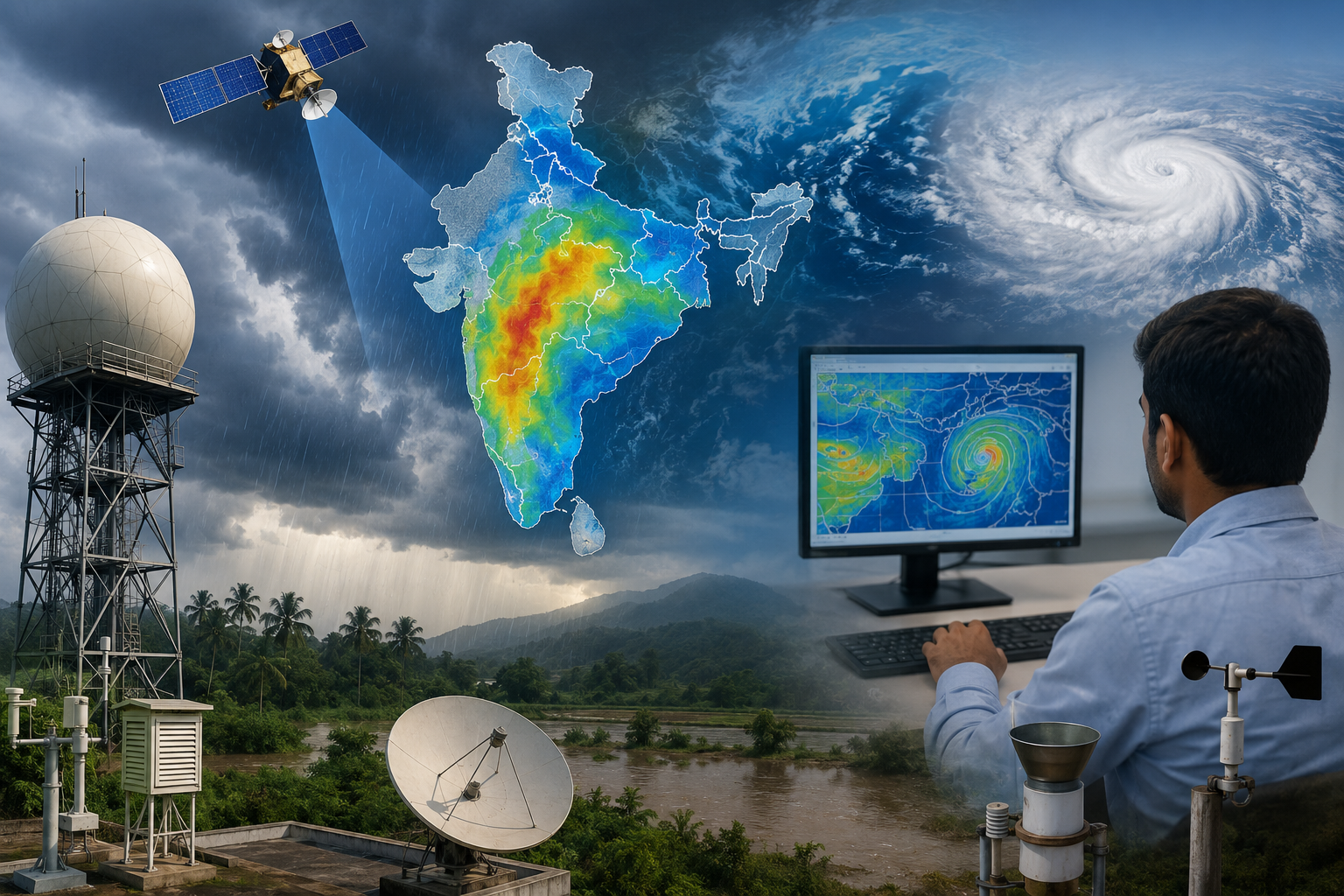
The Centre is also modernising meteorological infrastructure under Mission Mausam, which includes expanding the network of Doppler Weather Radars, Automatic Weather Stations, Automatic Rain Gauges, upper-air observing systems and wind profilers. The mission also leverages high-performance computing and artificial intelligence and machine learning-based forecasting tools to improve weather prediction capabilities.
In addition, the IMD is strengthening satellite-based observations through indigenous meteorological satellites while integrating satellite, radar and ground-based observations into forecasting models. Weather forecasts and warnings are being disseminated through mobile applications, web portals, APIs, SMS, television, radio and social media in coordination with Central and State government agencies.


