







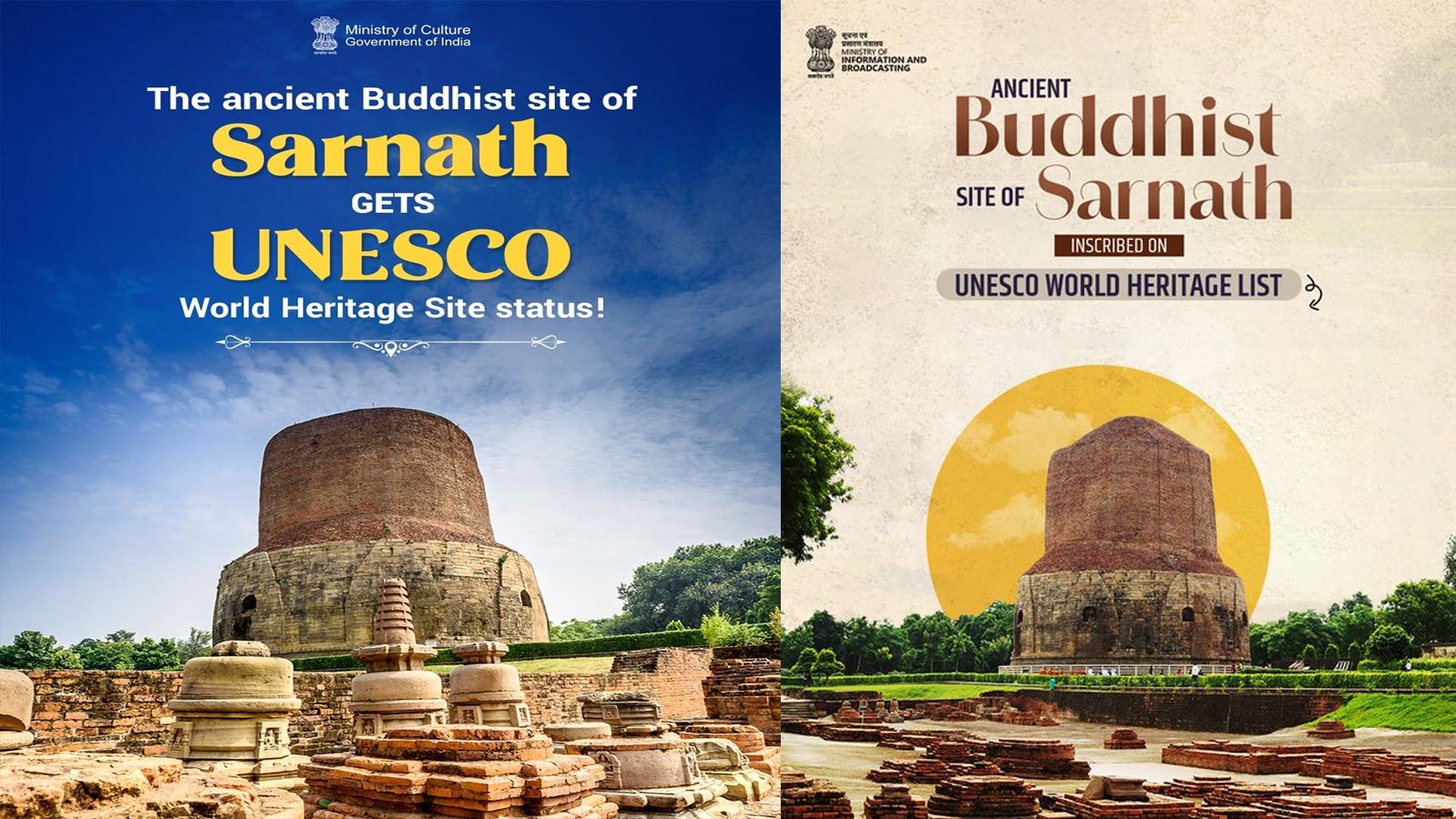
Prime Minister Narendra Modi on Saturday welcomed the inscription of Sarnath in Uttar Pradesh on the UNESCO World Heritage List, describing it as “a proud moment for every Indian” and a recognition of the country’s rich civilisational and spiritual heritage.
In a post on X, the Prime Minister said, “A proud moment for every Indian! Delighted that Sarnath in Uttar Pradesh has been inscribed on the UNESCO World Heritage List.”
Highlighting the site’s historical and spiritual significance, the Prime Minister said, “Sarnath has a close association with Lord Buddha, whose timeless message of wisdom, compassion and harmony inspires the world. This recognition celebrates India’s profound civilisational and spiritual heritage. It will also inspire more people across the world to come to Sarnath and connect with the ideals of Lord Buddha.”
The inscription was announced during the 48th session of the UNESCO World Heritage Committee, being held in Busan, South Korea, from July 19 to 29.
The Ministry of External Affairs (MEA) also welcomed the development, stating that the inclusion of Sarnath on the World Heritage List celebrates India’s rich heritage and will encourage people across the world to connect with Lord Buddha’s enduring message of wisdom, compassion and harmony.
According to the Permanent Delegation of India to UNESCO, Sarnath occupies a unique place in world history as the site where Lord Buddha delivered his first sermon after attaining enlightenment, setting in motion the Wheel of Dharma and establishing the Buddhist Sangha.
The delegation also highlighted the significance of the Lion Capital of Ashoka, discovered at Sarnath and later adopted as the National Emblem of India, further enhancing the site’s historical importance.
India’s Ambassador and Permanent Representative to UNESCO, Vishal V. Sharma, described the inscription as a landmark achievement, saying Sarnath continues to serve as a place of reflection for more than 500 million Buddhists around the world. He said the site’s teachings inspire people, particularly young generations, to seek truth, embrace non-violence, practise mindful living and contribute to inclusive social transformation, in line with the shared values of India and UNESCO.
Vice President C.P. Radhakrishnan also welcomed the recognition, calling it a moment of immense pride for the nation.
In a post on X, he said Sarnath stands as an enduring symbol of peace, wisdom and compassion and embodies India’s timeless spiritual and philosophical heritage. He added that the UNESCO inscription reaffirms India’s enduring civilisational legacy as a source of profound spiritual thought that continues to resonate with humanity across generations.
Union Culture Minister Gajendra Singh Shekhawat and Uttar Pradesh Chief Minister Yogi Adityanath also welcomed the inscription, describing it as a proud moment for the nation and a recognition of India’s rich cultural heritage.
The recognition marks a major milestone for India’s cultural heritage, acknowledging Sarnath’s outstanding universal value as one of Buddhism’s holiest pilgrimage destinations and reaffirming the country’s enduring civilisational and spiritual legacy.
The World Heritage inscription covers a serial property comprising Chaukhandi Stupa and the Archaeological Remains of Sarnath, including the Dhamekh Stupa, Dharmarajika Stupa, Mulagandhakuti Vihara, the Ashokan Pillar and other ancient monuments located near Varanasi.
According to the Archaeological Survey of India (ASI), Sarnath occupies a unique place in Buddhist history as the site where Lord Buddha delivered his first sermon after attaining enlightenment in the 6th century BCE, an event known as Dharmachakra Pravartana or the “Turning of the Wheel of the Law.” It also marks the establishment of the Buddhist Sangha and the teaching of the Noble Eightfold Path.
Regarded by Buddha himself as one of the four principal Buddhist pilgrimage sites, Sarnath flourished for centuries under the patronage of kings, monasteries and devotees. Numerous stupas, temples and monasteries were constructed around the sacred site before it declined following its destruction in the 12th century. The site remained largely forgotten until its rediscovery during the 18th century.
The archaeological complex preserves remains dating from the pre-Mauryan period (5th–4th century BCE) to the 12th century CE, offering a continuous record of nearly 1,600 years of religious, architectural and cultural development.
The nomination process began after Sarnath was included in UNESCO’s Tentative List in 1998. India’s formal nomination was submitted in January 2025, followed by an 18-month evaluation process involving technical assessments, consultations with UNESCO’s advisory body ICOMOS, and an on-site inspection before the World Heritage Committee approved the inscription.
UNESCO recognised Sarnath under Criteria (iii) and (vi), acknowledging its exceptional testimony to Buddhist civilisation and its direct association with events of outstanding universal significance in the life of Lord Buddha, particularly his first sermon and the formation of the Buddhist monastic community.
The recognition further strengthens India’s position as the birthplace of Buddhism. With Sarnath’s inclusion, three of Buddhism’s four most sacred pilgrimage sites—Lumbini in Nepal, the Mahabodhi Temple at Bodh Gaya in Bihar and Sarnath—are now on the UNESCO World Heritage List.
The inscription also highlights the historical significance of the Ashokan Lion Capital, discovered during ASI excavations at Sarnath and later adopted as the National Emblem of India, as well as the celebrated Dharmachakrapravartana Buddha sculpture from the Gupta period, both preserved in India’s oldest site museum established at Sarnath in 1904.
The Culture Ministry said the recognition is expected to boost international cultural tourism while reinforcing India’s cultural diplomacy with Buddhist-majority countries, including Japan, Thailand, Sri Lanka, Myanmar, Cambodia, Vietnam, South Korea and Mongolia.
The Ministry said the UNESCO recognition also acknowledges the Archaeological Survey of India’s sustained conservation efforts over more than 150 years in excavating, preserving and managing the ancient site.
With the latest addition, India now ranks sixth globally and second in the Asia-Pacific region in terms of the number of UNESCO World Heritage Sites. The country currently has 69 properties on UNESCO’s Tentative List, from which one site can be nominated annually for consideration by the World Heritage Committee.
The Ministry said it remains committed to protecting Sarnath’s Outstanding Universal Value through sustainable tourism management, scientific conservation and measures to prevent unplanned development around the heritage site, ensuring its authenticity and integrity for future generations.


