







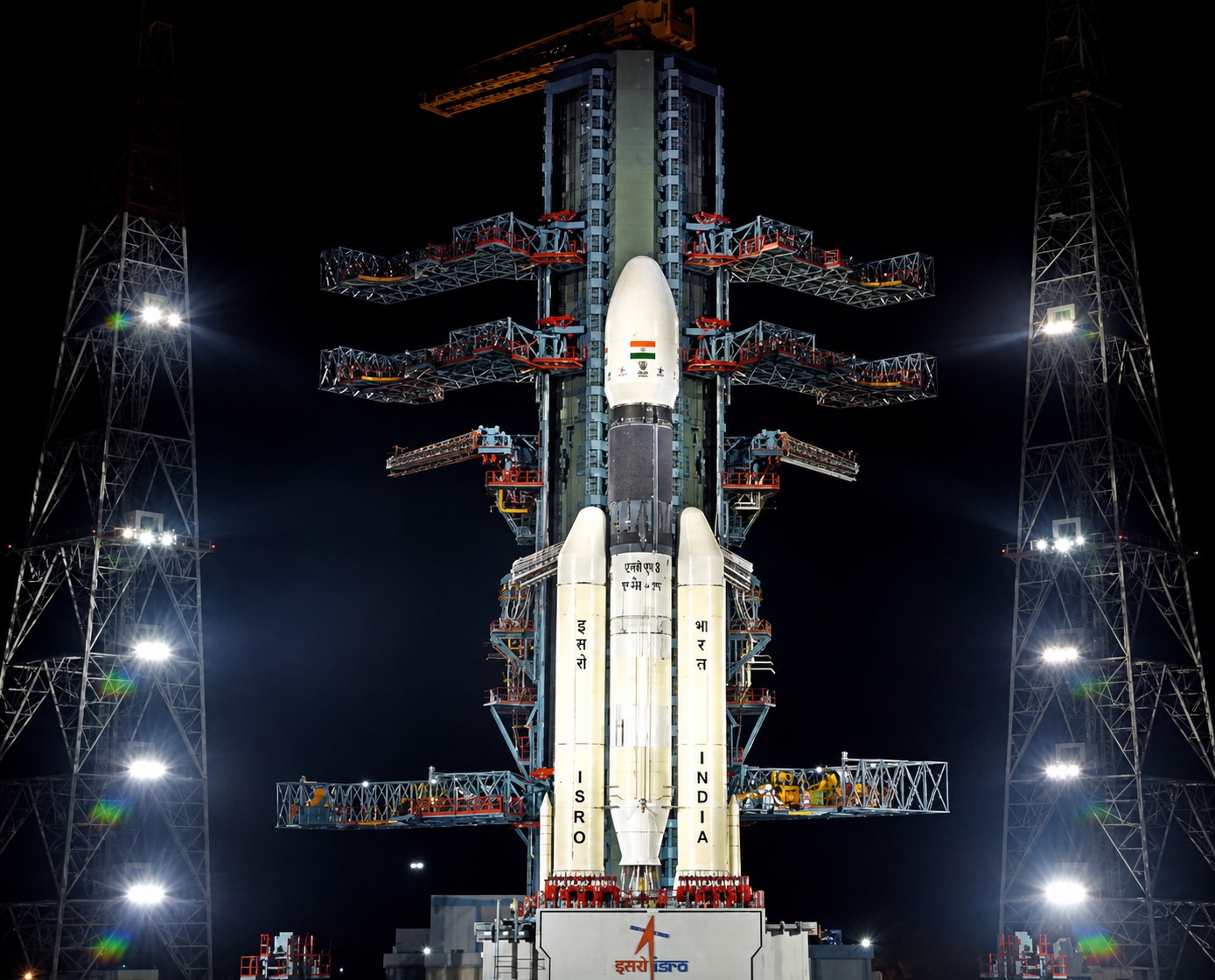
Six years ago, on July 22, 2019, the Indian Space Research Organisation (ISRO) launched Chandrayaan-2, India’s second mission to the Moon and its first attempt at a soft lunar landing. Although the Vikram lander did not achieve a successful touchdown, the mission marked a significant technological milestone. Its orbiter continues to study the Moon and generate valuable scientific data years after launch, while the mission also validated several critical technologies and generated engineering insights that were incorporated into Chandrayaan-3, contributing to its historic success in 2023.
What was Chandrayaan-2?
Approved at a total cost of Rs 970 crore, Chandrayaan-2 was launched aboard the GSLV Mk III-M1 rocket from the Satish Dhawan Space Centre in Sriharikota on July 22, 2019. Of the total project cost, Rs 603 crore was allocated for the mission, while Rs 367 crore was spent on the launch vehicle.
The mission had two primary objectives:
-
To conduct scientific studies of the Moon through the orbiter’s payloads.
-
To demonstrate indigenous technologies for a soft landing and rover operations on the lunar surface.
The Chandrayaan-2 spacecraft comprised three modules:
-
Orbiter: Designed to conduct long-term remote sensing of the Moon and carry out scientific observations from lunar orbit.
-
Vikram Lander: Built to attempt a precision soft landing near the Moon’s largely unexplored south polar region.
-
Pragyan Rover: A six-wheeled robotic rover housed inside Vikram, designed to explore the lunar surface and conduct in-situ scientific experiments.
Mission timeline
July 22, 2019: Chandrayaan-2 was launched aboard the GSLV Mk III-M1 rocket from the Satish Dhawan Space Centre in Sriharikota.
July–August 2019: After four Earth-bound manoeuvres, the spacecraft performed the Trans-Lunar Injection (TLI) manoeuvre and began its journey to the Moon.
August 20, 2019: Chandrayaan-2 successfully entered lunar orbit.
Late August 2019: A series of orbit-lowering manoeuvres placed the spacecraft in a 119 × 127 km lunar orbit.
September 2, 2019: The Vikram lander separated from the orbiter in preparation for its landing attempt.
September 7, 2019: Following two successful de-orbiting manoeuvres, Vikram began its powered descent towards the lunar surface before making a hard landing during the final phase.
What happened during the landing?
After a series of precise Earth and lunar manoeuvres, Chandrayaan-2 entered lunar orbit on August 20, 2019. The Vikram lander separated from the orbiter on September 2 to begin preparations for its descent to the lunar surface.
The powered descent on September 7 began as planned. Vikram successfully completed the rough braking phase, descending from an altitude of 30 km to 7.4 km while reducing its velocity from 1,683 metres per second to 146 metres per second.
However, during the subsequent fine-braking phase, the reduction in velocity exceeded the mission’s designed limits. This caused the lander’s trajectory to deviate from the planned path, pushing key flight parameters beyond the permissible range. As a result, Vikram made a hard landing within about 500 metres of its designated landing site, leading to the loss of communication with the spacecraft.
Why was the mission still a success?
Although the Vikram lander and Pragyan rover could not complete their planned surface operations, ISRO described Chandrayaan-2 as a major technological success. The mission successfully demonstrated several critical capabilities, including the launch of a complex lunar mission, precise Earth and lunar orbital manoeuvres, lander separation, de-boost operations and the successful execution of the rough braking phase during descent. These achievements validated key technologies and provided invaluable engineering data for future lunar missions.
The orbiter emerged as the mission’s biggest achievement.
Carrying eight state-of-the-art scientific instruments, the orbiter has continued studying the Moon’s surface composition, mineralogy, exosphere and water signatures. The precision of the launch and orbital manoeuvres extended its operational life from the planned one year to about seven years.
The scientific data generated by the orbiter continues to be shared with researchers, contributing to studies on the Moon’s geology and environment.
Foundation for Chandrayaan-3
Data collected from the Chandrayaan-2 descent was used by ISRO to modify landing algorithms, strengthen the lander structure, and expand the landing zone for subsequent missions.
These modifications were implemented in the Chandrayaan-3 mission, which achieved a soft landing near the Moon’s south pole on August 23, 2023. With this landing, India became the fourth nation to achieve a soft lunar landing and the first to land in the south pole region.
The Chandrayaan-2 orbiter remains operational in lunar orbit, providing scientific data to researchers.
Remembered as much for its achievements as its challenges, Chandrayaan-2 remains one of ISRO’s most ambitious missions. Six years on, it continues to hold a significant place in India’s space exploration journey and reflects the country’s growing ambitions in exploring the Moon and beyond.


