







Twelve years after its launch, the Pradhan Mantri Jan Dhan Yojana (PM-JDY) has emerged as a cornerstone of India’s financial inclusion journey, expanding access to formal banking, credit, insurance, pensions and digital payments for millions of underserved citizens.
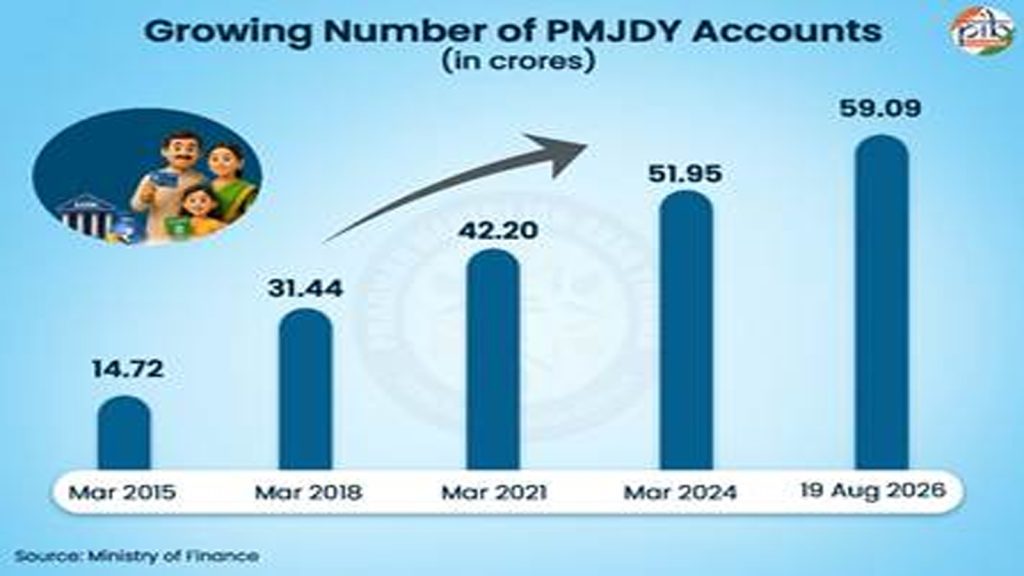
Launched in 2014 as India’s national mission for financial inclusion, PM-JDY has steadily widened the reach of the formal financial system. The number of Jan Dhan accounts has increased nearly fourfold, from 14.72 crore in 2015 to 59.09 crore as of August 19, 2026.
Of the total accounts, 45.95 crore are in rural and semi-urban areas, while 13.14 crore are in urban and metropolitan areas, underlining the scheme’s broad reach across different sections of the population.
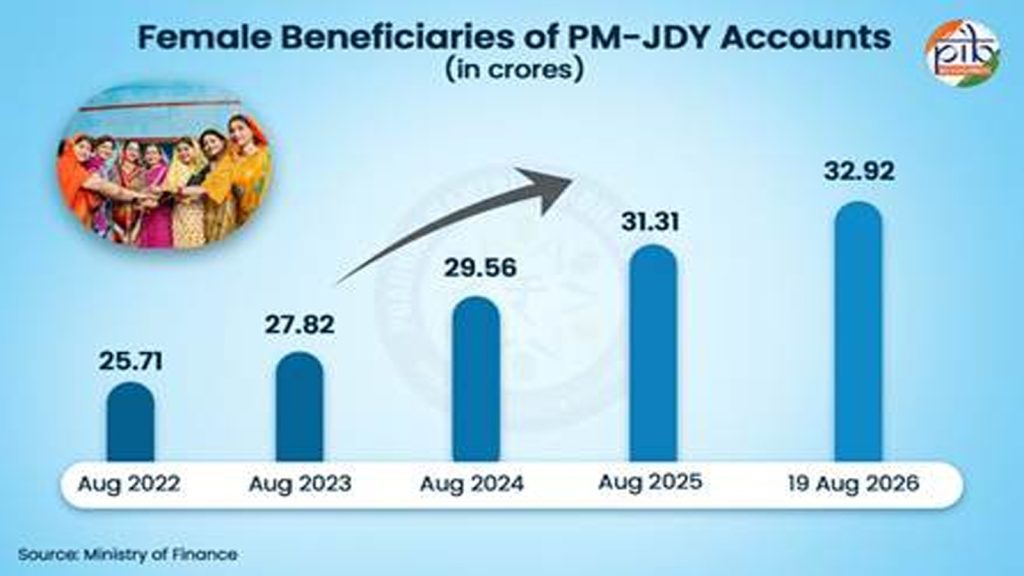
The scheme’s impact is also reflected in the growing participation of women, with 32.92 crore female beneficiaries as of August 19, 2026. The expansion of women’s access to formal banking has been a significant aspect of the government’s financial inclusion efforts, strengthening financial independence and economic empowerment.
From bank accounts to broader financial security
Financial inclusion is viewed as an important foundation for broad-based economic growth and poverty reduction. Access to formal financial services enables people to manage financial risks, save, invest in their future and build livelihoods, while greater access to finance can also contribute to reducing income inequalities.
PM-JDY was initially conceived around the goal of providing a bank account to “every household.” In 2018, the focus was expanded to “every unbanked adult,” widening the scope of the initiative.
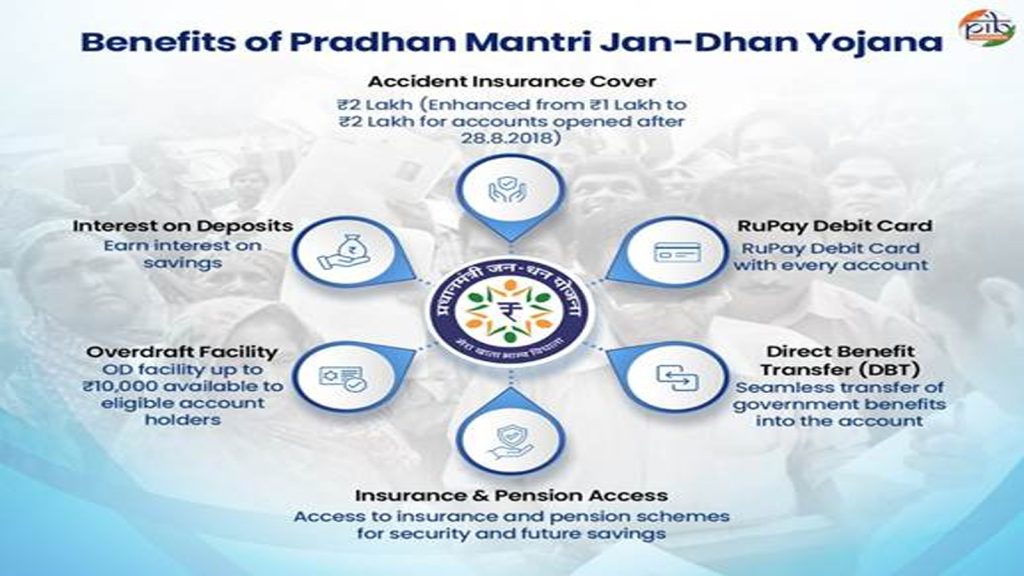
Today, the scheme provides underserved and low-income groups access to basic banking services, need-based credit, remittances, insurance and pension facilities.
The growth in deposits indicates that Jan Dhan accounts are increasingly being used as part of the formal financial system rather than merely serving as account-opening instruments.
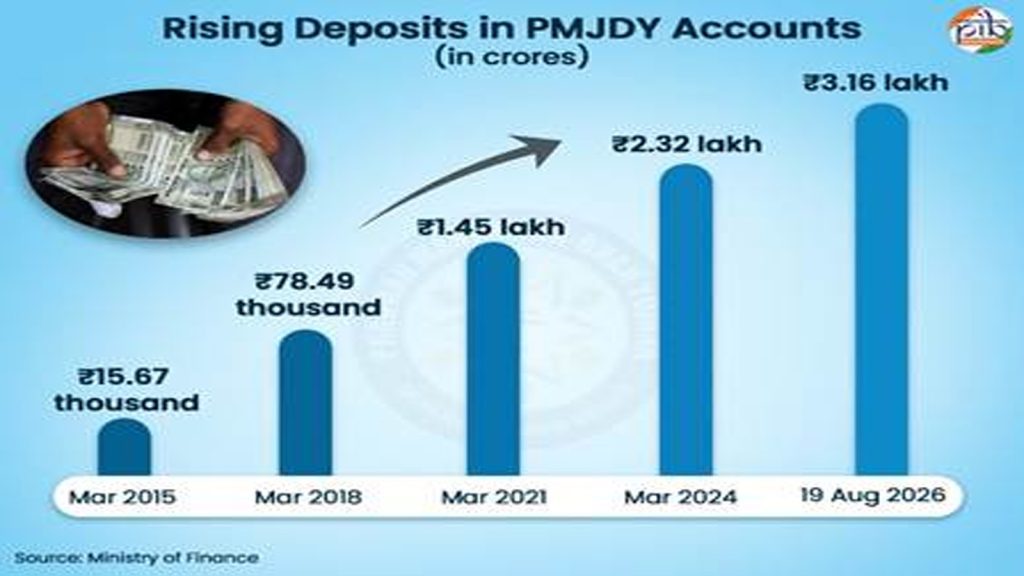
Deposits in PM-JDY accounts have increased almost 20 times, from ₹15,670 crore in March 2015 to ₹3,16,514 crore as of August 19, 2026.
The government attributes this rise to growing savings habits among low-income households, increasing trust in formal banking and deeper participation in the financial system.
A massive expansion in financial inclusion
The broader progress in financial inclusion is reflected in India’s Financial Inclusion Index, which has risen from 53.9 in 2018 to 67 in 2026.
The increase reflects deeper access to financial services such as credit, insurance, savings and digital payments.
The scale of the Jan Dhan initiative has also received international recognition. The International Monetary Fund and the World Bank have highlighted the scheme’s role in expanding access to formal banking services and bringing more people into the formal financial system.
In January 2015, the scale of the financial inclusion campaign under PMJDY was recognised by Guinness World Records, after 18,096,130 bank accounts were opened in a single week as part of a campaign led by the Department of Financial Services, Government of India.
Women at the centre of the financial inclusion drive
One of the most significant features of PM-JDY’s expansion has been the growing number of women beneficiaries.
As of August 19, 2026, women accounted for 32.92 crore PM-JDY beneficiaries.
The increasing participation of women in formal banking is significant because access to financial services can strengthen their financial independence and economic participation.
The growing number of accounts and deposits therefore represents not only a quantitative expansion of banking access but also a broader effort to bring traditionally underserved sections into the formal economy.
Banking without the burden of minimum balance
PM-JDY is designed to make basic banking accessible to people who may previously have remained outside the formal financial system.
Indian citizens are eligible to open PM-JDY accounts, with no upper age limit. A basic savings bank account is opened for an unbanked person and there is no requirement to maintain a minimum balance.
Accounts can be opened at a bank branch or through a Business Correspondent/Bank Mitra outlet, which functions as an extended arm of the bank branch. After submitting the account-opening form and required KYC documents and completing verification, the account is activated by the bank.
A joint account can also be opened.
Documents that can be used for opening an account include an Aadhaar card, government identity proof such as a voter ID, PAN card or ration card, permanent address proof such as a passport, driving licence or utility bill, a passport-size photograph and the duly filled and signed PMJDY account-opening form. Other documents notified by the government may also be accepted.
The interest rate applicable to savings bank accounts is applicable to PM-JDY accounts as well.
RuPay cards bring digital access
An important component of the scheme is the RuPay debit card provided to PM-JDY account holders.
The domestic debit card can be used at ATMs and most point-of-sale machines, providing account holders with access to digital and electronic transactions.
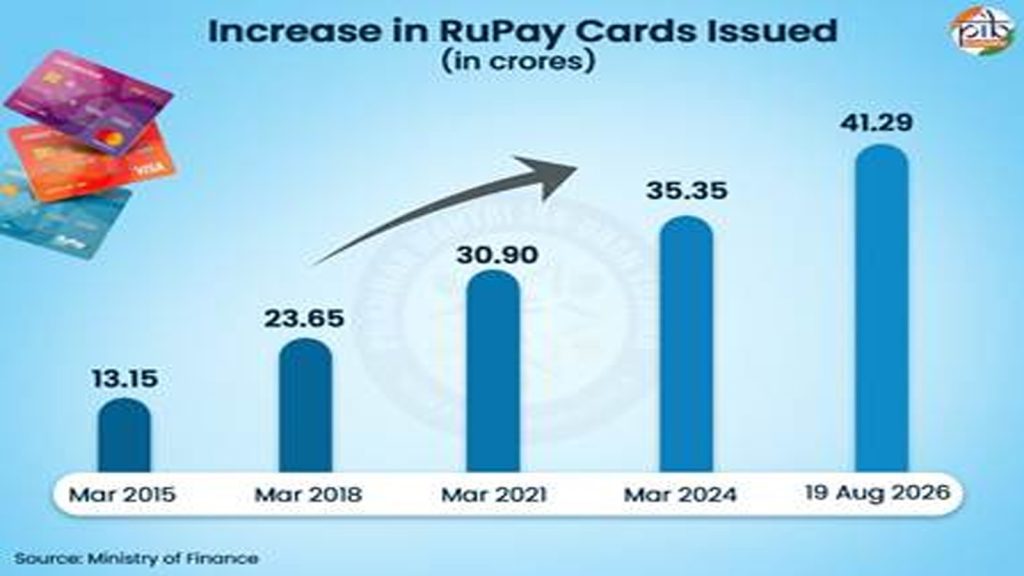
As of August 19, 2026, 41.29 crore RuPay debit cards had been issued to PM-JDY account holders.
The accounts also provide an element of financial protection. An accident insurance cover of ₹1 lakh is available, which was enhanced to ₹2 lakh for new PM-JDY accounts opened after August 2018. No premium is charged from the beneficiary, with the premium paid by the National Payments Corporation of India.
Credit support through overdraft
PM-JDY also goes beyond savings by providing access to limited credit.
An overdraft facility of up to ₹10,000 is available to one PM-JDY account holder per household, subject to eligibility conditions. The facility can be availed after six months of satisfactory operation of the account.
This component gives eligible account holders access to a formal source of small-scale credit, complementing the scheme’s focus on savings and basic banking.
Linking citizens to insurance, pensions and government benefits
Jan Dhan accounts also serve as an important gateway to several social security and financial inclusion programmes.
PM-JDY accounts are eligible for Direct Benefit Transfer (DBT) as well as schemes including – Pradhan Mantri Jeevan Jyoti Bima Yojana (PM-JJBY), Pradhan Mantri Suraksha Bima Yojana (PM-SBY), Atal Pension Yojana (APY), and Micro Units Development & Refinance Agency Bank (MUDRA) scheme.
Through these linkages, the scheme connects basic bank accounts with a wider ecosystem of government benefits, insurance, pensions and credit.
Deposits show growing trust in formal banking
The sharp increase in PM-JDY deposits offers another measure of the scheme’s evolution.
From ₹15,670 crore in March 2015, deposits reached ₹3,16,514 crore by August 19, 2026.
The nearly 20-fold increase indicates that millions of account holders are increasingly participating in formal savings mechanisms.
The growth also suggests a gradual shift from simply providing banking access to enabling people to actively use the formal financial system for saving and managing their money.
Rural and semi-urban India remains at the heart of the programme
The distribution of PM-JDY accounts shows that rural and semi-urban areas remain the largest beneficiaries of the initiative.
With 45.95 crore accounts in rural and semi-urban areas compared with 13.14 crore accounts in urban and metropolitan areas, the scheme has established a substantial formal banking presence among communities that have traditionally faced greater barriers to accessing financial services.
This broad geographical reach has helped make financial inclusion a nationwide effort rather than one concentrated in major urban centres.
From access to empowerment
The evolution of PM-JDY over 12 years reflects a wider transformation in the way financial inclusion is approached.
The initiative began with the fundamental objective of ensuring that people had access to a bank account. Over time, that basic account has become a gateway to a broader range of financial services – from digital payments and savings to insurance, pensions, credit and government transfers.
The growth in accounts, deposits, female beneficiaries and RuPay cards illustrates the scale of this transformation.
With 59.09 crore accounts, 32.92 crore female beneficiaries, ₹3,16,514 crore in deposits and 41.29 crore RuPay cards issued as of August 19, 2026, PM-JDY has created an extensive financial inclusion network.
Its significance lies not only in the number of accounts opened but in the wider opportunities associated with formal financial participation. By connecting underserved citizens with banking, credit, insurance, pensions and digital payments, the scheme is seeking to turn financial access into greater security, opportunity and economic confidence.
Twelve years into the programme, Jan Dhan has thus evolved from a campaign to provide bank accounts into a broader platform for financial inclusion and economic empowerment, with formal banking becoming increasingly accessible to millions of Indians.


