







India’s school education system is showing broad-based signs of progress, with improvements in enrolment, teacher availability, student retention, transition rates, gender participation and school infrastructure, according to the Unified District Information System for Education Plus (UDISE+) 2025–26 report released by the Department of School Education and Literacy (DoSE&L).
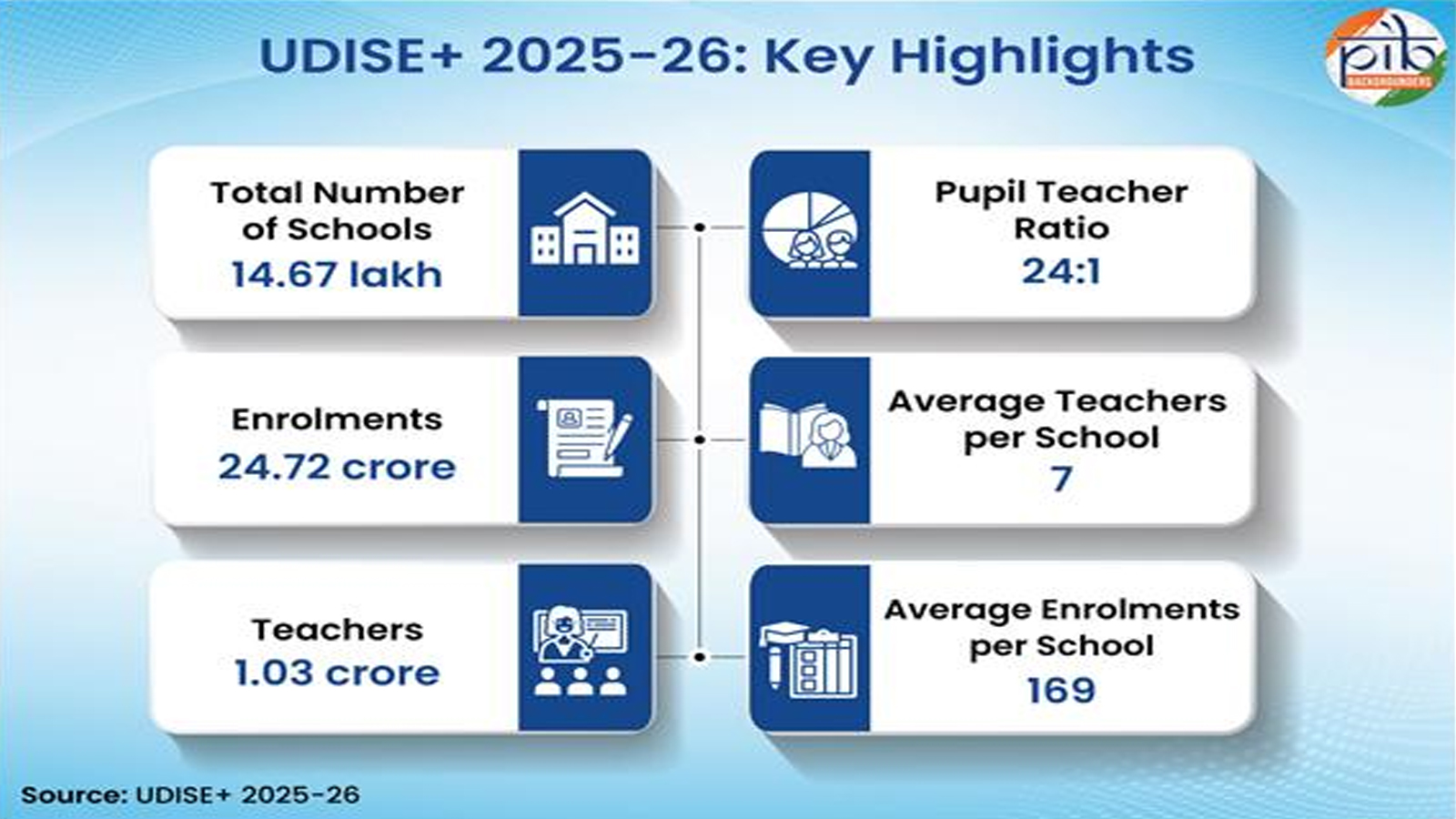
The report provides a comprehensive picture of the country’s school education landscape, covering 14.67 lakh schools, 1.03 crore teachers and 24.72 crore students. Its findings point to a school system that is not only expanding access but also strengthening the conditions required for students to remain in education and progress through successive stages.
The data also provides a detailed picture of how schools are responding to the changing requirements of education, with greater access to computers and internet connectivity alongside continued improvements in basic facilities such as electricity, drinking water, toilets and handwashing infrastructure.
At the centre of the report is the UDISE+, a digital platform developed by DoSE&L to collect and manage comprehensive school education data across India.
Since its launch in 2018–19, UDISE+ has been used to support evidence-based planning, policymaking and monitoring of educational progress. It is also an important data repository for tracking the implementation of the National Education Policy (NEP) 2020, whose objectives include universal access, equity, quality learning and improved student retention.
A vast school system with improving teacher availability
The scale of India’s school education system is reflected in the numbers recorded by UDISE+ 2025–26.
The country has nearly 14.67 lakh schools, more than 1.03 crore teachers and over 24.72 crore enrolled students. On average, this translates into about seven teachers and 169 students per school.
The overall Pupil–Teacher Ratio (PTR) stands at 24:1, which remains within the NEP 2020-recommended benchmark of 30:1.
The PTR provides an indication of the number of students available per teacher at a particular stage of education. A lower ratio allows teachers to devote greater attention to individual students and supports stronger classroom interaction.
The report shows particularly favourable ratios across the different stages of school education. At the Foundational stage, the PTR is 10:1, while it is 12:1 at the Preparatory stage, 17:1 at the Middle stage and 21:1 at the Secondary stage.
These figures point to improved teacher availability across the school education continuum and create conditions for greater individual attention and classroom engagement.
More students progressing through the schooling continuum
Access to education is also reflected in the Gross Enrolment Ratio (GER), particularly at the higher stages of schooling.
The Secondary stage GER has risen to 71.7%, while the Middle stage GER stands at 89.6%.
The distribution of students across the four stages is relatively balanced. The Secondary stage accounts for 27.16% of total enrolment, followed by the Preparatory stage at 25.60%, the Middle stage at 25.58% and the Foundational stage at 21.66%.
The combination of the rising Secondary stage GER and the distribution of enrolment across the different stages reflects continued efforts to expand educational access and sustain participation as students move through school.
The data on student retention and transition provides another indication of progress.
Retention rates stand at 98.5% at the Foundational stage, 91.1% at the Preparatory stage, 83.7% at the Middle stage and 51.9% at the Secondary stage.
The transition rates between stages are also high. According to the report, 99.2% of students move from the Foundational stage to the Preparatory stage, 93.8% progress to the Middle stage and 88.3% advance to the Secondary stage.
Together, these figures present a picture of a large number of children remaining within the school system and progressing through successive stages of education.
Dropout rates show improvement
The report records a decline in dropout rates at key stages of school education.
At the Preparatory stage, the dropout rate has declined to 1.8%, while the rate at the Secondary stage stands at 7.0%. The Middle stage recorded a marginal increase to 3.6%.
Despite this increase at the Middle stage, dropout rates across all three stages remain significantly lower than the levels recorded in 2022–23.
The reduction in dropout rates, combined with high retention and transition rates, suggests an improving continuum of student participation in school education.
Fewer single-teacher and zero-enrolment schools
Another change highlighted by the UDISE+ report is the decline in the number of schools operating with only one teacher.
In 2025–26, the number of single-teacher schools fell by approximately 3% to 1,00,843.
At the same time, the number of schools reporting zero enrolment declined substantially. Such schools fell by 29% compared with 2024–25, reaching 5,663.
The report links these changes to continued efforts to rationalise teacher allocation, optimise deployment and align educational resources more effectively with student requirements.
The decline in both categories represents an effort to ensure that schools have the necessary human resources and that available educational infrastructure corresponds more closely with actual student needs.
Girls account for nearly half of total enrolment
Gender participation remains another important dimension of the school education system.
According to UDISE+ 2025–26, girls constitute 48.4% of total student enrolment, indicating a relatively balanced distribution between boys and girls.
Women also account for a majority of the teaching workforce, making up 54.9% of all teachers.
The participation of women in teaching, alongside the substantial share of girls in total enrolment, reflects continued progress towards gender equity within the school education system.
Broad-based social representation
The report also provides a picture of the social composition of school enrolment.
Students belonging to Other Backward Classes (OBCs) constitute the largest share of enrolment at 44.9%. They are followed by students from the General category at 27.5%, Scheduled Castes at 17.7% and Scheduled Tribes at 10%.
Together, Scheduled Caste (SC) and Scheduled Tribe (ST) students account for 27.7% of total enrolment.
The figures underline the broad social composition of India’s school system and the continued focus on equitable access to education.
Focus on children with special needs
The inclusion agenda also extends to Children with Special Needs (CWSN).
The report records the gender composition of this group, with 57.16% boys and 42.84% girls.
The data highlights the continued emphasis on accessible infrastructure, specialised support services and equitable learning opportunities for children with special needs.
Inclusive education, as reflected in the report, is therefore not limited to enrolment figures but also encompasses the physical and institutional conditions required to enable students from different backgrounds and with different needs to participate in schooling.
Schools become increasingly connected
One of the notable areas of development identified in UDISE+ 2025–26 is the expansion of digital infrastructure.
The proportion of schools equipped with computers has increased to 69.9%, while 67.4% of schools have internet connectivity.
The expansion of digital access provides schools with greater opportunities for technology-enabled education and strengthens the infrastructure needed to support a more digitally connected learning environment.
The progress in digital infrastructure forms part of a broader transformation in school facilities, where traditional basic amenities and newer technology-enabled resources are developing alongside each other.
Basic facilities reach a large majority of schools
The report records high levels of availability of several essential school facilities.
Electricity is available in 95% of schools, while 99.5% have access to safe drinking water.
The availability of toilets is also widespread. Girls’ toilets are available in 98.5% of schools, while boys’ toilets are available in 97.2%.
Handwashing facilities are present in 96.9% of schools, while 90.5% have libraries.
The report also records progress in facilities connected with environmental sustainability and accessibility. Rainwater harvesting is available in 29.9% of schools, while 58.2% have ramps with handrails.
These figures collectively reflect the continuing expansion of the physical infrastructure needed to provide a conducive, accessible and inclusive school environment.
What the numbers say about the education system
Taken together, the findings of UDISE+ 2025-26 point to progress across several interconnected dimensions of school education.
The system is operating at an enormous scale, with nearly 15 lakh schools serving almost 25 crore students and employing more than one crore teachers. Within this vast network, the data shows improvements in teacher availability, student retention, transition and dropout rates, alongside an expansion of school infrastructure.
The 24:1 overall pupil-teacher ratio remains below the NEP 2020 benchmark of 30:1, while stage-wise ratios range from 10:1 at the Foundational level to 21:1 at the Secondary level.
At the same time, the 71.7% Secondary stage GER indicates continued scope for expanding participation at the higher stages of schooling, even as the Middle stage GER remains high at 89.6%.
The decline in single-teacher schools and zero-enrolment schools further indicates changes in the distribution and utilisation of educational resources.
The gender figures also show substantial participation of girls in school education and women in the teaching workforce, while the social composition data points to participation across different social groups.
Infrastructure and inclusion moving together
A defining feature of the report is that improvements are not limited to enrolment and teacher-related indicators.
The physical environment in which students learn is also changing. With nearly all schools having access to safe drinking water, high availability of toilets and handwashing facilities, and a large majority having electricity and libraries, basic infrastructure has reached a high level across the school system.
At the same time, computer and internet availability is expanding, adding a digital dimension to the transformation of school infrastructure.
The availability of ramps with handrails and the focus on Children with Special Needs further underline the importance of accessibility and inclusion in the evolving education system.
UDISE+ as a tool for evidence-based policymaking
Beyond individual indicators, the significance of the UDISE+ 2025-26 report lies in its role as a national education database.
By bringing together information covering schools, students, teachers, enrolment, retention, transitions, infrastructure and social and gender participation, UDISE+ provides a basis for understanding the changing school education landscape.
Since its introduction in 2018-19, the platform has supported evidence-based planning, policymaking and monitoring. Its data also enables the assessment of progress towards the objectives of the National Education Policy 2020.
The 2025-26 findings therefore provide not only a snapshot of the present state of school education but also a set of indicators through which future progress can be assessed.
A school system in transition
The UDISE+ 2025-26 report presents India’s school education system as one undergoing sustained and broad-based change.
The numbers tell a story of 24.72 crore students, 1.03 crore teachers and 14.67 lakh schools, but the significance of the data goes beyond the scale of the system.
Behind the figures are improvements in the availability of teachers, a favourable pupil-teacher ratio, stronger student retention and transitions, lower dropout rates, greater participation of girls and women, broader social representation and growing access to digital and physical infrastructure.
The reduction in single-teacher and zero-enrolment schools indicates efforts to better align resources with student needs, while improvements in computers and internet connectivity point towards an increasingly technology-enabled education environment.
The report ultimately reinforces the direction of the NEP 2020 vision: an education system that seeks to be equitable, inclusive, accessible, technology-enabled and learner-centric.
As UDISE+ continues to provide the data foundation for planning and monitoring, the 2025-26 report offers a detailed picture of the progress being made across India’s school education system – and of the continuing effort to ensure that access to quality education reaches every learner.


