







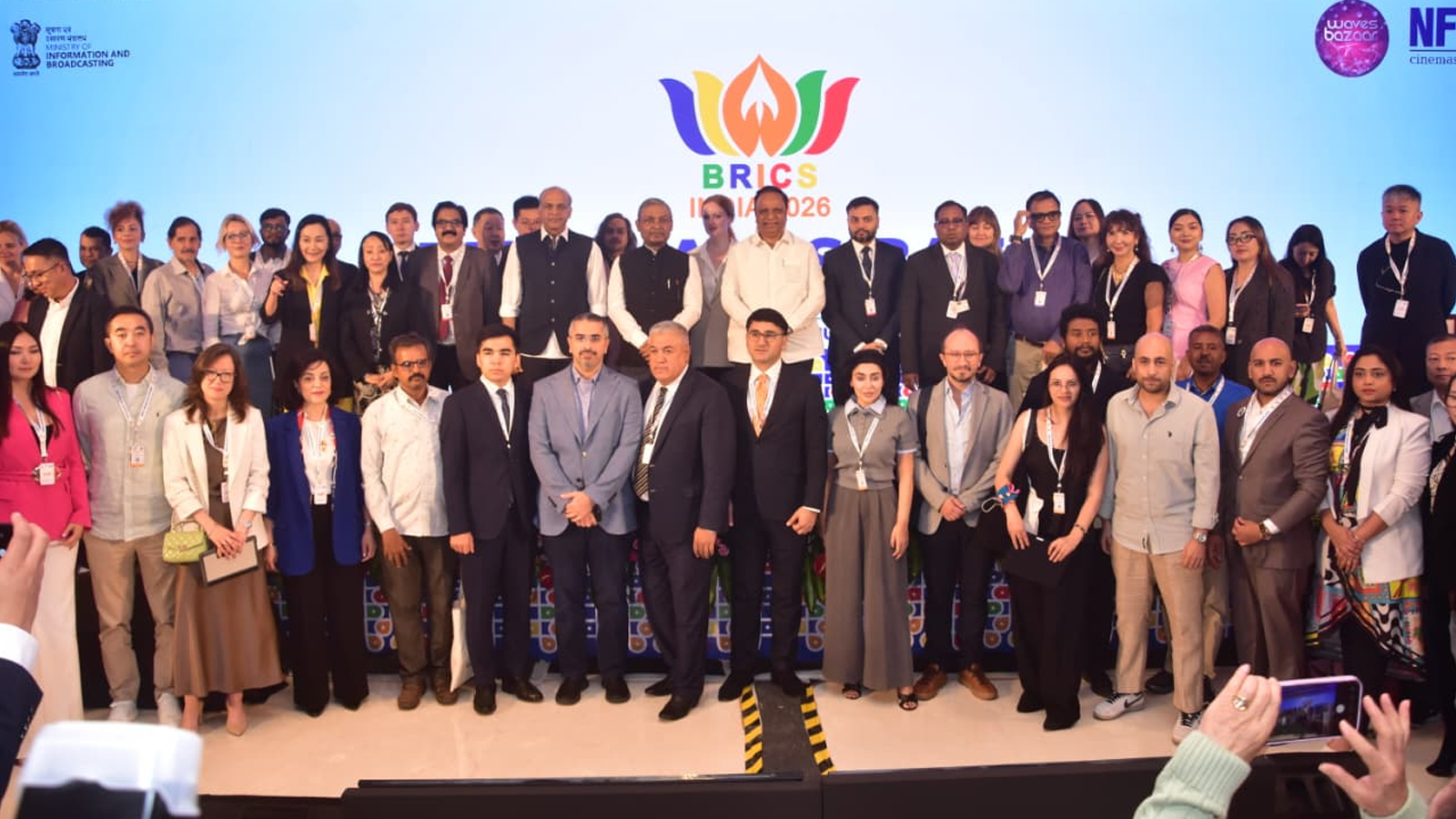
The two-day BRICS WAVES Bazaar, a premier international marketplace for the creative economy, commenced in Mumbai on Thursday, bringing together more than 500 delegates from BRICS member and partner countries to foster collaboration across the audiovisual and creative industries.
The event aims to create a platform for dialogue, business engagement, knowledge exchange and cross-border partnerships by bringing together government representatives, filmmakers, producers, investors, broadcasters, OTT platforms, technology companies, startups, cultural institutions and creative enterprises.
Inaugurating the event, Maharashtra Cabinet Minister for Electronics, Information Technology, Artificial Intelligence and Culture Ashish Shelar described the BRICS WAVES Bazaar as a high-level, curated platform designed to shape the future of the global creative economy.
Welcoming delegates to Mumbai, which he described as the heart of India’s creative ecosystem, Shelar said the boundaries between art and technology are rapidly dissolving, creating new opportunities for innovation and cultural exchange.
He said India’s “Orange Economy” – where heritage, creativity and commerce converge – is emerging as a key pillar of the country’s vision under the leadership of Prime Minister Narendra Modi, adding that India is steadily strengthening its position as a global cultural and intellectual hub.
Chanchal Kumar, Secretary, Ministry of Information and Broadcasting, said the initiative reflects PM Modi’s emphasis on culture and creativity as instruments for connecting nations and communities.
He said the BRICS WAVES Bazaar and the BRICS Film Festival, scheduled to be held alongside the International Film Festival of India (IFFI) in November 2026, would serve as complementary platforms – one promoting business partnerships and market access, and the other showcasing films, filmmakers and audiences.
Highlighting the collective strengths of BRICS countries, Kumar said the grouping possesses an enormous reservoir of stories, creative talent, technological capabilities and audiences. He said the Bazaar seeks to become a global platform where projects are discovered, co-productions are initiated, partnerships are forged and new markets are opened.
The event has brought together participants from 21 BRICS member and partner countries, with discussions covering collaboration in film, television, animation, visual effects (VFX), gaming, music, digital media and emerging content formats.
Kumar also stressed the need to improve the circulation of creative content among BRICS countries so that audiences gain greater access to one another’s films, television series, animation, music and digital productions.
He said India is ready to share its experience and work closely with BRICS partners to build stronger institutional and commercial linkages across the creative economy through initiatives such as WAVES, the WAVES Bazaar, the Indian Institute of Creative Technologies, India Cine Hub, and programmes supporting creator skilling, startups and emerging technologies.
Inviting BRICS countries to participate in the next edition of WAVES in Mumbai in 2027, Kumar said India remains committed to strengthening international cooperation in the creative industries.
Renowned filmmaker and International Film Festival of India (IFFI) Festival Director Ashutosh Gowariker invited delegates to participate in IFFI 2026, where around 250 films will be screened across eight curated sections.
Speaking about the universal appeal of cinema, Gowariker said people often discover countries through their films, stories and culture even before visiting them. He said platforms such as the BRICS WAVES Bazaar create opportunities for scripts to become films, filmmakers to find collaborators and creative partnerships to flourish across borders.
Rajiv Bodwade, Joint Secretary (MER-III), Ministry of External Affairs, said the event is being organised under India’s BRICS Chairship theme of “Building for Resilience, Innovation, Cooperation and Sustainability.”
Describing the creative economy as a major global growth engine, he said the sector contributes 3.1 per cent of global GDP and generates more than USD 1.4 trillion in international services exports. By combining their expanding digital markets with rich cultural heritage, BRICS countries are well positioned to capitalise on this growth, he added.
National Film Development Corporation (NFDC) Managing Director Prakash Magdum said the Bazaar features high-level conferences, keynote sessions, panel discussions, business networking events and curated business-to-business (B2B) meetings over two days.
The discussions will focus on international co-productions, content financing, digital transformation, intellectual property, women-led entrepreneurship, emerging technologies, public policy and South-South cooperation.
Concluding the inaugural session, Senthil Rajan, Joint Secretary, Ministry of Information and Broadcasting, said the BRICS WAVES Bazaar reflects India’s commitment to positioning the creative economy as a key driver of innovation, entrepreneurship, employment and economic growth.
The Ministry said the event aims to facilitate long-term partnerships while opening new avenues for trade, investment and cultural collaboration among BRICS member and partner countries by bringing policymakers and industry leaders together on a common platform.


