







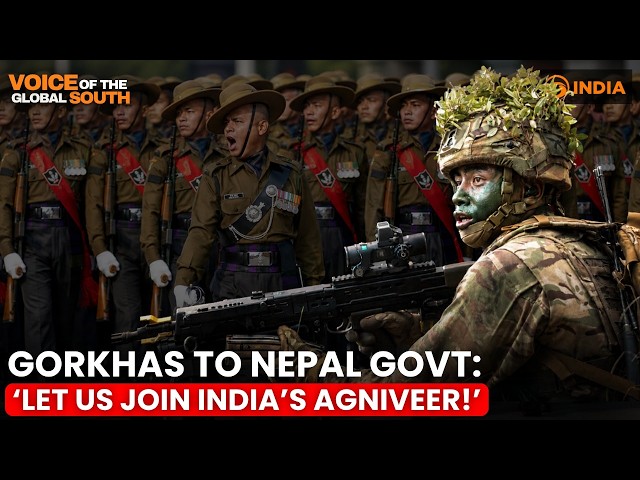
A 200-year-old military tradition stands broken as Nepal’s streets echo with protests over a four-year suspension of Gorkha recruitment into the Indian Army
In Nepal, the streets are echoing with anger. Hundreds of former Gorkha soldiers, young aspirants and their families have launched massive protests against their own government.
Their demand? Lift the suspension on recruiting Nepalese youth into the Indian Army.
A tradition that stood unbroken for more than 2-hundred years has now been frozen solid for over four years.
For generations, young men from the rugged hills of Nepal have had a singular, prestigious ambition — to wear the uniform of the Indian Army’s Gorkha Regiments. However, for four consecutive years, that gateway has been slammed shut. The cost? A devastating economic hit to Nepal’s marginalised hill communities, forcing hundreds of qualified and capable young men to swap the prestigious Gorkha uniform for low-wage labour in the Gulf.
So, what exactly broke this two-centuries-old tradition? The recruitment of Nepali citizens into foreign militaries is governed by the 1947 Tripartite Agreement signed between Nepal, India and the United Kingdom. For decades, this guaranteed Nepali recruits the same pay, regular pensions and long-term service benefits as their Indian counterparts. However, in June 2022, India fundamentally altered its military hiring structure by introducing the Agnipath Scheme.
What is the Agnipath Scheme?
— India’s Agnipath Scheme is a short-term military recruitment programme (Agnipath means path of fire in English)
— The Indian Government introduced it in 2022 in order to modernise and lower the age profile of the armed forces
— The goal is a younger, tech-savvy force, offering youth a short-term tour of duty
— A soldier recruited under the Agnipath Scheme is called an Agniveer or a fire warrior. This is the distinct, official rank given to the individual soldiers recruited through this specific Scheme
— Under this system, personnel are recruited below the officer rank into the Army, Navy, and Air Force for a fixed four-year tenure
— It replaces the old system of lifelong military careers
— After four years, up to 25 per cent of meritorious personnel from each batch are retained for regular permanent service of another 15 years
— The remaining 75 per cent exit the military
Kathmandu fiercely objected. The Nepal Government argued that this temporary-contract model violates the spirit of the 1947 accord. Citing severe concerns over the uncertain future of young men sent home after just four years without a pension, the then Government of Nepal officially halted all Indian Army recruitment rallies in August 2022. Recruitment had already been frozen before that because of the COVID-19 pandemic — meaning that no new Nepali Gorkha has entered the Indian Army in all these years. However, the freeze applies explicitly to Nepal-domiciled youth; it has not stopped the recruitment of Indian-domiciled Gorkhas from places such as Darjeeling, Dehradun or Dharamshala.
To understand why this issue is an emotional powder keg, one has to understand the history. The bond between the Indian Army and the Gorkha soldier was forged not in a peace summit but in the heat of battle. It dates all the way back to 1815, following the Anglo-Gorkha War. Impressed by the ferocious bravery of their Himalayan adversaries, the British East India Company began enlisting them. Upon India’s independence in 1947, the regiments were divided, and six Gorkha Rifles regiments transitioned seamlessly into the newly formed Indian Army, with a seventh raised later.
The late Field Marshal Sam Manekshaw once famously declared: “If a man says he is not afraid of dying, he is either lying or he is a Gorkha”.
Recent protests in Nepal were deliberately timed to coincide with a highly significant, top-tier diplomatic event. The Indian Army chief, Gen. Dhiraj Seth, just concluded a four-day visit to Nepal. The Kantipur Daily reported that during the Indian Army chief’s visit to the city of Pokhara, members of the All Nepal Indian Ex-Servicemen Welfare Association urged him to take the initiative to resume Gorkha recruitment.
Gen. Seth’s visit carried forward a sacred, reciprocal military tradition dating back to 1950. On 17th August, Nepal’s President, Ramchandra Paudel, decorated Gen. Seth with the honorary rank of General of the Nepali Army. Gen. Seth paid a courtesy call on Nepal’s Prime Minister Balendra Shah, who also holds the defence portfolio. While the streets of Nepal were burning with demands to fix the Agnipath issue, inside the halls of Singha Durbar, officials maintained a strict, calculated public silence on the recruitment deadlock. Official readouts focused strictly on strategic defence cooperation and regional stability.
If reports are to be believed, New Delhi has put the onus of a resolution on Kathmandu. However, the domestic media landscape within Nepal is deeply divided, reflecting a profound generational and economic anxiety.
Leading Nepali media outlets are providing wall-to-wall coverage of the veterans’ unrest. Newspaper columns are painting a grim picture. On one side, nationalist commentators argue that sending young Nepali citizens for short-term military service in the Indian Army without a pension demeans the sovereignty and dignity of Nepal. Still, others point out that more than 100,000 Nepali military veterans currently draw pensions from India, injecting vital funds that equate to nearly three per cent of Nepal’s G.D.P.
They argue that if the deadlock isn’t broken, Nepal stands to lose billions in future remittances. Veterans speaking to the press ask a blunt question: If the Government refuses to let Nepali youths join the Indian Army, where are the jobs at home? Col. Guru Saday Batabyal, who retired from the 4th Gorkha Rifles of the Indian Army, writes in The Himalayan Times newspaper that — “Continuing to suspend recruitment indefinitely may appear politically safe, but it comes with growing costs. Every year of delay deprives thousands of Nepali youth of access to employment, training and professional development. It also creates uncertainty around an institution that has served Nepal’s economic and social interests for generations.
For over two centuries, the phrase “Ayo Gorkhali” — The Gorkhas are here — has been a legendary rallying cry on the battlefield. It represents an unbreakable bond of blood, sweat, and shared sacrifice between India and Nepal.
However, today that bond is chained by competing agendas. As Prime Minister Shah prepares his briefcase for New Delhi, hundreds of thousands of young Nepali men are waiting, watching, and hoping that diplomacy can prevail over a deadlocked contract. Because for these youth, it isn’t just about a job — it’s about a legacy.
Ramesh Ramachandran is a senior consulting editor with D.D. India


