







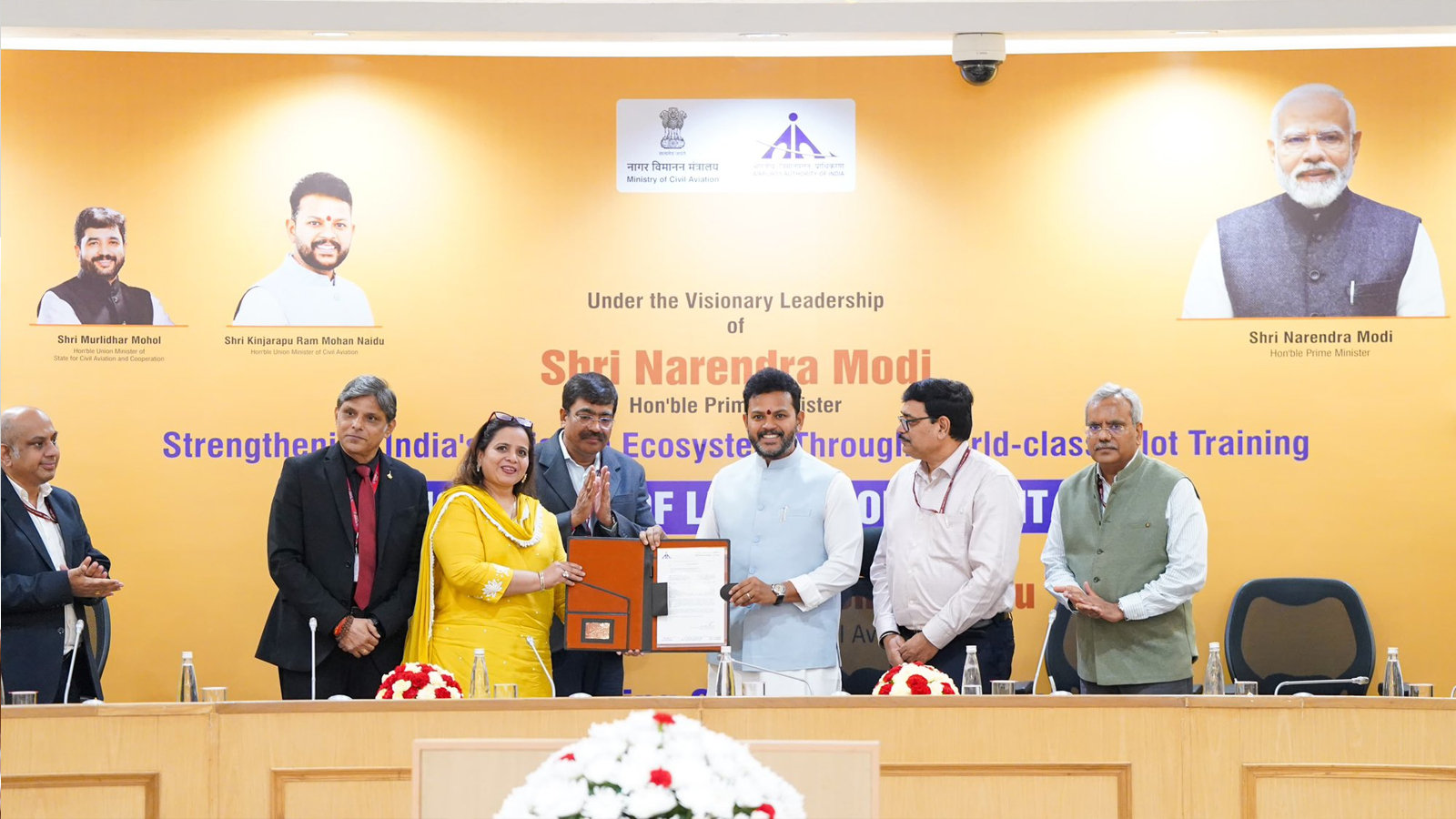
In a major push to strengthen India’s pilot training ecosystem amid rapid growth in the civil aviation sector, the government on Wednesday awarded Letters of Intent (LoIs) for the establishment of 11 new Flying Training Organisations (FTOs) across seven Airports Authority of India (AAI) airports.
Union Civil Aviation Minister Ram Mohan Naidu Kinjarapu presented the LoIs and also chaired a roundtable interaction with existing Flying Training Organisations, during which he launched the FTO IFR Slot Booking App to streamline instrument flight training at AAI airports.
With the addition of the new FTOs, India’s annual pilot training capacity is expected to increase by 750 cadets, providing a significant boost to the country’s domestic aviation training infrastructure.
At present, 41 FTOs operate from 63 flying bases across the country.
Addressing the gathering, the minister said India’s emergence as one of the world’s fastest-growing aviation markets under the leadership of Prime Minister Narendra Modi has created the need for a larger pool of skilled aviation professionals.
“Guided by the vision of Viksit Bharat and Aatmanirbhar Bharat, we are simultaneously expanding aviation infrastructure and building a future-ready workforce to support the sector’s long-term growth,” Naidu said.
Highlighting the progress made in recent years, he said six new FTOs have already been established over the past two years. During the same period, the number of training aircraft with Indian FTOs increased from 324 to 385, resulting in a 25 per cent increase in annual flying hours across the pilot training ecosystem.
The expansion has also translated into higher pilot output. The minister said the number of Commercial Pilot Licences (CPLs) issued rose from 1,347 in 2024 to 1,652 in 2025, the highest annual figure recorded in the past decade, with a further increase expected this year.
Naidu said India’s growing aviation market requires a strong domestic training ecosystem, noting that Indian airlines currently have 1,640 aircraft on order, with nearly 500 aircraft expected to join fleets over the next five years.
“Our vision is clear—’Train in India, Fly in India’,” he said.
The minister also highlighted several policy reforms introduced to encourage pilot training, including the liberalisation of FTO policies, abolition of airport royalties and rationalisation of land rentals. He said the CPL examination process has been digitised through the Pariksha Portal, simplifying application procedures, while India has become only the second country in the world to issue electronic pilot licences.
Emphasising quality and transparency in pilot training, Naidu said the Directorate General of Civil Aviation’s FTO Ranking Framework is helping improve standards across training institutes.
He noted that the framework has already reduced the number of lower-ranked Category ‘C’ FTOs while increasing the number of Category ‘B’ institutions. He also highlighted the performance of the Indira Gandhi Rashtriya Uran Akademi (IGRUA), which achieved an average of 1,765 flying hours per aircraft annually over the last six months – well above the global benchmark of around 1,500 hours. The academy also recorded a 27 per cent increase in revenue during FY 2025-26 and posted a budget surplus after more than two decades of recurring deficits.
Naidu further said progress in the development of the indigenous HANSA-3 (NG) trainer aircraft represents another important milestone in strengthening India’s self-reliant aviation training ecosystem.
The minister stressed that safety must remain the highest priority for all FTOs, calling for stronger instructor oversight, strict adherence to standard operating procedures and a robust safety culture throughout the sector.
During the event, Naidu also launched the FTO IFR Slot Booking App, a digital platform designed to facilitate Instrument Flight Rules (IFR) training by allowing FTOs to view available training slots at AAI airports and submit booking requests online, ensuring more efficient utilisation of airport infrastructure.
The programme was attended by Civil Aviation Secretary Samir Kumar Sinha, Additional Secretary Puneet Kansal, AAI Chairman Vipin Kumar, senior Ministry officials, DGCA, AAI and representatives of FTOs from across the country.


