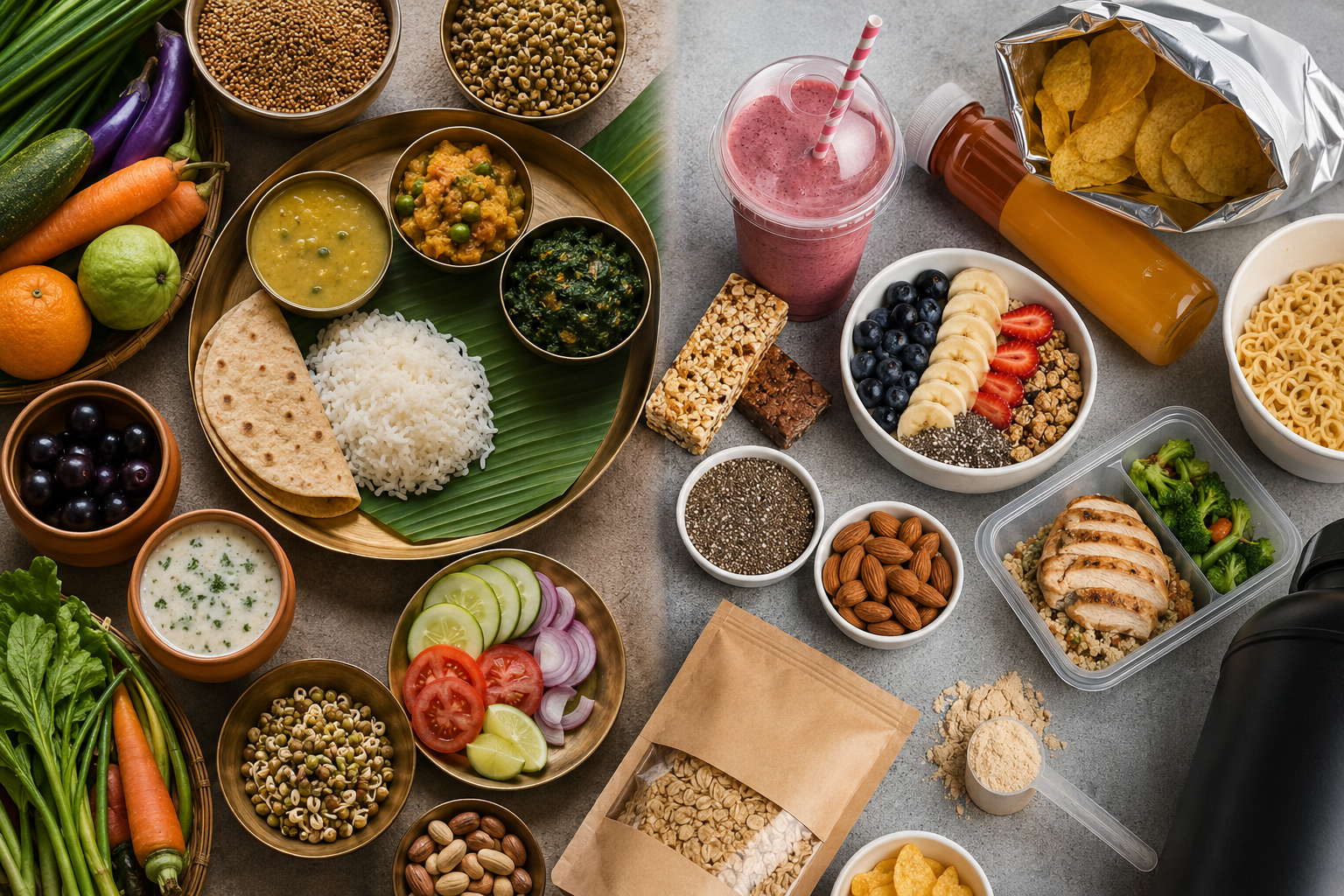
There was a time when eating well did not require decoding nutrition labels or following a carefully curated morning routine. Dal, vegetables, rice, roti, fruit and curd were simply part of everyday food. Walking was exercise. Staying healthy was less an aesthetic and more a habit.
Today, wellness can look very different. A supermarket basket marketed as healthy might contain almond milk, protein bars, imported berries, probiotic drinks and supplements. Add a gym membership, fitness tracker and the occasional wellness retreat, and health can begin to resemble a luxury lifestyle.
But there are two very different costs hiding beneath that image: the cost of accessing a nutritious diet and the cost of buying into the modern wellness culture.
The first is a genuine economic problem. The second is where marketing enters the picture.
The real cost of eating well
The affordability of healthy food is not a wellness-industry invention.
The State of Food Security and Nutrition in the World 2026, published jointly by the Food and Agriculture Organization, IFAD, UNICEF, the World Food Programme and the World Health Organization, estimates that the average minimum cost of a healthy diet reached US$4.28 per person per day in purchasing-power-parity terms in 2025. That is up from US$3.44 in 2021 and US$2.94 in 2017.
More significantly, 2.69 billion people, or 32.7 per cent of the world’s population, could not afford a healthy diet in 2025.
The numbers complicate the popular idea that eating well is simply a matter of making better choices. For a large part of the world’s population, income, food prices and access determine what choices are realistically available.
A healthy diet also does not cost the same everywhere. Fruits, vegetables and animal-source foods make up a substantial part of its cost, while staple foods tend to be less expensive. The challenge, therefore, is not simply finding something to eat, but being able to afford enough variety and nutritional quality.
That distinction matters when conversations about healthy living are reduced to personal discipline.
India’s changing food habits
India adds another layer to the story.
The Household Consumption Expenditure Survey 2023-24, released by the Ministry of Statistics and Programme Implementation, found that beverages, refreshments and processed food made up the largest share among food categories in household consumption expenditure. The category accounted for 9.84 per cent of rural food expenditure and 11.09 per cent in urban India.
The figures do not mean that traditional foods have disappeared from Indian kitchens. They do, however, point to the growing place of processed foods and beverages in household spending.
Research also suggests that India’s dietary habits are changing. The ICMR-INDIAB study, published in Nature Medicine in 2025 and based on 18,090 adults, examined dietary patterns across the country and found concerns around low-quality carbohydrates, saturated fat and relatively low protein intake.
The shift is therefore more complicated than a simple story of Indian food being replaced by Western food. It is about changing patterns of consumption, convenience, processing and marketing.
The superfoods we already had
India’s wellness conversation becomes particularly interesting when it comes to the language of “superfoods”.
Chia seeds have become staples of smoothie bowls and overnight oats, while sabja seeds have long been used in Indian drinks and desserts. Quinoa is frequently presented as a nutrient-rich ancient grain, while India has its own long history of consuming ragi, bajra, jowar and other millets. Blueberries have acquired premium status in wellness culture, while fruits such as jamun remain far less celebrated in the same spaces.
This is not an argument that these foods are interchangeable or nutritionally identical. It is a reminder that health does not necessarily arrive in imported packaging.
The World Health Organization defines a healthy diet through adequacy, balance, moderation and diversity, with minimally processed and unprocessed foods forming its foundation. WHO India similarly emphasises that healthy diets can be built around locally available foods and dietary customs, including cereals, pulses, vegetables, fruits and dairy.
For many Indian households, that means the foundations of healthy eating are already familiar.
The problem is that familiar food rarely comes with the same marketing language as wellness products.
When health became something to buy
This is where the modern wellness industry has changed the conversation.
Health is no longer only about food, movement and rest. It can now involve an entire ecosystem of products: speciality groceries, supplements, protein powders, fitness memberships, wearable devices, functional beverages and wellness retreats.
There is nothing inherently wrong with protein powder, fitness trackers, supplements, probiotic drinks or specialised foods. A person may have a genuine nutritional requirement. An athlete may find protein supplementation useful. A wearable may encourage someone to become more active. A convenient meal may help someone who has little time to cook.
The distinction is between useful and necessary.
The problem begins when a useful product becomes a perceived necessity.
Walking becomes something that needs to be counted. Drinking water becomes a reason to buy a functional beverage. Eating enough protein becomes synonymous with buying a branded powder. Breakfast becomes an elaborate ritual involving imported ingredients.
Health starts looking less like a collection of habits and more like a shopping list.
The convenience problem
There is another cost that rarely appears on a supermarket receipt: time.
Cooking requires planning, shopping, preparation and cleaning. Exercise requires time. Getting adequate sleep can be difficult for people working long or irregular hours. Access to fresh food also depends on where people live and what is available around them.
Modern cities have made food extraordinarily convenient. A meal can arrive within minutes, while snacks and ready-to-eat products are available almost everywhere.
The World Health Organization has highlighted the role of food environments in shaping dietary choices, including the availability and marketing of highly processed foods. Foods that are energy-dense and nutrient-poor can often be inexpensive and convenient, making healthier choices harder to sustain.
This creates an uncomfortable contradiction. Healthy living may be marketed as an expensive lifestyle, while less nutritious choices can be cheaper, faster and more heavily promoted.
The problem, then, is not simply willpower. It is also the environment in which people make decisions.
The Indian wellness paradox
India already has a vast repertoire of foods that can contribute to a nutritious diet: dal, chana, rajma, vegetables, seasonal fruit, rice, wheat, curd, milk, nuts and seeds.
Yet contemporary wellness culture can make familiar foods appear ordinary while giving newly packaged products an aura of expertise and sophistication.
That does not mean every modern wellness product is unnecessary, nor that traditional food is automatically healthy. It simply reveals how easily nutrition can become entangled with aspiration.
The language of wellness often promises more than nourishment. It sells discipline, optimisation and a particular image of the self.
And that image comes with a price tag.
What are we actually paying for?
Perhaps the most useful question is not whether healthy living is expensive.
It is what we are spending money on when we say we are investing in our health.
-Ranu Jain